Iranian Strike on Kuwaiti Power and Desalination Plant Kills Indian Worker
 Yemen Herald News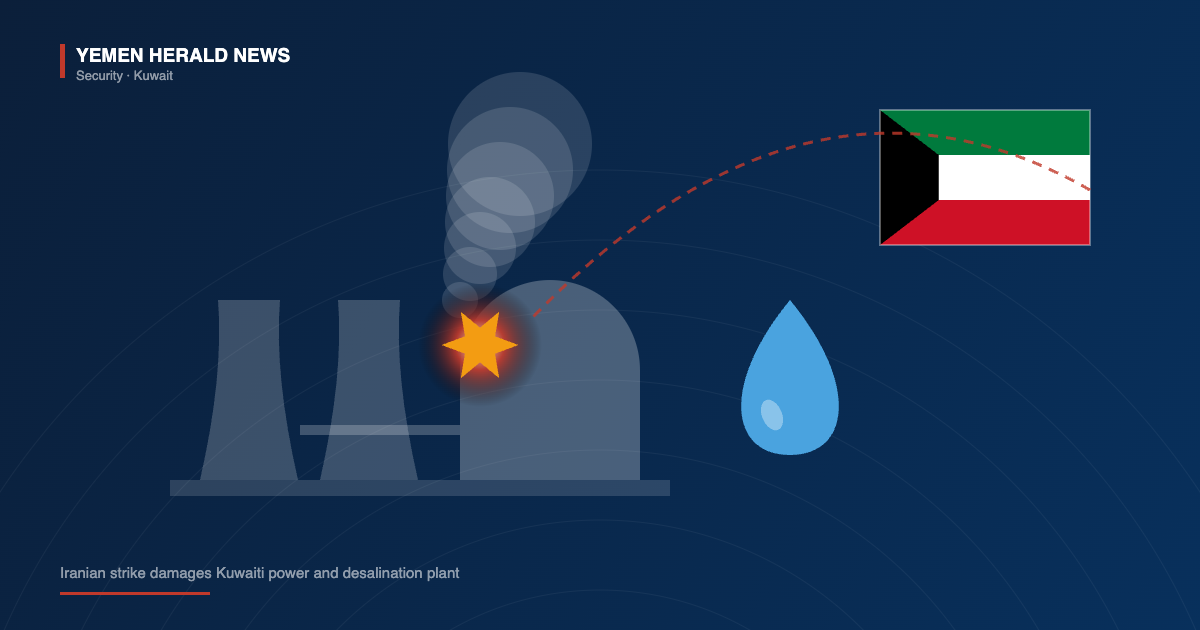
An Iranian strike on a power generation and water desalination complex in Kuwait killed an Indian worker and damaged a service building at the site, the Kuwaiti Ministry of Electricity, Water and Renewable Energy said. The attack took place on the evening of 29 March 2026 and was confirmed by the ministry the following day. Kuwait’s state news agency KUNA reported that ten soldiers were also injured in the incident.
Fatima Abbas Jawhar Hayat, the ministry’s spokesperson, said a service building at one of the country’s power and water stations had been struck as part of what the ministry described as Iranian aggression against the State of Kuwait, causing the death of the worker and substantial material damage to the structure. She said emergency and technical teams were deployed immediately under established contingency plans to contain the damage and to keep the plant running.
The ministry stressed that operational efficiency across the national electricity and water network remained intact despite the strike. Technical crews were working continuously to anticipate further emergencies and to guarantee the continuity of services, it said, and the ministry was coordinating with security agencies and other relevant authorities to secure the affected sites and protect the staff still working at them.
Officials urged the public to remain calm, to avoid circulating unverified accounts of the attack and to rely on official sources for information about the state of the network. The ministry said updates would be communicated transparently as the situation developed. Reuters and Al Jazeera both reported the strike, and The National reported the ministry’s reassurance that generation and desalination operations were continuing normally.
The Indian Embassy in Kuwait extended condolences over the death of the Indian national killed at the facility. Indian nationals form one of the largest expatriate communities in Kuwait and are heavily represented in the technical and maintenance workforce that keeps the country’s utilities running, which meant the human cost of the wider campaign fell disproportionately on foreign workers across the Gulf states.
Kuwait’s water supply depends almost entirely on desalination. The country has virtually no renewable fresh water of its own, and its coastal plants produce electricity and potable water in combined cycles, so damage to a single site can affect two utilities at once. That structural dependence is what makes such plants a sensitive target, and it explains the speed with which the ministry moved to reassure the public that supply was unaffected.
Kuwait’s summer load compounds the concern. Peak electricity demand climbs steeply as temperatures rise, and the same plants that generate that power also produce the water households consume, leaving little margin for extended outages. Any sustained loss of capacity at a combined plant would be felt in both the grid and the water network within days rather than weeks.
The attack came at the end of a month of sustained Iranian strikes on the Gulf Cooperation Council states. Iran began launching drones and missiles at GCC territory on 28 February 2026, after American and Israeli strikes on Iranian sites, and the campaign hit targets in Bahrain, Kuwait, Qatar, Oman, Saudi Arabia and the United Arab Emirates over the weeks that followed.
Kuwait was among the states that reported both interceptions and impacts. Reporting compiled during March recorded thirty-two people injured in Kuwait, alongside sixteen in Qatar, five in Oman and four in Bahrain, with the heaviest toll in the United Arab Emirates. Kuwait’s international airport was among the civilian sites hit during the campaign, and an oil refinery in the country was also reported struck.
Human Rights Watch said in a report published on 17 March that many of the Iranian strikes had hit civilian objects, including residential buildings, hotels, civilian airports, embassies and financial centres, and argued that attacks directed at such targets were unlawful. Utilities of the kind hit in Kuwait occupy a contested category, since power and water plants serve civilians directly while also supporting military infrastructure.
Gulf governments presented their air defences as broadly effective through the same period. Bahrain said on 12 March that GCC states had collectively intercepted more than 900 Iranian missiles, around 2,500 drones and 17 aircraft since the campaign began. Even at those rates of interception, individual strikes and falling debris continued to cause deaths, injuries and damage on the ground across the region.
For Yemen the episode had a familiar shape. Attacks on power stations, desalination units and fuel storage have been a recurring feature of the war there since 2015, and the resulting damage to utilities has been among the main drivers of the country’s humanitarian emergency. The Kuwaiti case illustrated how quickly a single strike on a service building can raise questions about the resilience of an entire national supply system.
Kuwait did not announce a change in its formal position on the wider conflict after the attack. Like its neighbours, it had sought to avoid being drawn directly into the confrontation between Iran on one side and Israel and the United States on the other, while hosting American forces on its territory and defending its own airspace against incoming fire.
The ministry gave no timetable for repairs to the damaged service building and did not name the station publicly in its initial statement. It said only that the affected site had been secured and that no interruption to the electricity or water supply had resulted, a formulation Gulf utilities used repeatedly during the campaign to acknowledge damage without disclosing which installations had been hit.
About the Author