HRW says Houthi forces damaged main supply road into besieged Taiz
 Yemen Herald News
AL-TURBA, Yemen — Houthi forces used explosives to damage the main road carrying food, medicine and fuel into besieged Taiz, Human Rights Watch said Monday.
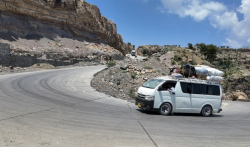
The attack struck the Hayjat al-Abd road at about 4 a.m. on Oct. 18, the rights group said. The road links Aden to Taiz city.
The damaged stretch lies near the town of al-Turba, about 75 kilometres south of Taiz city.
Human Rights Watch said it verified four photographs and a video showing a damaged culvert on the road’s switchbacks. The damage was consistent with a detonation beneath the surface, according to the group.
The group attributed the attack to Houthi forces. It said the Houthis had controlled al-Turba since Oct. 4 and that no ground fighting took place nearby that night.
Human Rights Watch said it wrote to the Houthis on Oct. 21 about the attacks and received no reply. The Houthis have not publicly addressed the findings.
Asharq Al-Awsat reported on Oct. 22 that Houthi fighters had blown up culverts on the same road, which it described as the main route linking Taiz to Lahj and Aden. Its account came from residents of al-Maqatirah and neighbouring districts, and it did not cite Human Rights Watch.
The newspaper said culverts were also destroyed at Naqil Musayr, which links western al-Maqatirah to al-Turba. Part of Naqil al-Khazrah, a stone stairway serving villages in al-Shamayatayn, was blown up, it said.
Five trucks overturned on the alternative route through al-Suha and Karbah, according to the paper. That road takes at least three hours to reach al-Turba.
If the destruction was intended to disable infrastructure indispensable to civilian survival, it would violate the laws of war and amount to a war crime, Human Rights Watch said. The group said the attack may also have caused disproportionate civilian harm.
“The Houthi attack on the remaining commercial supply route to besieged Taizz further endangers civilians already struggling with severe shortages of food, water, medicine, and fuel,” said Niku Jafarnia, the group’s Yemen and Bahrain researcher.
The road had been the main entry point for food, medicine and fuel reaching residents of Taiz city, according to the group.
An earlier attack damaged a road about 85 kilometres southeast of Taiz, near al-Muharraqah and Souq al-Wahati, between Sept. 30 and Oct. 1. Human Rights Watch said it was unable to conclusively determine who carried that attack out.
Satellite imagery taken at 6:57 a.m. on Oct. 1 showed damage across the full width of that road, the group said.
Roads into and out of Taiz have largely been blocked by fighting since the Oct. 1 attack, according to Human Rights Watch. Some supplies, including flour, still reached the city along the Hayjat al-Abd road before the second attack.
The World Food Programme said on Oct. 14 that it could not reach more than 600,000 people in Taiz who depend on humanitarian assistance, the group said.
Most districts in Taiz are considered to have emergency levels of hunger, Human Rights Watch said. Wheat flour stocks in the city are nearly exhausted, according to the group.
Fighting in the area has been mainly between the Houthis and forces aligned with Yemen’s internationally recognised government, the group said.
The Houthis have besieged Taiz since 2015. They have cut roads serving the city, including the route to Aden.
Houthi road blockades have restricted civilians’ movement and impeded essential goods, including water, along with humanitarian access, Human Rights Watch said.
The Associated Press reported on Oct. 24 that water trucks were largely being prevented from entering Taiz and that Houthi control of roads had cut residents off from nearby wells.
Families were paying as much as 75 percent more for bottled water than a few weeks earlier, the agency said. Truckers who bring water in have in some cases tripled their rates.
Desalination plants serving the city are running low on fuel and well below capacity, according to the same report.
Hadil al-Shahid, a Taiz salon owner, said her household’s daily 10 litres of bottled water now lasts about four days.
Taiz is Yemen’s third-largest city, with more than 1 million residents.
The province has taken in roughly half of the people displaced in Yemen since August, an estimated 124,000, according to UN migration experts cited by the agency.
Three Houthi officials, speaking anonymously, told the agency the group controls about 80 percent of the countryside around Taiz and several neighbourhoods inside the city. The agency said it could not verify that account.
Amnesty International has called on the Houthis to open roads into the city.
Jens Laerke, a spokesperson for the UN humanitarian office, said the risk of disease, including cholera, was rising as fuel shortages halted pumps, generators and waste collection.
Reuters reported on Oct. 26 that fuel in Taiz city had reached 2,000 Yemeni rials a litre, citing a driver, Abdullah al-Radfani.
Christian Lindmeier, a World Health Organization spokesperson, said 42 health facilities in Taiz city had reported acute shortages of fuel, oxygen, medicines and supplies.
Ricardo Pires, a UNICEF spokesperson, said 52,000 of 168,000 children screened in Taiz this year were acutely malnourished, including more than 11,500 severely.
Asharq Al-Awsat said about 20 people were taken from their homes in Qadas, in al-Mawasit district, citing residents and unnamed local sources.
The newspaper credited two photographs of the damaged road to posts on X and Facebook.
About the Author