Kuwait Says Ten Soldiers Were Injured in a Missile and Drone Attack on an Army Camp
 Yemen Herald News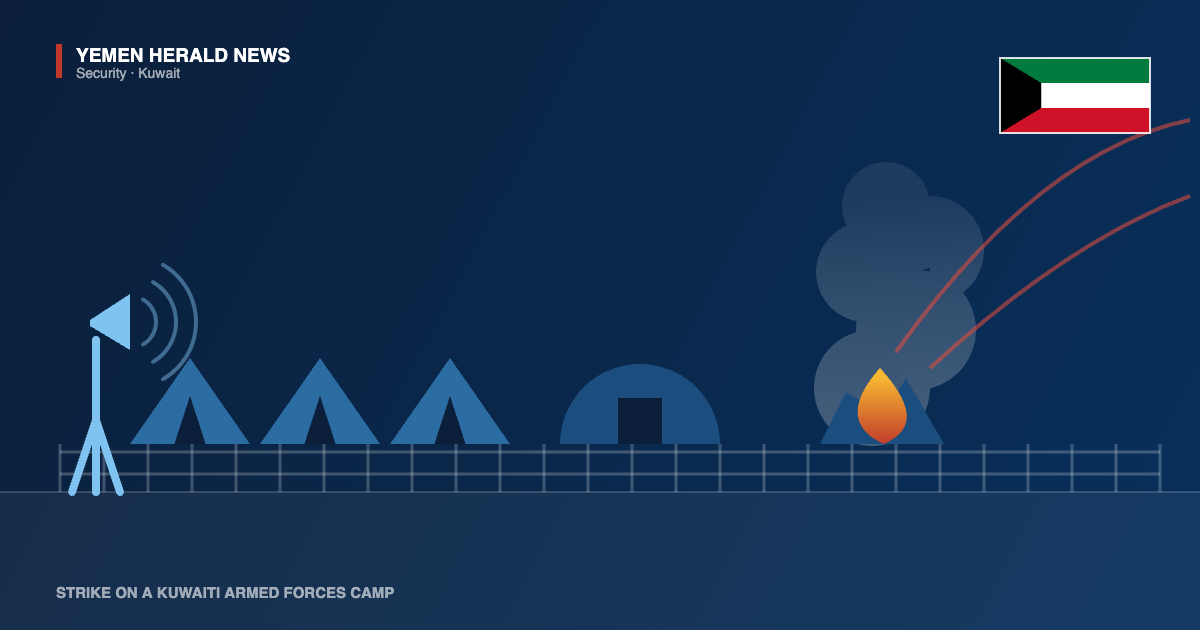
Ten members of the Kuwaiti armed forces were injured when a missile and drone attack struck one of the army’s camps, the Ministry of Defence said on Sunday 29 March 2026. The ministry said the wounded were receiving medical treatment and that the site had also sustained material damage.
Colonel Saud Abdulaziz al-Atwan, the defence ministry spokesman, said the armed forces had detected 14 ballistic missiles and 12 hostile drones in Kuwaiti airspace over the preceding 24 hours. That volume of fire produced the strike on the camp, which was the first attack of the campaign to cause a significant number of Kuwaiti military casualties in a single incident.
Warehouses belonging to a private logistics company were also hit. The ministry reported material damage at that site but no injuries. The pairing was characteristic of the period: a military installation and a commercial facility struck in the same wave, with the harm concentrated at the military one.
Kuwait’s National Guard had reported earlier the same day that it intercepted four drones over locations under its protection, part of a parallel stream of engagements run by the guard alongside the regular armed forces. Air-raid sirens sounded repeatedly across the country during the same period, and the defence ministry issued its usual advisory that explosions audible to residents were air-defence systems engaging incoming targets.
The ministry did not identify the camp, its location or the branch of the armed forces stationed there, and it did not say whether the injuries were caused by a direct hit or by debris. Withholding such detail is standard practice during an active campaign, since precise information about where a weapon landed and what it damaged helps an attacker refine subsequent targeting.
The figures al-Atwan gave describe an unusually heavy day. A count of 14 ballistic missiles alongside 12 drones inverts the ratio seen in most of the daily statements issued by Gulf states through March, in which drones typically outnumbered missiles by a wide margin. A concentration of ballistic weapons in a single 24-hour window is harder for a defensive network to absorb, because each engagement offers only seconds of decision time.
That the attack got through does not indicate a systemic failure so much as the arithmetic of saturation. No air-defence network intercepts everything, and the probability that at least one weapon reaches a target rises with the number launched. Kuwaiti statements through the campaign consistently reported both what was destroyed and, less prominently, that some weapons had caused damage on the ground.
The attacks on Kuwait formed part of a wider Iranian campaign that began at the end of February 2026, following American and Israeli strikes on Iran. Kuwait’s territory contains long-standing United States military facilities, and Kuwaiti and American sites were struck in the same series of waves, which is central to how the country came to be targeted despite not describing itself as a party to the fighting.
The most serious single incident in Kuwait had come earlier. On 1 March, an Iranian one-way attack drone struck a tactical operations centre used by United States forces at Port Shuaiba, an industrial port south of Kuwait City. Six United States Army Reserve soldiers were killed and more than 30 were injured. Survivors later disputed the Pentagon’s account of the attack, telling American reporters that the unit had been unprepared to defend the position.
Kuwaiti military casualties accumulated more gradually. Reporting later in the conflict put the total number of Kuwaiti service members wounded in attacks associated with strikes on United States bases in the country at 67, a figure that places the ten injured on 29 March as one of the larger single-incident tolls rather than an outlier.
Kuwait’s airport and its ports were struck at other points in the campaign. Drones damaged a radar system at Kuwait International Airport on 28 March, and on 1 April drones hit fuel tanks belonging to the Kuwait Aviation Fueling Company, starting a large fire. Neither incident caused casualties, but together with the camp strike they mapped a target set spanning military, aviation and energy sites.
Kuwait’s official position through the campaign was consistent. The government condemned each attack as a violation of its sovereignty, pressed the case in legal terms through the foreign ministry, and confined its military response to air defence. It did not declare itself a belligerent, and no Kuwaiti statement in this period indicated any intention to do so.
The practical burden fell on the armed forces and the National Guard, which between them maintained continuous alert across military installations, ports, the international airport and energy infrastructure. Both issued statements after significant engagements, and both used near-identical language about readiness and the protection of vital sites, reflecting a division of responsibility rather than any difference of posture.
For the wider public the routine was sirens, audible interceptions and instructions to stay away from debris. Kuwaiti authorities asked residents to rely on official channels rather than on footage circulating online.
What the 29 March statement recorded, in the end, was the point at which the campaign’s cost to Kuwait stopped being purely material. Until then the ministry’s announcements had largely described interceptions and damage to buildings and vehicles. The injury of ten service members in a single strike marked a different order of consequence, and it was reported plainly, with the numbers attached.
About the Author