Yemen’s parliament speaker discusses Bab al-Mandab security with Pakistan’s Ayaz Sadiq
 Yemen Herald News
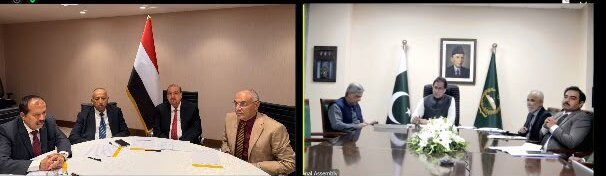
ADEN, Yemen — Yemen’s parliament speaker discussed security in the Bab al-Mandab Strait with his Pakistani counterpart in a virtual meeting on Monday.
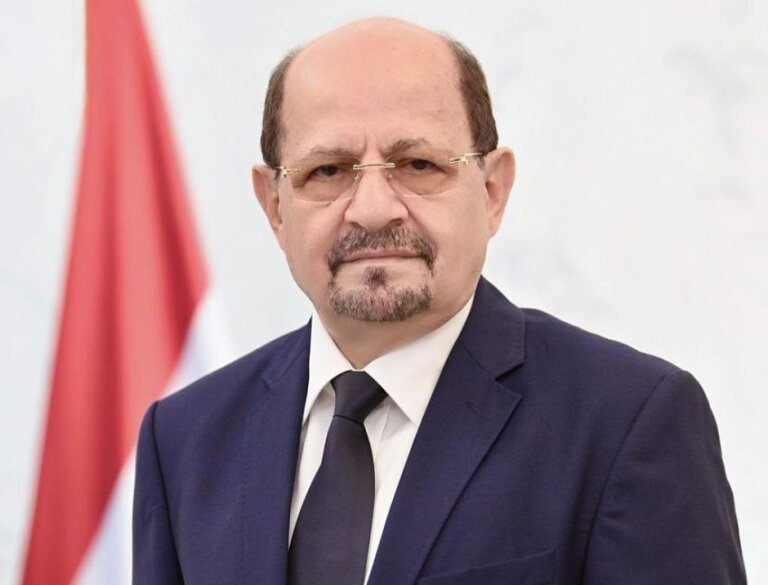
Sultan al-Barakani, speaker of Yemen’s House of Representatives, spoke with Sardar Ayaz Sadiq, speaker of Pakistan’s National Assembly.
Azam Nazeer Tarar, Pakistan’s federal minister for law and justice, also took part, the Associated Press of Pakistan reported.
The two discussed regional peace and stability, relations between the two countries and the strategic importance of the strait.
Sadiq reaffirmed Pakistan’s support for Yemen’s sovereignty and independence, in line with UN resolutions.
He said dialogue, mediation and diplomacy were essential for a lasting peace in Yemen.
Al-Barakani condemned attacks on Saudi Arabia and acknowledged Pakistan’s diplomatic role in the region, the agency said.
Saba, the state news agency of Yemen’s internationally recognised government, reported the meeting from Aden. It said the two speakers reviewed developments in Yemen, the consequences of what it called Houthi escalation, and threats to Saudi security and to international waterways in the Red Sea.
The Associated Press of Pakistan and the Pakistani newspaper Dawn reported the meeting separately. Their accounts agree with Saba on the participants, the date and the main subjects.
Sadiq said Pakistan and Saudi Arabia were one soul in two bodies.
Protecting the holy sites in Makkah and Madina was Pakistan’s foremost priority, he said, and he reaffirmed his country’s commitment to their protection.
He described the Makkah Agreement as an important step toward regional peace and reconciliation.
Pakistan’s foreign ministry condemned missile attacks on the Makkah and Madina regions of Saudi Arabia in a statement on Monday.
It said the attacks were allegedly launched by Houthi-led Ansarallah forces, and called them a grave violation of Saudi sovereignty and territorial integrity.
The ministry praised what it called the vigilance and efficiency of Saudi air defences. It reaffirmed Pakistan’s commitment to the Makkah Alliance.
The Houthis dispute the government’s characterisation of the fighting and describe their operations as defensive.
The National Assembly passed no resolution on the matter.
Bab al-Mandab links the Red Sea to the Gulf of Aden, between Yemen and the Horn of Africa. It carries a large share of the shipping traffic between Europe and Asia.
Houthi forces have attacked vessels in the Red Sea and the Gulf of Aden since late 2023.
The Saudi-led coalition said this month that it downed 10 ballistic missiles and a cruise missile. It also said it destroyed Houthi missile tunnels and launchers.
The coalition warned separately against the use of traditional boats to smuggle weapons.
The Arab League condemned Houthi attacks on Dammam airport and the Shaybah oil field this month.
The United States ordered some diplomats and their families to leave Saudi Arabia over the attacks.
Al-Barakani was elected speaker of the House of Representatives on April 13, 2019, at a session in Seiyun.
That was the first sitting of the chamber loyal to the internationally recognised government since the war began in 2015.
He is a member of the General People’s Congress. He was born in July 1956 in Al-Maafer District, in Taiz governorate.
Houthi forces have encircled Taiz since 2015.
Hans Grundberg, the UN special envoy for Yemen, said on Oct. 9 that the country had slid back into full-scale war.
The current escalation began in July. More than 250,000 people have been displaced since June, according to UN figures.
The European Parliament asked the European Union on Oct. 22 to designate the Houthis a terrorist organisation. The bloc has not done so.
The humanitarian response plan published by the UN Office for the Coordination of Humanitarian Affairs in March put more than 22 million people in Yemen in need of assistance, and sought 2.16 billion dollars to reach 12 million of them.
The ministry did not report casualties from the attacks.
Saudi Civil Defence said debris from an intercepted missile injured two people in Khamis Mushait this month.
The Houthis said they fired dozens of ballistic missiles at Riyadh airport and two Saudi bases.
Pakistan’s foreign ministry used the name Makkah Alliance. The National Assembly speaker referred to a Makkah Agreement.
Yemen’s House of Representatives has met only intermittently since 2015, when the war drove the government from Sanaa.
Ahmad Obaid bin Daghr, chairman of the Shura Council, praised Kuwait’s aid to Yemen at a meeting in Riyadh this month.
Yemen’s UN envoy, Abdullah al-Saadi, discussed the escalation with French officials last week.
Rashad al-Alimi, chairman of the Presidential Leadership Council, condemned attacks on Aden airport on Oct. 21, as he received the credentials of eight ambassadors.
Tom Barrack, a US envoy, said this month that American ground involvement in Yemen would be fruitless.
The World Health Organization said this month that 42 health facilities in Taiz faced severe shortages. Aid agencies said water output in the city had halved while cholera cases tripled.
The OCHA plan recorded 5.2 million internally displaced people and 18.3 million as acutely food insecure.
The International Organization for Migration has put the number of people displaced across Yemen at 268,000.
The European Commission allocated an additional 22.5 million euros in humanitarian aid for Yemen this month, bringing its total for the year to 110 million euros.
Neither side said whether further contacts were planned.
About the Author