Drone Strike Sets Fire to Laden Kuwaiti Tanker Al Salmi at Dubai Anchorage
 Yemen Herald News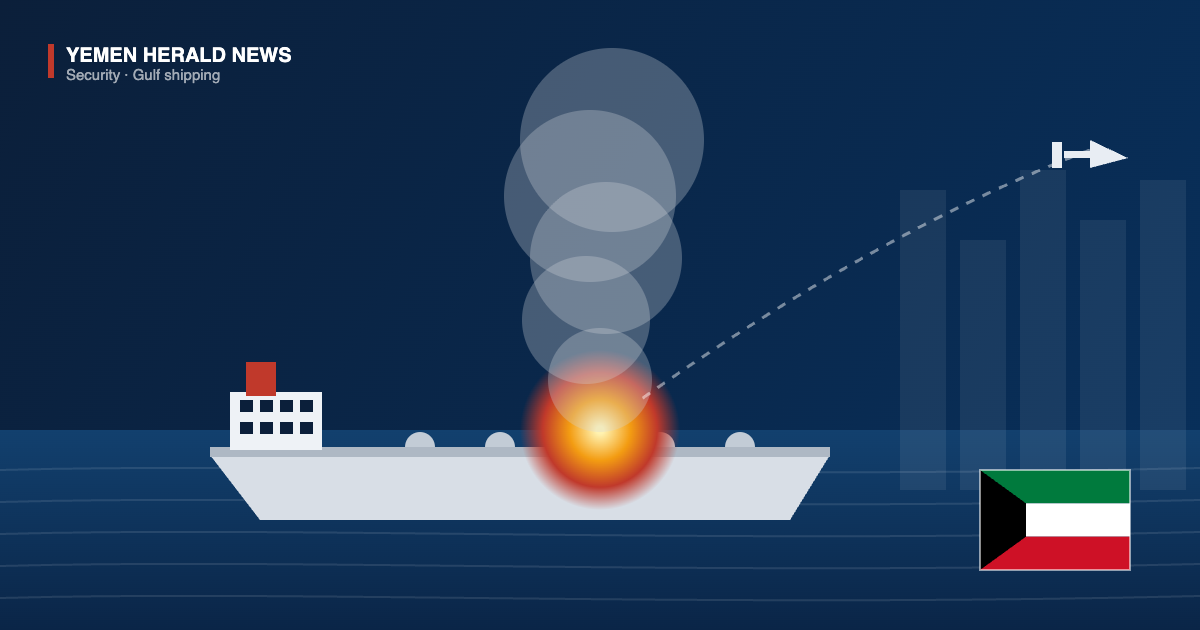
A fire broke out aboard the Kuwaiti crude oil tanker Al Salmi at the Dubai port anchorage in the early hours of 31 March 2026 after the vessel was struck in a drone attack. Dubai authorities said the blaze was extinguished, that all crew were accounted for and that no oil escaped into the water.
The Al Salmi is a very large crude carrier with a capacity of around two million barrels. Kuwait Petroleum Corporation said the ship was fully laden at the time of the strike, carrying crude loaded in Kuwait and Saudi Arabia and bound for the Chinese port of Qingdao.
The attack took place at approximately ten minutes past midnight local time while the vessel lay at anchor. The strike damaged the hull and started a fire on board. The Dubai Government Media Office said response teams stabilised the situation and confirmed there had been no leakage.
All 24 crew members were secured and no injuries were reported. Kuwait Petroleum Corporation described the damage to the vessel as material and said the ship had been targeted by Iranian drones, while cautioning at the time about the risk of a spill in the surrounding waters.
The incident formed part of a wider campaign against shipping in Gulf waters. Missiles and explosive drones have been directed at vessels in the region since the United States and Israel struck Iran on 28 February 2026, and the Al Salmi was among the larger ships hit in that sequence.
What distinguished this strike was its location. Attacks on merchant shipping in recent years have concentrated in the Red Sea and the Gulf of Aden, at the southern end of the route. A drone reaching an anchorage inside Dubai’s port limits placed the threat at the opposite end of the corridor, in the waters of a major transhipment hub.
Dubai’s anchorage handles a continuous rotation of tankers, container vessels and bunkering craft. Ships waiting for a berth or for cargo instructions are stationary, closely spaced and predictable in position, which makes them harder to defend than a vessel under way in open water.
A fully laden very large crude carrier presents a particular hazard. Two million barrels of crude in a single hull is among the largest concentrations of hydrocarbons that moves by sea, and a fire that reaches the cargo tanks rather than remaining confined to the hull structure becomes very difficult to control.
That the fire was contained without leakage was therefore significant beyond the fate of the individual ship. A spill of that scale in the shallow, enclosed waters of the Gulf would have affected desalination intakes on which several countries depend for drinking water, as well as fisheries and coastal infrastructure.
The commercial consequences of attacks of this kind extend well past the vessel involved. War risk insurance premiums for voyages through affected waters rise quickly once an incident occurs inside a port area, and those costs are passed into freight rates and ultimately into the delivered price of crude.
Shipowners respond by rerouting, slowing schedules or refusing charters into the affected area altogether. Each of those responses lengthens voyages and reduces the effective supply of tanker capacity, which tightens the market even when the volume of oil actually available for export has not changed.
For Kuwait, the strike touched the export chain directly. Kuwait Petroleum Corporation manages the country’s crude exports, and the great majority of that flow moves east to Asian refiners. Qingdao, the Al Salmi’s stated destination, is one of the principal crude import terminals serving Chinese refineries.
For the United Arab Emirates, the concern was the security of its ports rather than its own cargo. Dubai’s standing as a shipping and logistics centre rests on the reliability of its harbours, and an attack inside the anchorage tested that reputation in a way that an incident in open water would not.
The response by Dubai’s emergency services was cited by officials at the time as evidence that port contingency planning worked. The fire was extinguished within hours, the crew were removed from danger, and the vessel did not lose containment, all of which limited the incident to material damage.
Gulf shipping had already been operating under elevated risk before the strike. Insurers had widened the designated high-risk areas, naval forces had increased patrolling along the main routes, and operators had adjusted routing and communication procedures for transits through the region.
The attack also underlined how exposed the Gulf’s energy infrastructure is to comparatively cheap weapons. A single drone able to reach an anchorage can impose costs across an entire trading route, without needing to sink a vessel or halt exports, simply by making the waters appear unsafe to underwriters.
Crew welfare is a further dimension that receives less attention. Seafarers on vessels transiting or waiting in a contested area work under sustained stress, often without the option of leaving the ship, and recruitment and retention across the tanker sector have been affected wherever a route has come to be regarded as dangerous.
Contemporary reporting of the incident was consistent across Gulf and international outlets on the essential facts: the identity and cargo of the vessel, the timing of the strike, the extinguishing of the fire, the safety of the crew and the absence of a spill. The attribution to Iranian drones was made by Kuwait Petroleum Corporation and reported at the time.
About the Author