Yemen’s foreign ministry condemns attack on Qatari LNG tanker in the Arabian Gulf
 Yemen Herald News
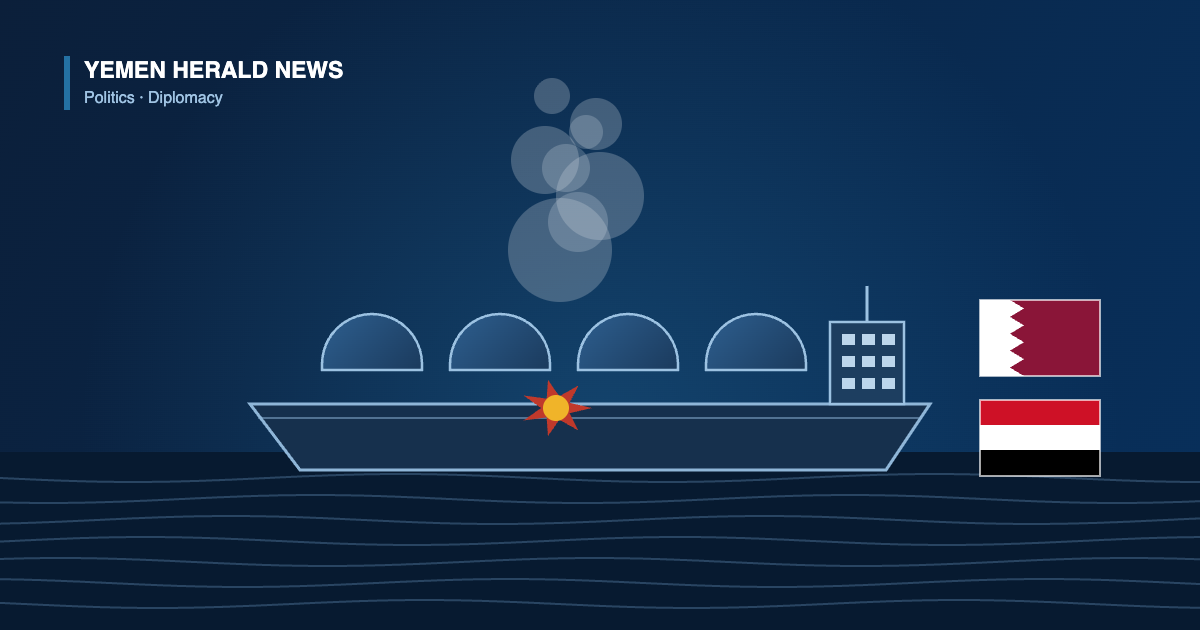
ADEN, Yemen — Yemen’s Ministry of Foreign Affairs and Expatriates condemned an attack on a Qatari liquefied natural gas tanker in the Arabian Gulf, the ministry said Sunday.
The ministry named the vessel as the al-Maida, owned by Qatar Gas Transport Company, known as Nakilat. Other reporting on the incident gives the ship’s name as the Al Mayeda.
Yemen rejects any action that threatens the safety of maritime navigation and global energy supplies, the statement said.
The ministry said the Republic of Yemen stands in solidarity with Qatar. It said Yemen supports all measures Qatar takes to protect its security, its interests and the safety of its tankers.
The statement called for respect for international law and for freedom of navigation. It said the international community should take urgent measures to strengthen maritime security and protect international trade.
Saba, Yemen’s state news agency, carried the statement from Aden on Sunday morning. The account of Yemen’s position rests on that statement alone. No independent confirmation of it has been published, and Yemen Herald found no second origin for it.
The attack on the vessel has been reported more widely. Nakilat said the carrier was struck by unidentified objects on Friday evening while it was sailing in the Arabian Gulf. The company did not say what the objects were.
No crew members were injured, the company said. It reported no environmental damage.
Nakilat said the vessel was in a safe condition and operational. The impact was still being assessed, it said.
The carrier had 25 crew members aboard, six of them Indian nationals. All were reported safe.
The vessel sails under the flag of the Marshall Islands. It was carrying Qatari liquefied natural gas bound for Pakistan.
The tanker was approaching the Strait of Hormuz when it was hit.
India’s shipping minister, Sarbananda Sonowal, said on Oct. 31 that the six Indian crew members and the rest of the crew were safe. He said India was monitoring the situation and was in contact with the ship management company. Sonowal described the incident as a projectile attack in the Persian Gulf.
Iranian authorities had approved the tanker’s transit before the attack, Bloomberg reported, citing people familiar with the matter. The same report said Pakistan had asked Iran to secure safe passage for the vessel.
Qatar News Agency first reported the attack.
The company issued the statement on Sunday through the Qatar Stock Exchange. Nakilat also provides towage and marine support services to Qatari ports and terminals.
Qatar’s foreign ministry condemned the attack the same day. It called the strike a dangerous act that threatens the safety of maritime navigation and the security of global energy supplies.
The Qatari ministry said Doha reserves the right to take all necessary measures under international law and the UN Charter. It referred to reckless and irresponsible practices that it said could have repercussions for regional security and the global economy.
Qatari authorities have begun investigations to establish the circumstances and identify those responsible, the ministry said.
Qatar did not name a party. No group has claimed responsibility.
The strike is the latest on commercial shipping since the US-Israel war on Iran began in February, Al Jazeera reported. Figures from the International Maritime Organization and the UK Maritime Trade Operations centre indicate more than 120 commercial ships have been hit since the war began.
Iran closed the Strait of Hormuz early in the war. It warned that vessels passing without its permission would face destruction.
Attacks on shipping rose after the United States reimposed a blockade on Iran’s southern ports in July.
October saw more vessels hit than any other month of the war, with at least 29. March accounted for 20.
Oman rescued 25 people from a burning oil tanker in the Strait of Hormuz in a separate incident, Al Jazeera reported. Iran said four tankers caught fire after striking mines in the strait.
Yemen’s own coastline has carried a separate series of attacks. The Houthis announced a blockade of Saudi-linked shipping on July 13, according to the Armed Conflict Location and Event Data Project.
Through Sept. 25 the group had attacked 10 commercial ships, mostly tankers, the project recorded. At least six were struck.
Seven of the targeted vessels flew a Saudi flag or belonged to a Saudi company. The Houthis claimed Saudi links for two of the remaining three.
Those attacks took place in the Red Sea, along the Saudi and Yemeni coasts, in the Bab al-Mandab strait and in the Gulf of Aden.
The MSV Faize Noore Oliya was sunk on Aug. 4, the project recorded. An attack on the vessel Tihama on Aug. 11 killed four crew members.
Aug. 24 was the last maritime attack the project corroborated in that series.
Houthi forces advanced about 150 kilometres along Yemen’s Red Sea coast in September, the project said. They captured Mocha and reached Bab al-Mandab.
More than half of all battles recorded in Yemen that month were in Taiz and Lahj governorates, the project said. Fighting there had shifted into the highlands.
The Houthis have not commented on the attack on the Qatari carrier.
The Yemeni ministry’s statement did not mention the Red Sea, Bab al-Mandab or the Houthis.
Nakilat is a Qatari public shareholding company with public and private sector ownership.
About the Author


 Adel Haddad