Yemen and Jordan sign environmental protection memorandum in Amman
 Yemen Herald News
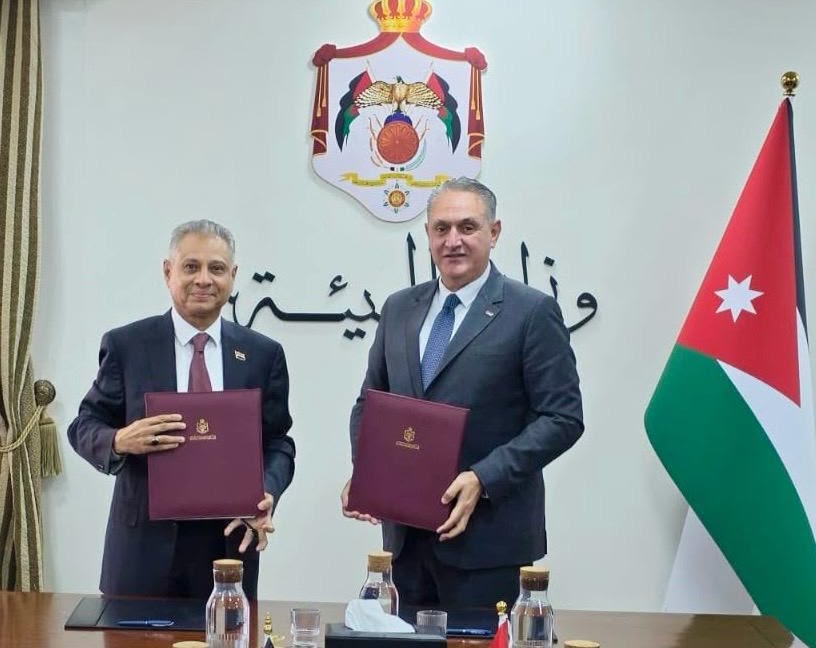
AMMAN, Jordan — Yemen and Jordan signed a memorandum of understanding on environmental protection in Amman on Sunday, the Yemeni state news agency Saba reported.
Yemen’s ambassador to Jordan, Jalal Faqira, signed for Yemen. Jordan’s environment minister, Ayman Suleiman, signed for Jordan.
The agreement provides for the exchange of policies, expertise and technologies for protecting air, water and soil, according to Saba. It also covers the promotion of clean technologies and the management of waste and hazardous materials.
The document extends to ecotourism, marine environmental protection and the management of nature reserves. It covers work to combat desertification.
The two sides agreed to conduct joint studies and research on protecting biodiversity, Saba reported.
The memorandum provides for cooperation on climate change through adaptation and mitigation measures. It covers the exchange of expertise in environmental impact assessment.
It also provides for folding environmental considerations into national development plans, according to the agency.
A joint technical committee is to be set up to oversee implementation, Saba said. The committee will coordinate cooperation programmes and activities. It will also propose new areas of partnership.
Saba attributed no statement to either signatory. It did not report a duration for the memorandum, or any renewal terms.
The account of the signing rests on Saba, which is Yemen’s state news agency. No independent confirmation has been published, and Yemen Herald found no second origin for it.
Saba gave the Jordanian signatory’s name as Ayman Abdullah. Jordan’s state news agency, Petra, named Ayman Suleiman as environment minister in reports through October, and Jordan’s environment ministry lists him in the post. Petra gives the Yemeni ambassador’s full name as Jalal Ibrahim Faqira.
Sunday’s signing follows a second bilateral agreement signed in the same city last month. Faqira signed a memorandum on culture and heritage in Amman on Oct. 21, Saba reported at the time. Nidal al-Ahmad, secretary-general of Jordan’s culture ministry, signed for Jordan.
That agreement covers the exchange of expertise in digitising archives, manuscripts and heritage material, according to Saba. It provides for joint digital platforms for cultural content.
It also covers the use of virtual reality, augmented reality and artificial intelligence to preserve and manage cultural data. It provides for exchanges of cultural and artistic delegations, and for reciprocal cultural weeks.
Jordan has set out its own environmental programme separately. Its environment ministry launched a green growth strategy running from 2026 to 2029 in July, Petra reported. Suleiman presented it.
Suleiman discussed climate cooperation and priorities for the COP31 climate conference with Turkish officials on Oct. 6, according to Petra.
Yemen’s environmental portfolio sits with the Ministry of Water and Environment, which Tawfiq al-Sharjabi heads. Sunday’s memorandum was signed by the embassy in Amman rather than by that ministry, according to Saba’s account.
The Green Climate Fund approved a 28 million dollar project for Yemen at its 46th board meeting in South Korea, Saba reported on Oct. 27. Al-Sharjabi set out the funding, according to the agency.
The project is called Climate and Water Information Management and Early Warning Systems in Yemen. The fund is providing a grant of 24.73 million dollars, Saba said.
A further 3.647 million dollars comes from the Trust Fund for Resilience, Recovery and Reconstruction in Yemen, which the World Bank manages, according to the agency.
The project is to upgrade and expand climate and water monitoring networks. It is to build a national information platform and develop forecasting and early warning services.
Those services are intended for irrigation planning, agriculture, water source protection and disaster preparedness, Saba reported. The project is expected to reach 9.2 million people, among them farmers, displaced people and residents of rural and remote areas.
Jordan and Yemen have kept up parliamentary contacts alongside the ministerial track. Mazen Qadi, speaker of Jordan’s lower house, met Faqira in Amman on June 17, Petra reported.
Fahmi Abdulhadi bin Shubraq, chairman of Yemen’s Environment Protection Authority, addressed the high-level segment of the 17th Conference of the Parties to the Convention on Biological Diversity in Yerevan, Armenia, Saba reported on Oct. 28.
Shubraq asked for least developed and conflict-affected countries to be given priority in biodiversity financing, according to the agency. He asked for technology transfer and capacity-building support, and for international funding to be made easier to reach.
He also called for stronger protection of land and marine ecosystems, and for benefits from genetic resources and digital sequence information to be shared fairly, Saba reported.
Yemen has completed a third national biodiversity strategy and action plan covering 2025 to 2030, according to the agency. It is aligned with the Global Biodiversity Framework.
Al-Sharjabi led Yemen’s delegation to the 17th session of the Arab Ministerial Water Council in Cairo, Saba reported on Oct. 26. He asked for an integrated Arab approach to water security and for the rehabilitation of water and sanitation infrastructure.
He cited water scarcity, groundwater depletion and climate change, according to the agency. He proposed a joint Arab mechanism for sharing water and agricultural data.
Qadi said Jordan supported Yemen’s security, stability, unity and sovereignty, and a political solution to its conflict, according to the agency. Faqira said Yemen wanted to widen cooperation in the economic, cultural and investment sectors.
The two called for more contact between the two countries’ legislatures and for an exchange of expertise, Petra reported.
Saba did not say when the joint technical committee would meet for the first time.
About the Author


 Adel Haddad