Two explosions hit Aden’s al-Buraiqa district as Houthis and the government dispute the target
 Yemen Herald News
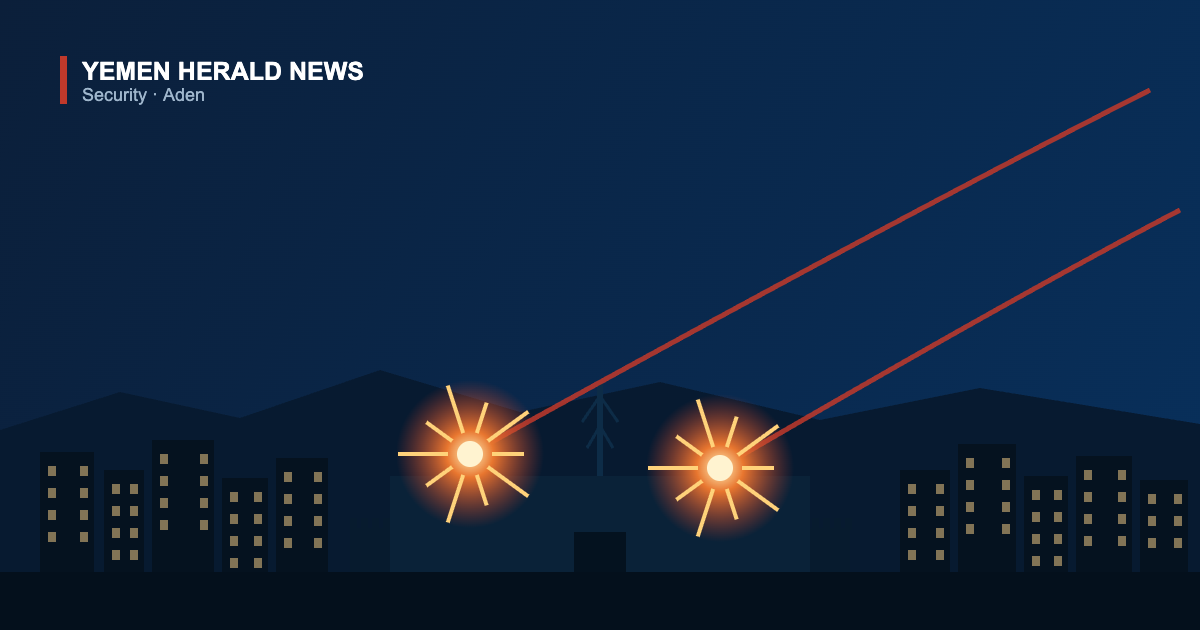
ADEN, Yemen — Two explosions struck the al-Buraiqa district of Aden on Wednesday night, and the Houthis and Yemen’s government gave conflicting accounts of what was hit.
A Xinhua reporter in the city said two explosions were heard that night. The agency published no damage assessment.
A local security source, speaking on condition of anonymity, told Xinhua that two missiles had targeted separate military sites in al-Buraiqa, in western Aden, where forces linked to the Saudi-led coalition maintain a presence.
Yahya Saree, the Houthi military spokesman, said in a post on Telegram that the group had struck a Saudi military command centre and operations room in al-Buraiqa with several ballistic missiles. He did not give a number.
Saree said the facility had directed and overseen Saudi military reinforcements on fronts in Lahij, al-Dhale, Taiz and other governorates.
He said missiles had also been fired at government forces in Lahj, al-Jawf and Marib.
Saree said the missiles hit their targets and caused large casualties. The group claimed dozens of casualties without giving figures, according to Xinhua’s account of his statements.
No independent body has published a casualty count for the Aden strikes. Yemen Herald could not verify the Houthi claim, and found no damage assessment from the Yemeni government, the Saudi-led coalition or any international organisation.
The accounts differ on the scale of the attack. Saree said several ballistic missiles were used, while the security source cited by Xinhua described two missiles and the agency’s reporter said two explosions were heard.
They differ on how many places were hit. Saree described a single command centre and operations room; the security source described separate military sites.
Salem al-Awalqi, the information minister, condemned what he called repeated shelling by the Houthi militia on Aden, most recently targeting the densely populated al-Buraiqa district.
The attack “reflects the militia’s established pattern of targeting civilians and terrorising innocent people,” al-Awalqi said in a social media post.
He did not confirm or deny that a Saudi command centre stood in the district.
The two sides also characterise the same ground differently. Saree described a facility directing Saudi reinforcements, and al-Awalqi a densely populated residential district.
Neither account rests on reporting by an outside party. The Houthi claim was made on Telegram and the government response on social media, and neither has been corroborated by a party without a stake in the fighting.
The two sides differ over what was struck rather than over whether anything was. Aden is the seat of Yemen’s internationally recognised government.
The Saudi-led coalition said on X the same night that it had intercepted and destroyed five missiles and two drones fired toward Saudi Arabia.
It put the breakdown at three cruise missiles aimed at the Riyadh region, two ballistic missiles toward the kingdom’s western region and two drones toward Mecca and southern areas.
The coalition gave no further detail on the targets and reported no casualties.
Saudi Arabia’s Civil Defence Authority said early Thursday that debris from the interception of two ballistic missiles had fallen in the village of Sabuhah, in Mecca province.
The authority described the launches as “a flagrant violation of international humanitarian law.” It reported no casualties.
A Houthi spokesman, who was not named, denied on Wednesday what he described as Saudi lies that the group had sent a drone toward Mecca.
He said a drone had been launched at a pumping station in Yanbu, on the Red Sea, and that King Khalid International Airport in Riyadh had been targeted with three cruise missiles.
Saudi authorities have not confirmed either claim. The coalition described the Riyadh launches only as aimed at the region and did not name a target.
The World Health Organization said on Wednesday that strikes in the escalation had hit health facilities and ambulances, and that fuel shortages were disrupting emergency medical services in Taiz.
Displacement figures for the escalation differ by agency. The International Organization for Migration put the number displaced at more than 300,000 as of Nov. 1.
The UN Office for the Coordination of Humanitarian Affairs put it at 313,000 since early August, and said Taiz accounted for two of every five displacements recorded in that period.
A WHO warning on Wednesday put the figure above 320,000 since Aug. 1, including nearly 16,000 in the preceding week, without naming the body that produced the count.
More than 43,000 people have left the al-Madaribah wa al-Arah district of Lahij since early October, according to the WHO situation report that carried the IOM figure. It said Aden was hosting more than 56,000 displaced people.
Yemen’s needs predate the current exchanges. The humanitarian needs and response plan for 2026, issued in March, put the number of people requiring assistance at more than 22 million.
That plan recorded 18.3 million people as acutely food insecure and 5.2 million as already displaced. It sought 2.16 billion dollars to reach 12 million people.
It also counted more than 2.2 million children under five as acutely malnourished, 516,157 of them severely.
WHO said a vaccination campaign in the areas affected by the fighting was targeting nearly one million children.
The Civil Defence Authority did not say whether the debris at Sabuhah damaged any property.
About the Author


 Adel Haddad