Turkey’s parliament ratifies Mecca defense pact as Saudi deployment remains a separate decision
 Yemen Herald News
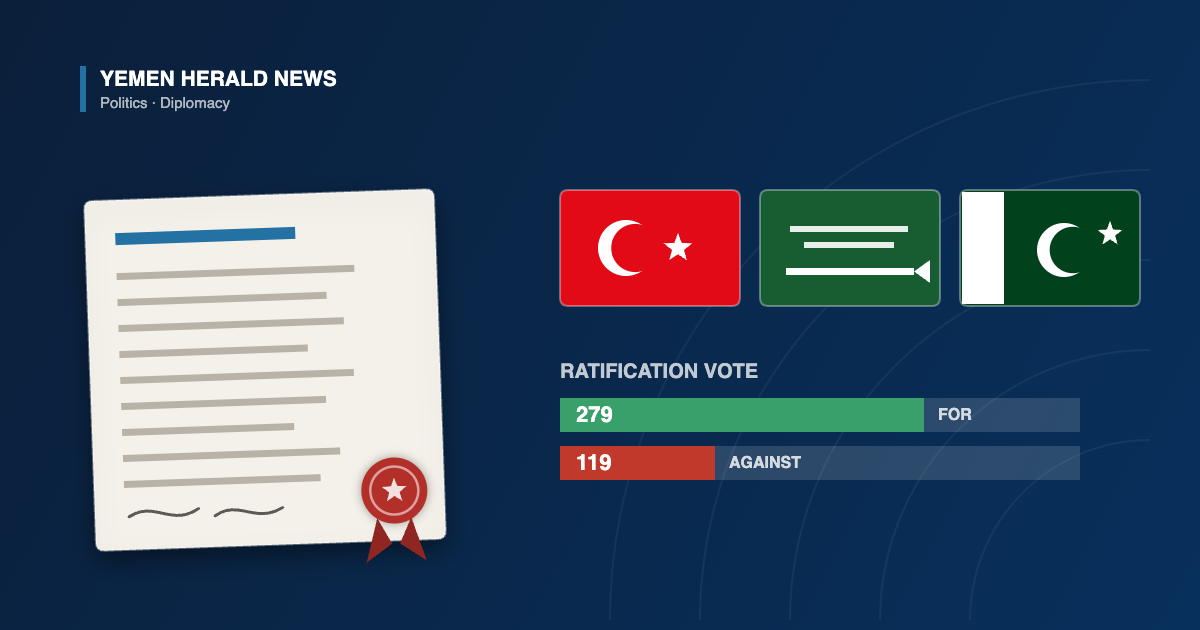
ANKARA, Turkey — Turkey’s parliament has ratified a three-way defense pact with Saudi Arabia and Pakistan, though any troop deployment to the kingdom would require a separate vote.
The Grand National Assembly approved the Mecca Joint Defense Agreement by 279 votes to 119. Xinhua and Al-Monitor reported the same count.
Saudi Arabia pursued the pact as it came under sustained Houthi missile and drone attack, according to both Al-Monitor and Middle East Eye.
The two accounts of the vote differ on the day it was held. Xinhua, filing from Ankara on Nov. 5, said lawmakers voted that Thursday. Al-Monitor, in a report also dated Nov. 5, placed the vote on the Wednesday.
They describe the chamber differently as well. Xinhua called it a 600-seat parliament. Al-Monitor said 398 of 592 lawmakers took part.
Saudi Arabia, Turkey and Pakistan signed the agreement in Mecca on Aug. 7, according to Middle East Eye. It named the signatories as Turkish President Recep Tayyip Erdogan, Pakistani Prime Minister Shehbaz Sharif and Saudi Crown Prince Mohammed bin Salman.
The agreement commits the three governments to treat an armed attack on any one of them as an attack on all three, Xinhua and Al-Monitor both reported.
Middle East Eye described the obligation in narrower terms, saying the nature and level of assistance is to be determined according to the circumstances.
Beyond the mutual-defense clause, the agreement provides for closer military cooperation, intelligence sharing, collective deterrence and defense-industry cooperation, Xinhua reported.
What the ratification does not do is clear Turkish forces to enter Saudi Arabia.
Xinhua reported that the collective-defense provision does not automatically trigger a deployment. Any assistance is set through consultations and each country’s constitutional and legal procedures, it said.
Sending Turkish troops abroad would require separate parliamentary authorization, according to the same report.
Al-Monitor assessed the effect differently, saying ratification clears a hurdle for Turkey to deploy troops to Saudi Arabia. It judged any deployment likely to be confined to training, advisory services and equipment supply rather than a large contingent.
Turkish Defense Minister Yasar Guler said on Oct. 23 that the scope of support would be decided after ratification, Al-Monitor reported.
“We absolutely do not foresee entering into any conflict with the Houthis,” Guler said, in remarks carried by Al-Monitor.
The ratification bill runs to three articles, Xinhua reported. The first approves the 16-article agreement. The second sets entry into force on publication in Turkey’s Official Gazette. The third assigns implementation to the president.
The government submitted the bill in October, according to Xinhua.
Two opposition parties voted against. Al-Monitor named them as the Yeni Party, which it described as the second-largest in parliament, and the pro-Kurdish DEM Party.
Both argued the pact could draw Turkey into regional conflicts and impose unclear military obligations without sufficient parliamentary oversight, Al-Monitor reported.
Erdogan’s governing alliance holds a majority in the chamber, according to the same report.
Pakistan and Saudi Arabia completed their ratifications earlier. Pakistan’s Foreign Office spokesperson, Sajjad Haider Khan, said both countries had finished the procedures, in a transcript the ministry published and Middle East Eye reported on Oct. 24.
Islamabad called the agreement defensive and consistent with the UN Charter, according to that report.
Middle East Eye said Saudi Arabia was looking for allies to help it against Yemen’s Houthis.
When Middle East Eye published, Turkey had not completed its domestic approval, leaving the agreement short of ratification by all three signatories.
Al-Monitor dated the escalation in attacks on Saudi Arabia to early October and said the Saudi-led coalition launched a fresh offensive against the Houthis on Oct. 4.
Al-Monitor described the attacks as deadly and as striking Saudi airports and energy infrastructure.
Senior officials from the three countries met in Riyadh on Oct. 5 and agreed measures for the rapid deployment of forces in the kingdom, Al-Monitor reported.
Middle East Eye identified that meeting as the Strategic Political and Defense Committee. It said the committee called for collective defense commitments to be implemented, subject to the three countries’ domestic laws.
Saudi Civil Defense issued alerts for Abha and Khamis Mushait during the same period and later lifted them, according to Middle East Eye.
The same report referred to a Houthi strike on King Khalid International Airport in Riyadh on Oct. 10.
Reuters reported on Oct. 21 that Riyadh’s allies were providing primarily defensive support, Middle East Eye said.
Al-Monitor characterized the attacks on the kingdom as Iran-backed. None of the three reports carried a Houthi response to the Turkish vote.
The three accounts do not agree on what the treaty is called. Xinhua rendered it the Mecca Joint Defense Agreement, Al-Monitor the Mecca defense agreement, and Middle East Eye the Mecca Joint Defence Agreement.
None of the three reports said whether the agreement had been published in the Official Gazette, the step Xinhua identified as bringing it into force.
Xinhua attributed the 279-to-119 figure to the outlet Turkiye Today rather than to a tally of its own.
Middle East Eye gave no calendar date for Pakistan’s ratification, saying only that it was announced on a Friday.
The Saudi-led coalition intervened in Yemen in 2015, according to Al-Monitor. Xinhua’s account of the vote did not mention Yemen or the Houthis.
About the Author


 Adel Haddad