Saudi-led coalition says it struck 60 Houthi sites as Houthi health ministry reports 17 killed
 Adel Haddad
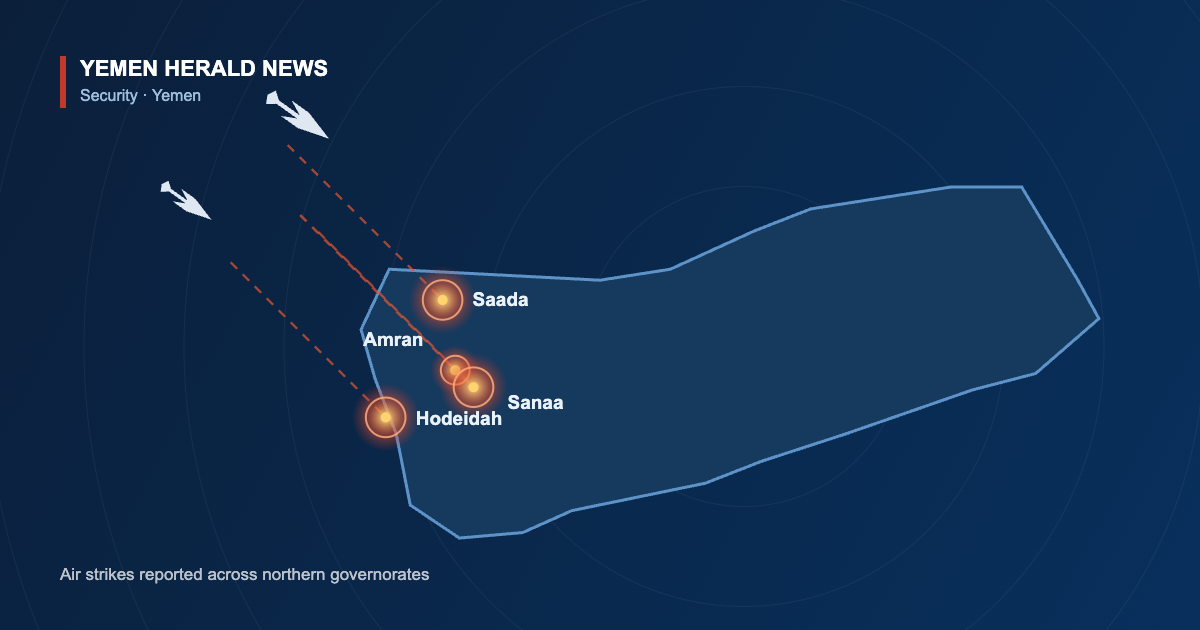
SANAA, Yemen — A Saudi-led coalition said it struck 60 Houthi military targets in four Yemeni governorates on Tuesday, and Houthi health authorities reported casualties in three of them.
Coalition spokesman Maj. Gen. Turki al-Malki announced the operation on Wednesday morning, Al Jazeera and The Associated Press reported.
Al-Malki called it a precision operation and said the strikes destroyed tunnels the Houthis used as workshops and storage for ballistic missiles, according to Al Jazeera.
He said the raids hit Sanaa, Hodeidah, Amran and Saada, the broadcaster reported.
The Associated Press carried a narrower version of the same briefing. It said al-Malki put the targets at dozens of ballistic missile warehouses and drone workshops, and named only the capital and three further provinces.
Neither agency said it had verified the coalition’s account.
The casualty figures came from the other side of the front line.
Anees al-Asbahi, a spokesman for the Houthi-run health ministry, said a strike hit a sponge factory in Hodeidah, killing at least 15 people and wounding 15, The Associated Press reported.
Al-Asbahi said at least two more people were killed and four wounded in Saada, and nine were wounded in Sanaa, according to the agency. The Houthis put the overall toll at 17 dead.
Those three governorates all appear on the list al-Malki gave. Amran, the fourth, drew no reported casualties.
The two sides do not agree on what was hit. The coalition described tunnels, missile stores and drone workshops. The Houthi health ministry described a factory.
Al Jazeera’s report carried no casualty figure. The Associated Press said it had not spoken to witnesses on the ground about the strikes.
The toll rests on Houthi authorities alone, and Yemen Herald found no independent account of it.
The Houthis said they fired back.
Yahya Saree, the group’s military spokesman, said it had targeted oil pumping stations near Riyadh and a radar installation in southern Saudi Arabia, Al Jazeera reported.
The coalition said it intercepted two Houthi cruise missiles aimed at Riyadh on Wednesday.
Saudi Arabia sounded alerts in Jizan, Najran and Khamis Mushait, three cities near the Yemeni border, The Associated Press reported. Officials later said the danger had passed.
Saudi authorities have not responded to Saree’s claims, according to Al Jazeera.
The air campaign ran alongside ground fighting in the south.
Al Jazeera correspondent Hadeel al-Yamani, reporting from Taiz, said government forces and the Houthis were fighting in and around the city.
Local authorities in Taiz said the Houthis were shelling residential areas and that villages on Jabal Sabr were under siege, Al Jazeera reported.
They said sniper fire was killing and wounding people daily, most of them women and children.
The same authorities said Houthi fighters had set up checkpoints to take money from civilians and were seizing medicines that lacked licences issued in Sanaa, according to Al Jazeera.
The Taiz Public Health and Population Office condemned the seizures in a statement published Monday, the broadcaster said.
Taiz officials asked the United Nations to step in, saying medical supplies were being blocked on the road from Aden.
Yemen’s army and allied forces pulled back from Dhubab airport and the area around the Bab al-Mandeb strait, in western Taiz governorate, to defend Aden, Al Jazeera reported.
Fighting resumed at Tur al-Bahah in Lahij province. Aden is the seat of Yemen’s internationally recognised government.
The strikes follow a change in the coalition’s command. Saudi Arabia replaced its commander of coalition forces in Yemen on Nov. 16, Al Jazeera reported at the time.
Yemen’s human rights ministry gave its own account of the past three and a half months on Wednesday. Minister Mishdal Omar told a news conference the ministry had recorded 3,334 violations against civilians and civilian property between Aug. 1 and Nov. 15, Asharq Al-Awsat reported.
Omar put the toll at 594 civilians killed and 1,255 wounded. He said 233 people had been abducted, arbitrarily detained or forcibly disappeared.
He said 93 educational facilities had been attacked and that the ministry had logged 517 violations in the health sector.
Omar cited International Organization for Migration figures putting displacement since August at more than 347,000 people, with 143,130 in Taiz, 91,314 in Lahij and 70,404 in Aden, according to the newspaper.
He said about 2.5 million people in Taiz were at risk under the siege, that 2,450 tons of food aid had been blocked and that 186 health facilities were out of service. The ministry reported about 1,400 cases of acute watery diarrhoea and suspected cholera there.
Yemen Herald could not confirm the ministry’s figures.
In Marib, Lt. Gen. Sultan al-Arada, the governor and a member of the Presidential Leadership Council, met senior military and security officials on Wednesday to review the fronts in Marib and al-Jawf, Asharq Al-Awsat reported.
Al-Arada called for intelligence-sharing, risk assessment and regular readiness reviews, the newspaper said.
The United Nations humanitarian response plan for Yemen, published in March, puts more than 22 million people in need of assistance and 18.3 million as acutely food insecure.
It counts 5.2 million people displaced inside the country and seeks 2.16 billion dollars to reach 12 million of them.
The Associated Press photographed displaced families carrying cooking gas cylinders into the al-Fardous camp at Ras Imran, outside Aden, on Tuesday.
About the Author