Houthi forces reach Khor Omeir as security sources say an assault on Aden is not imminent
 Adel Haddad
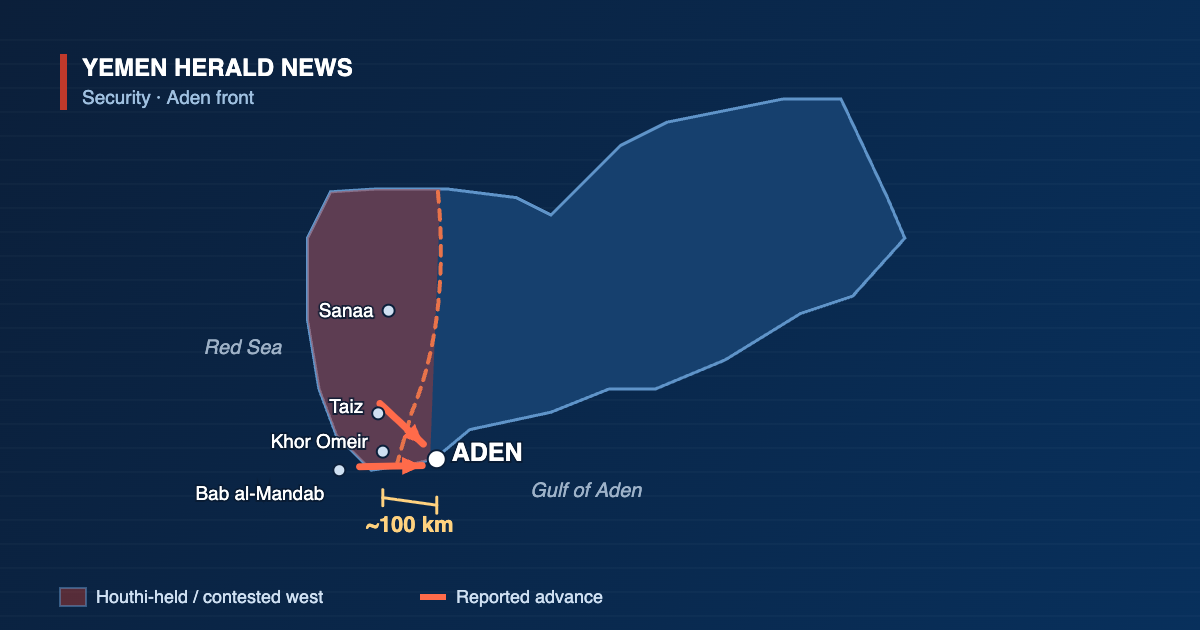
ADEN, Yemen — Houthi forces have advanced to the coastal area of Khor Omeir, about 100 kilometres west of Aden, The National reported Wednesday.
A Yemeni security official told the newspaper the group now sits roughly 100 kilometres west of the city. The official was not named.
Security sources and analysts cited by the paper said a ground assault on Aden may not be as close as the advance suggests.
Aden is the temporary capital of Yemen’s internationally recognised government, Al Jazeera said.
Ali Al Shaabani, a security and political expert quoted by The National, said the group lacked the strength to take the city outright.
“But right now they can’t take it back as they are,” he said.
Al Shaabani said a siege was the likelier course. He compared it to Taiz, where he said the Houthis have surrounded the city and government-allied forces since October.
Seizing Aden would threaten international shipping, he said. It would also give the group access to the Red Sea and the Horn of Africa, with the island of Socotra a further objective.
Al Shaabani listed other options open to the Houthis. They included fighting in Hadramout and Shabwa, or on the northern Saudi border.
He tied the choice to the wider regional conflict, saying it hinges on whether the war between the United States and Iran resumes in full.
The Houthis have said they are not interested in attacking Aden, according to The National.
A source in Sanaa told the newspaper the group was not seeking to control the Bab al-Mandab strait, which the source said already lies within range of its missiles.
The operation was aimed at securing the strait rather than closing it, the source said. The source referred to a September offensive that took the port of Mokha, and was not named.
Al Jazeera gave a different account of the withdrawal on the coast.
It reported that the Yemeni army and allied forces pulled out of Dhubab airport and territory around Bab al-Mandab, in western Taiz governorate, in order to defend Aden.
The two accounts differ on why government forces left the strait. Al Jazeera attributed the move to the defence of Aden. The Sanaa source described it as a Houthi decision about securing the waterway.
Yemen Herald could not establish which account is correct.
Al Jazeera correspondent Yousef Mawry reported that the Houthis cut a government supply route along the Red Sea coast, forcing troops to abandon several positions.
Fighting resumed between government forces and the Houthis at Tur al-Bahah, in Lahj province, Al Jazeera said.
In Taiz, Al Jazeera correspondent Hadeel al-Yamani reported fierce battles between the two sides.
Local authorities accuse the Houthis of shelling civilians and residential neighbourhoods, al-Yamani said.
She reported that villages in Jabal Sabr were under complete siege, with snipers firing on civilians daily.
The Taiz Public Health and Population Office said in a statement Monday that Houthi checkpoints were levying charges on civilians and confiscating medicine and medical supplies that lacked licences issued in Sanaa.
The office called the practice “a direct assault on pharmaceutical security,” according to Al Jazeera. Officials asked the United Nations to intervene.
The National described residents of Taiz as cut off from food, fuel, water and medical supplies.
Government forces launched the offensive they call Dawn of Yemen on Oct. 5, Al Jazeera reported, with the stated aim of regaining territory held by the Houthis, including Sanaa.
Army spokesman Colonel Majed al-Nuzaili said Monday that government forces had carried out 661 attacks on Houthi positions across several fronts, according to Al Jazeera.
He gave the breakdown as 15 air strikes, 526 artillery attacks, 53 drone strikes and 67 rocket attacks, the broadcaster said.
Al-Nuzaili said in a statement on X that the attacks destroyed or damaged 71 military vehicles and pieces of equipment, along with command-and-control centres, observation posts and fortifications.
Those figures are the army’s own. Yemen Herald found no independent confirmation of them.
The spokesman said operations were under way in Taiz, Marib and al-Jawf, as well as on southern fronts, and would continue until the army’s objectives were met. He said forces were taking precautions to protect civilians.
The Saudi-led coalition said it intercepted two cruise missiles fired toward Riyadh on Wednesday, Al Jazeera reported.
Houthi military spokesman Yahya Saree said the group had targeted oil pumping stations near the Saudi capital and a radar installation in the south of the country.
Saudi authorities had not responded to those claims, Al Jazeera said.
Air-raid alerts sounded in Jizan, Najran and Khamis Mushait on Wednesday before the danger passed, the broadcaster reported.
The Institute for the Study of War said in an analysis published Tuesday that government-aligned forces are a fragmented coalition of rival factions, and that the fragmentation has contributed to defeats since September, The National reported.
Saudi Arabia replaced the commander of coalition forces in Yemen on Monday, naming Fayyad Al Ruwaili in place of Fahd Al Salman, according to The National.
Yemen’s parliament passed legislation on Wednesday classifying the Houthis as a terrorist group, the newspaper said. One of the law’s 55 articles states that no member of the group would receive immunity in a future settlement.
Anti-Houthi forces have pulled back from further positions around Taiz, where fighting has run for several weeks, The National said.
The Houthis are also known as Ansar Allah.
About the Author