KSrelief Delivers Tents and Shelter Kits to Displaced Families in Marib
 Yemen Herald News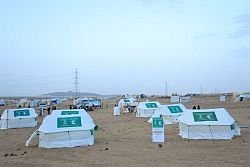
The King Salman Humanitarian Aid and Relief Centre distributed tents and shelter kits to displaced families in Yemen’s Marib governorate in April 2026, in a round of assistance the Saudi agency described as part of the fifth phase of its emergency shelter plan for the country. The distributions included supplies for households at Al-Jufaina camp, one of the larger displacement sites near Marib city, and a separate allocation of two hundred tents and three hundred shelter kits for families whose shelters had been damaged by flooding and high winds. The kits contained basic living items intended to allow a household to re-establish itself after losing its shelter.
The scale of individual distributions is modest relative to need, and the agency’s own reporting reflects that. One April round covered nine tents and nine shelter kits for thirty-two people, while a further distribution recorded in May 2026 reached eight individuals. Shelter programming in Yemen typically works this way, with repeated small allocations directed at newly damaged or newly arrived households rather than a single large hand-out, because the caseload turns over continuously as weather events and localised displacement create fresh demand. KSrelief has run comparable rounds elsewhere in the country during the same period, including distributions in Hadhramaut and Saada, and has previously delivered winter kits in Marib under the same emergency shelter framework.
Marib is where most of that demand sits. The governorate lies east of Sanaa and stayed under the control of the internationally recognised government after Houthi forces took the capital in 2014. Its comparative stability during the first years of the war, together with an economy supported by oil and gas infrastructure, drew large numbers of people fleeing Houthi-held areas from 2015 onwards. Humanitarian assessments have since identified Marib as hosting the single largest concentration of displaced people in Yemen, with more than sixty per cent of the country’s displaced population recorded there.
Weather is a recurring driver of shelter need rather than an occasional shock. Displacement sites around Marib are largely informal settlements of tents and improvised structures built on open ground, without the drainage, foundations or windbreaks that planned camps provide. Seasonal rains arriving with strong winds regularly flatten or soak shelters, and the same events destroy stored food, bedding and documents. Because most tents in these sites have been in continuous use well beyond the lifespan the material is designed for, they fail more readily each year, which is why agencies treat shelter replacement as a standing requirement rather than an emergency response.
The national context is one of sustained large-scale need. Humanitarian planning figures for 2026 counted roughly 5.2 million internally displaced people across Yemen, along with some 329,000 migrants and about 63,000 refugees and asylum seekers. The United Nations Office for the Coordination of Humanitarian Affairs, which issued its Humanitarian Needs and Response Plan for the year in March 2026, assessed that 18.3 million people were acutely food insecure. Around sixty-three per cent of the population was found to lack a safe and sustainable source of drinking water, and a similar share of health facilities lacked basic equipment or maintenance.
Those indicators interact. A household that loses its shelter in a storm is more exposed to waterborne illness, has fewer means of storing food safely and is less able to keep young children warm at night, and each of those factors raises the likelihood that moderate malnutrition becomes severe. Aid organisations therefore describe shelter as a health and nutrition intervention as much as a physical one, particularly for children under five and for pregnant and breastfeeding women, who are the groups most consistently identified as at risk in Yemeni displacement sites.
Funding has tightened at the same time as need has persisted. United Nations reporting in June 2026 described a deepening hunger crisis in Yemen driven in part by funding shortfalls, with agencies reducing rations, narrowing eligibility criteria or suspending programmes in some districts. Displaced households are usually affected first when general distributions are cut, because they have no land, limited savings and irregular access to paid work. Bilateral contributions such as those channelled through KSrelief cover a portion of the gap, though they are directed at specific projects rather than at the pooled appeal.
The economic environment in government-held areas compounds the problem independently of aid volumes. The Yemeni riyal has depreciated substantially outside Houthi-controlled territory, public sector salaries have been paid irregularly, and government revenue contracted sharply after oil exports were suspended following attacks on export terminals in late 2022. The practical consequence is that materials such as timber, plastic sheeting and rope can be available in local markets while remaining unaffordable to the families who need them, which shifts the burden of shelter repair onto aid agencies.
Aid workers have argued for several years that the response requires predictable multi-year funding rather than annually renewed emergency appeals, given that a substantial share of the displaced population in Marib has now been away from home for close to a decade. Until a political settlement makes returns possible, the shelter caseload in the governorate is unlikely to fall, and distributions of the kind carried out in April 2026 will continue to address damage as it occurs rather than resolve the displacement that produced it. The gap between what is delivered in any single round and what site assessments record as outstanding remains the clearest measure of that shortfall.
About the Author