Marib Deputy Governor and New ICRC Office Head Discuss Humanitarian Coordination
 Yemen Herald News
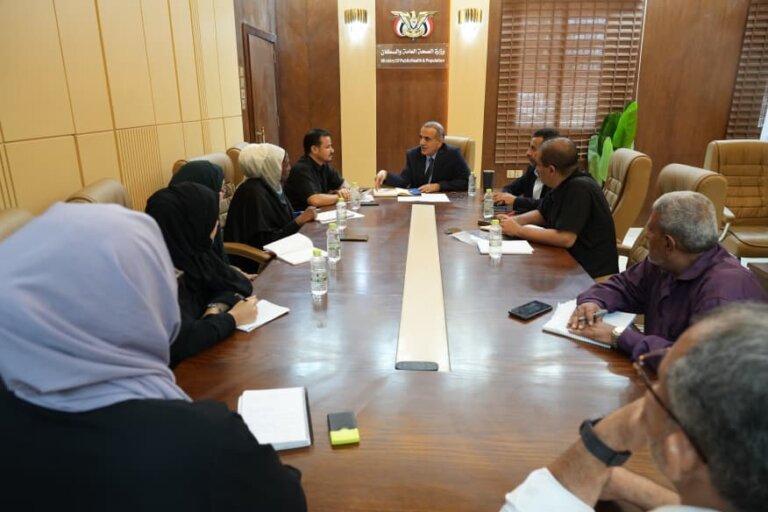
The deputy governor of Marib, Dr. Abd-Rabu Miftah, met the newly appointed head of the International Committee of the Red Cross office in the governorate, Ignacio Javier Martin, in late April 2026 for talks on strengthening the humanitarian partnership between the local authority and the organisation. The official Yemeni news agency Saba, reporting the meeting on 28 April 2026, said the two discussed coordination on the ICRC’s intervention projects in food, health, water and livelihood support.
The meeting also reviewed the general humanitarian situation in Marib. Local officials told the agency that the governorate has absorbed more than 62 per cent of Yemen’s displaced population, living in what they described as extremely difficult humanitarian and living conditions. That proportion is the local authority’s own assessment; independent monitoring bodies use different baselines, but they agree that Marib hosts the single largest concentration of internally displaced people in the country.
Estimates compiled by humanitarian agencies indicate that Marib has received more than a million displaced people since the conflict began in 2014, with the resident IDP population assessed at around 900,000 in early 2023. Displacement into the governorate has continued at a lower but steady rate. Monitoring by the International Organization for Migration recorded close to 9,000 people newly displaced across Yemen in the first half of 2026, with Marib accounting for the majority of those movements.
Only a small share of Marib’s displaced population lives in formally managed camps. Assessments have found roughly 21,000 people in three sites run under the camp coordination and camp management framework, and a further 32,000 or so spread across eighteen sites outside it, including community centres, schools and a stadium. The overwhelming majority live in informal settlements or in rented accommodation within Marib city, where the influx has driven up rents and placed heavy pressure on water, electricity and waste services.
That pattern has reshaped the city. Marib was a modest provincial centre before the war and has since expanded into one of the largest urban areas under government control, with an economy sustained partly by oil and gas infrastructure in the surrounding desert. Local authorities, headed by Governor Sultan Ali al-Aradah, have repeatedly argued that the governorate carries a national burden without a corresponding share of national or international resources.
Marib’s position in the war has also shaped its humanitarian profile. The governorate was the focus of sustained Houthi offensives between 2020 and 2022, when fighting along its western and southern approaches displaced tens of thousands of people from surrounding districts and from camps that themselves came under fire. Front lines have been comparatively quiet since the United Nations-brokered truce of April 2022 lapsed without formal renewal, but no agreement has replaced it.
The ICRC has maintained a presence in Marib through much of the conflict. Its work in Yemen spans support to hospitals and primary health facilities, rehabilitation of water systems, distribution of food and household essentials, and programmes intended to restore livelihoods rather than deliver relief indefinitely. The organisation also carries out protection work under international humanitarian law, including detainee visits and family reunification.
Water is a particular constraint. Marib sits in an arid zone dependent on groundwater, and the sudden multiplication of its population has accelerated the depletion of aquifers that were already under strain before the war. Agencies working in the governorate have prioritised borehole rehabilitation, network repairs and trucking to sites without piped supply, but these are stopgaps rather than solutions, and local officials have pressed for investment in longer-term water infrastructure.
Changes of office head are routine, but they matter operationally in a context where access depends heavily on relationships with local authorities. Aid organisations working in Yemen negotiate movement, project approvals and beneficiary selection with governorate-level officials on both sides of the front lines, and continuity in those relationships affects how quickly programmes can be launched or adjusted.
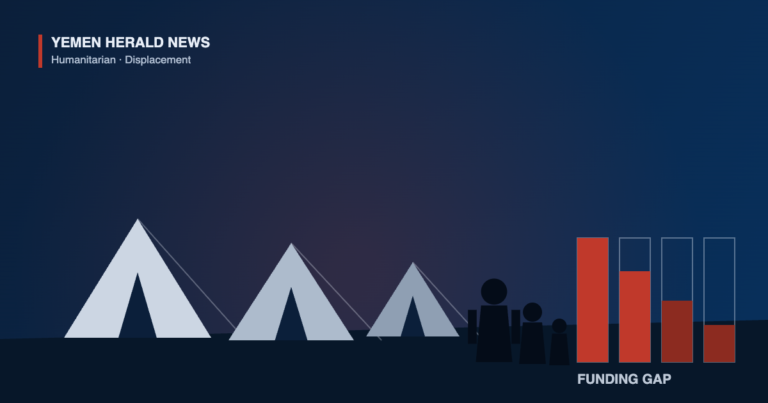
The talks took place against a backdrop of contracting humanitarian funding. The United Nations appeal for Yemen has been substantially underfunded for several consecutive years, and agencies have responded by narrowing their target caseloads and suspending programmes judged less immediately life-saving. In its 2026 response plan the United Nations Office for the Coordination of Humanitarian Affairs estimated that more than 22 million people in Yemen would need assistance during the year, while setting a target of reaching 12 million and seeking 2.16 billion US dollars to do so.
Food insecurity remains the dominant concern nationally, with 18.3 million people assessed as acutely food insecure and more than 2.2 million children under five acutely malnourished. Displaced households are consistently among the worst affected, since displacement severs access to land, employment and family support networks at once.
Saba’s report did not indicate that the meeting produced new commitments or funding, and neither the local authority nor the ICRC published figures for planned activity in the governorate following the talks. Meetings of this kind are a standard part of how humanitarian operations are coordinated at governorate level.
What they do signal is where local priorities sit. In Marib’s case, officials have consistently pressed for a shift away from short-cycle emergency distributions towards water infrastructure, health facilities and livelihood support that would reduce dependence on aid over time. Whether that shift is possible depends less on local negotiation than on funding, which has moved the other way.
About the Author