Yemen’s Trade Minister and German Ambassador Discuss Economic Cooperation
 Yemen Herald News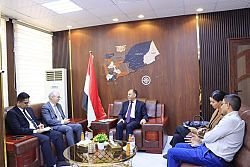
Yemen’s Trade Minister and Germany’s ambassador have discussed economic cooperation and recovery, in talks framed as an opportunity to strengthen the ties between the two countries at a difficult moment for the Yemeni economy. Dr. Mohammed al-Ashwal, the Minister of Industry and Trade, met the German Ambassador, Thomas Friedrich Schneider, to explore avenues for cooperation that could support Yemen’s efforts at economic revitalisation.
Yemen has been embroiled in conflict since 2015, in a war that has produced one of the world’s worst humanitarian crises. The conflict has devastated the economy, leaving infrastructure in ruins and a large share of the population reliant on humanitarian assistance, and creating an environment in which economic revitalisation is both urgently needed and difficult to achieve.
In this context, the government has sought to pivot toward efforts at economic development, and cooperation with partners possessing relevant expertise is regarded as valuable. Germany, with its substantial industrial and economic capacity, represents a potential partner in supporting Yemen’s economic recovery and in fostering more stable economic relations.
Germany has historically been a significant actor in international development, and its involvement in Yemen could contribute to efforts to strengthen the country’s economy. Its expertise in industry and its experience in development cooperation offer potential avenues for supporting Yemen’s economic ambitions, complementing the assistance provided by other partners.
The focus on trade and economic cooperation reflects the importance of these areas to Yemen’s recovery. Reviving trade, supporting industry and fostering economic activity are central to rebuilding the economy, and cooperation with partners such as Germany can help mobilise the resources, expertise and relationships that support these efforts.
The devastation of Yemen’s economy during the conflict has been profound. The disruption of production, the collapse of the currency and the loss of livelihoods have left the economy severely weakened, and reviving it is essential both to relieving hardship and to building the foundations for stability and recovery.
The Ministry of Industry and Trade plays a central role in efforts to revitalise the economy, overseeing matters related to industry, trade and commerce. Its engagement with partners such as Germany reflects the collaborative effort required to support economic recovery, drawing on both national leadership and international expertise and resources.
The pursuit of sustainable economic development, referenced in the discussions, reflects an aspiration to build an economy capable of enduring and providing for the population over the long term. Achieving this requires attention to the foundations of the economy and to the development of sectors capable of generating growth and employment.
Germany’s industrial expertise offers particular relevance to efforts to develop Yemen’s industry and economy. Cooperation drawing on this expertise could support the modernisation and development of industrial activity, contributing to the diversification of the economy and to the creation of employment, though realising such cooperation faces significant challenges in the current environment.
The engagement between Yemen and Germany forms part of the broader web of relationships on which Yemen’s recovery depends. With domestic resources severely constrained, the government relies on the support and cooperation of international partners to advance economic development, making the cultivation of these relationships a priority.
The reliance of much of the population on humanitarian assistance underscores the stakes of economic recovery. Reviving the economy and creating opportunities for livelihoods are essential to reducing dependence on aid and to improving the conditions of life, making the pursuit of economic development central to the broader effort to address the crisis.
The prospects for cooperation between Yemen and Germany will depend on a range of factors, including the security situation, the practical feasibility of economic activity and the priorities of both governments. Translating intentions into concrete cooperation requires favourable conditions and sustained effort, and progress may be gradual given the challenges Yemen faces.
The framing of the cooperation as a potential lifeline for the economy reflects the importance attached to it by its proponents. While the challenges are considerable, cooperation with partners such as Germany is seen as offering avenues for supporting recovery, mobilising resources and expertise in the service of the country’s economic ambitions.
Germany’s involvement in Yemen could also signal a measure of confidence in the country’s prospects, contributing to efforts to attract engagement and investment. The participation of a significant economic actor in supporting Yemen’s development may encourage broader involvement, though much will depend on the evolution of the situation.
The pursuit of economic revitalisation is bound up with the broader effort to achieve stability and recovery in Yemen. A functioning and growing economy is central to the wellbeing of the population and to the prospects for stability, making cooperation in support of economic development an important element of the country’s recovery.
Germany’s engagement with Yemen has spanned humanitarian relief, development support and, at times, backing for the wider political process, and the trade discussion fits within that broader pattern of involvement. For Yemeni officials, cultivating an economic relationship with one of Europe’s largest industrial economies is as much about the long term as the present: even where immediate projects are constrained by the realities of the conflict, keeping such partners engaged helps ensure that expertise and investment might be drawn upon more fully once conditions permit a genuine shift from emergency relief toward reconstruction and growth.
For now, the meeting between al-Ashwal and Schneider reaffirmed the interest of Yemen and Germany in strengthening economic cooperation and in supporting the country’s recovery. As Yemen works to revive its economy amid the challenges of the conflict, engagement with partners such as Germany represents one avenue through which resources and expertise might be mobilised for its development.
About the Author