Yemen’s Ambassador and Morocco’s Constitutional Court Chief Discuss Justice Cooperation
 Yemen Herald News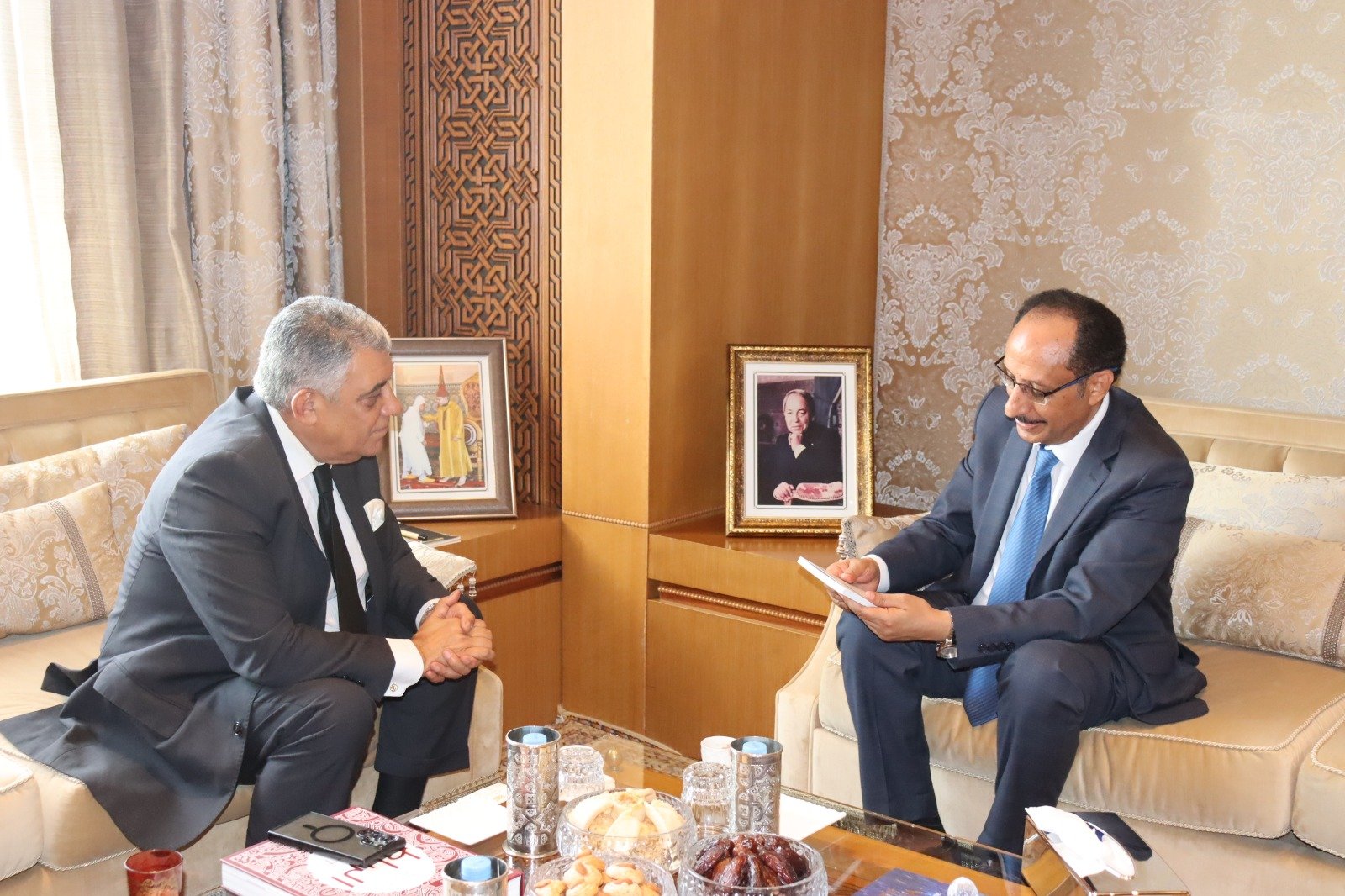
Yemen’s Ambassador to Morocco, Ezzedine al-Asbahi, has held talks in Rabat with Dr. Mohamed Amin Benabdallah, the President of Morocco’s Constitutional Court, focusing on ways to strengthen cooperation and exchange expertise in the field of constitutional justice. The meeting reflected Yemen’s continuing effort to deepen its ties with Morocco, which the internationally recognised government in Aden regards as a valuable partner in the area of legal and constitutional development.
During the discussion, al-Asbahi praised Morocco’s progress in building and strengthening its constitutional judiciary in recent years, and underlined Yemen’s interest in drawing on that experience to support its own institutions. He framed the exchange as part of a wider ambition to improve governance and legal frameworks in Yemen, structures that have been severely strained by years of conflict and political division. Learning from established institutions abroad, he suggested, could help Yemen rebuild capacity that has been eroded during the war.
Morocco’s Constitutional Court occupies a central place in the kingdom’s legal system, ruling on the constitutionality of laws and overseeing aspects of the electoral process. Benabdallah, a respected jurist and academic who was appointed to lead the court, represents an institution that emerged from the constitutional reforms Morocco adopted earlier in the past decade. For a Yemeni diplomat seeking models of constitutional adjudication in the Arab world, the Moroccan court offers a relatively settled example of how such a body can function within a national system. Morocco overhauled its constitutional arrangements in 2011, and the court that grew out of those reforms has since become an established part of the country’s institutional landscape.
The relationship between Yemen and Morocco has long rested on shared cultural, linguistic, and political bonds, and the two countries have maintained diplomatic ties through periods of regional turbulence. Al-Asbahi, who presented his credentials to King Mohammed VI as Yemen’s plenipotentiary ambassador, has used his posting to pursue cooperation across a range of sectors, from trade and agriculture to education and now the judiciary. The latest meeting fits within that broader pattern of engagement aimed at widening the practical content of the bilateral relationship. In the course of his posting, he has held talks with Moroccan ministers and officials, visited academic and research institutions in the kingdom, and worked on areas ranging from social solidarity to Yemen’s participation in regional bodies, building a network of contacts that the embassy can draw on across different fields.
Both sides acknowledged the shared challenges involved in advancing constitutional justice, albeit from very different starting points. While Morocco has pursued a gradual process of constitutional and institutional reform, Yemen continues to grapple with the consequences of a prolonged conflict that has fractured its state institutions and complicated any effort at legal continuity. Against that backdrop, Morocco’s experience in developing its constitutional framework was presented as particularly relevant to Yemeni officials thinking about eventual reconstruction.
The humanitarian dimension of Yemen’s crisis was not far from the conversation. Years of war have displaced millions of people and left a large share of the population dependent on aid, while the machinery of government has been weakened across much of the country. By cultivating partnerships with states such as Morocco, Yemeni representatives say they hope to strengthen institutional capacity and to lay groundwork for restoring functioning governance structures once conditions allow. Cooperation on constitutional matters, in this view, forms one strand of a longer-term recovery effort.
Supporters of such exchanges argue that strengthening judicial and constitutional institutions is essential not only for domestic governance but also for wider regional stability. A credible constitutional order, with mechanisms for resolving disputes and protecting rights, is often seen as a foundation for durable peace. For Yemen, where competing authorities and armed factions have undermined central institutions, the idea of rebuilding an independent and respected constitutional judiciary carries particular weight, even if its realisation remains a distant goal.
The meeting also pointed toward what both sides described as an emerging pattern of cooperation on constitutional questions across the Arab world. Sharing methods and experiences among judicial bodies, officials suggested, could help reinforce judicial independence and constitutional integrity in a region where many states are navigating complex political transitions. Morocco’s willingness to share its insights was presented as a constructive contribution to that wider conversation, rather than a one-off diplomatic courtesy.
Practical follow-up, however, will determine how much the talks ultimately achieve. Diplomatic meetings of this kind frequently generate expressions of goodwill that take time to translate into concrete programmes, and any cooperation between the two countries’ judicial bodies would need sustained commitment to move beyond the exploratory stage. For now, the encounter served chiefly to signal intent and to open a channel through which more detailed collaboration might later develop.
Looking ahead, the discussions between Yemeni and Moroccan officials could pave the way for further engagement on legal and constitutional matters, potentially including training, the sharing of documentation, or exchanges between specialists. For Yemen, still consumed by the demands of its conflict and humanitarian emergency, such cooperation represents a modest but meaningful step toward strengthening the institutions on which any future stability will depend, and a reminder that diplomacy continues even amid the country’s deepest difficulties.
About the Author