
Marib Governor al-Arada Honours EU and Dutch Ambassadors at End of Visit
 Yemen Herald News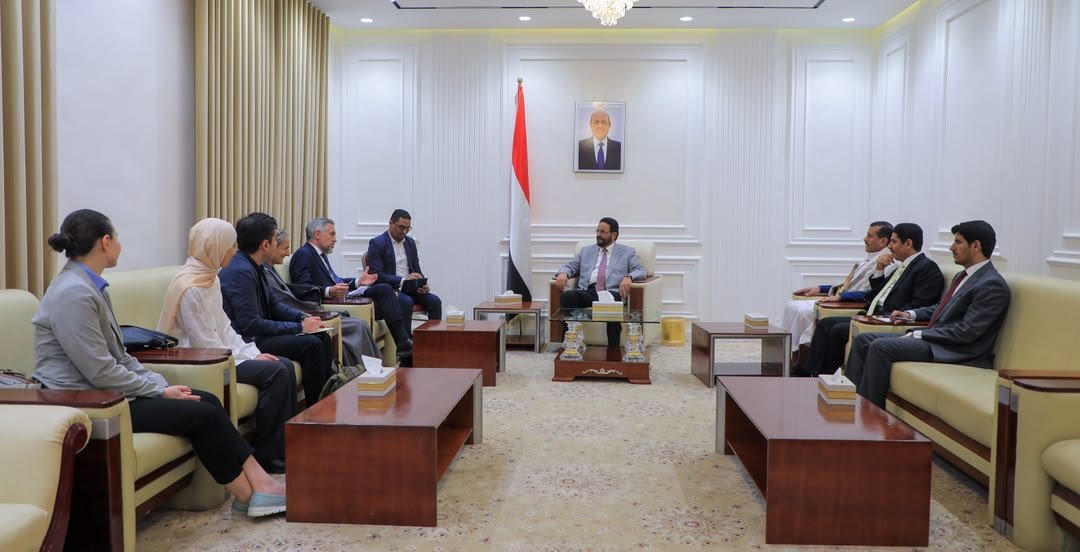
In a gesture underscoring Marib’s ties with international partners, the Governor of Marib and member of the Presidential Leadership Council, Sultan al-Arada, has honoured the European Union’s Ambassador to Yemen, Patrick Simonnet, and the Dutch Ambassador, Jeannette Seppen, with commemorative shields at the conclusion of their joint visit to the governorate. The presentation recognised the two envoys’ efforts to strengthen Yemen’s partnership with international actors at a time when the country continues to struggle with the consequences of a conflict that escalated in 2015.
Al-Arada expressed his appreciation for the ambassadors’ engagement with Yemen and stressed the value of direct, face-to-face contact with global partners. Such visits, he said, allow outside actors to gain a clearer and more nuanced understanding of the pressing needs of Marib, a governorate that has stood at the centre of the fighting and borne a heavy share of its humanitarian burden. He voiced hope that similar field visits would continue, describing them as a way to convey an accurate picture of local conditions.
The governor framed the visit as an opportunity to deepen cooperation, suggesting that closer engagement could open the door to greater development assistance and broader collaboration benefiting both Marib and Yemen as a whole. By bringing senior European diplomats to see conditions on the ground, officials hope to keep international attention focused on a region whose stability they regard as critical to the wider country.
The engagement came against a difficult backdrop. Yemen continues to face deep socio-economic problems compounded by the prolonged conflict, and the humanitarian picture remains stark. According to United Nations estimates for 2025, around 19.5 million people across the country require some form of humanitarian assistance, while roughly 4.8 million remain displaced from their homes. Against those figures, visits by international diplomats are seen as important for mobilising resources and sustaining the attention needed to ease the population’s suffering.
Marib has occupied a particularly important place in the war. For long stretches it served as a frontline governorate and a focal point of fighting, as government forces and their allies sought to hold the area against repeated offensives. Its strategic significance, including its energy resources and its position in central Yemen, has made control of the region a major prize, and the intensity of the conflict there has at times displaced large numbers of civilians.
That history helps explain why the governorate has become home to one of the largest concentrations of internally displaced people in the country. Families uprooted from other parts of Yemen have sought refuge in and around Marib city, placing heavy demands on local services and infrastructure. The pressure on housing, water, health care and schooling has been immense, and aid agencies have repeatedly highlighted the scale of need among displaced communities there, warning that funding shortfalls risk leaving many families without adequate shelter, food or medical care.
For the European Union and the Netherlands, engagement with Marib forms part of a wider pattern of support for Yemen’s internationally recognised institutions and for humanitarian and development efforts in government-held areas. Ambassador Simonnet, who took up his post as the bloc’s envoy to Yemen in 2025, has made repeated visits to such areas, after earlier diplomatic assignments in the Gulf, while the Netherlands has been among the European states active in supporting relief and development work in the country. European support in Marib has extended into practical development projects, including cooperation aimed at strengthening water security through renewable energy, illustrating the breadth of assistance directed at government-held areas. The visit to Marib fits within that broader diplomatic effort.
The honouring of the two ambassadors also carried a symbolic dimension. By presenting commemorative shields, al-Arada signalled both gratitude and a desire to cement relationships that local authorities see as vital to Marib’s recovery. For a governorate that has often felt the brunt of the war, visible recognition from European partners serves to reaffirm that its situation has not been forgotten on the international stage.
Officials on both sides framed the visit as more than a ceremonial occasion, presenting it as a step toward translating goodwill into practical cooperation. Whether that ambition is realised will depend on continued engagement and on the availability of funding for development and humanitarian programmes, which remain under strain amid competing global demands. Still, the encounter reflected an effort to keep channels open between Yemeni authorities and key European states.
Looking ahead, al-Arada’s call for further field visits suggests that local authorities hope to build on the trip’s momentum. For Marib, the goal is to convert diplomatic attention into tangible support that can help address the needs of its residents and the many displaced families it hosts. As Yemen navigates the uncertainties of its prolonged crisis, such engagements serve as a reminder that diplomacy and development efforts continue alongside the search for a lasting political settlement. For local officials, each such visit is also a chance to argue that investment in Marib’s stability pays wider dividends, helping to anchor a fragile equilibrium in a part of the country that has repeatedly proven decisive to the course of the war. Sustaining that message, they believe, is essential to ensuring the governorate remains a priority for international partners.
About the Author




