Marib Governor al-Arada Pledges Support to Implement Yemen’s Largest Wartime Detainee Swap
 Yemen Herald News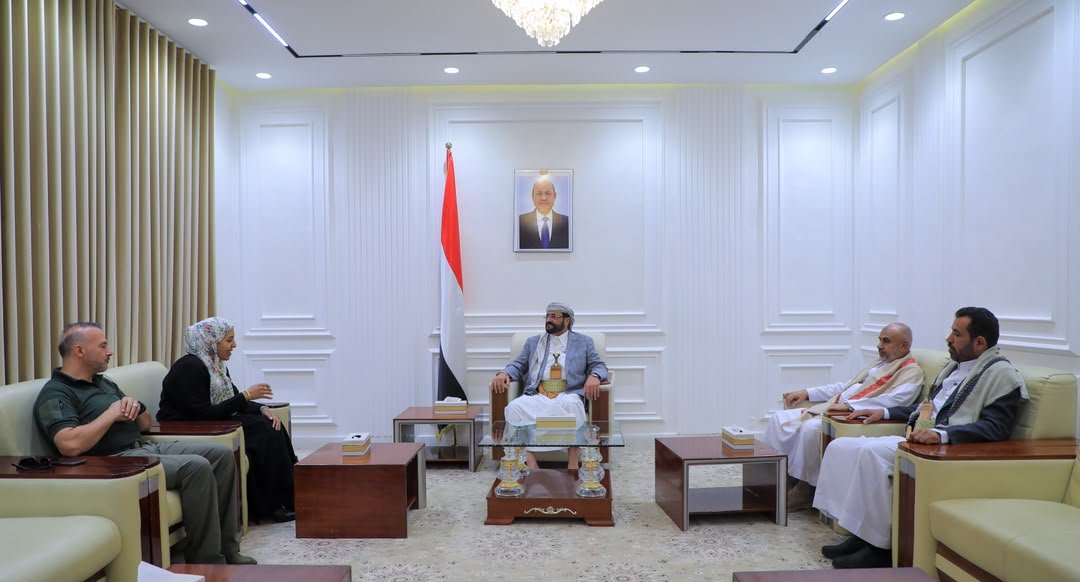
Sultan al-Arada, a member of Yemen’s Presidential Leadership Council and the Governor of Marib, has welcomed a delegation from the Office of the UN Special Envoy for Yemen for talks focused on carrying out a landmark plan to release and exchange detainees. Described as the first visit of its kind to Marib Governorate, the meeting reflected the expanding role the United Nations is playing in managing one of the most sensitive strands of Yemen’s fragile peace process.
The UN team was led by Radwa Mohammed Nour al-Din of the Special Envoy’s office. During the discussions, al-Arada stressed the value of close cooperation and a shared determination to see the mission’s field programme through to completion. He assured the visitors that Marib would provide the security and logistical backing needed for operations to proceed smoothly and safely, a significant commitment in a province that has spent years on the front lines of the war.
The visit formed part of the groundwork for a major prisoner and detainee exchange between Yemen’s internationally recognised government and the Houthi movement. UN Special Envoy Hans Grundberg announced the agreement after roughly fourteen weeks of negotiations hosted in the Jordanian capital, Amman, where it was signed on 14 May 2026 in the presence of United Nations and Red Cross officials. It stands as the largest release deal reached since the conflict began more than a decade ago, and it is to be implemented in stages under close international supervision.
According to details released around the signing, the operation is expected to cover in the region of 1,700 detainees held by the two sides, with the Yemeni government citing a figure of 1,728. The arrangement pairs around 1,100 prisoners linked to the Houthis with roughly 580 held by the government, among them seven Saudi and twenty Sudanese nationals. The exchange is structured as a sequence of consecutive phases, with early steps tied to clarifying the fate of specific high-profile detainees, a mechanism designed to build confidence as the process advances.
The detainee question carries weight far beyond those directly involved. For thousands of families separated by years of fighting, the return of relatives held by the opposing side offers a rare source of hope, and both mediators and local leaders have presented prisoner exchanges as a humane measure capable of easing suffering and nurturing trust between rival camps. Al-Arada acknowledged that the effort resonated deeply within Yemen’s wider humanitarian emergency, where the needs of ordinary people are too often overshadowed by military and political calculation.
That emergency remains severe. Yemen’s civil war, which escalated in 2015 amid a power struggle between the Iran-aligned Houthi movement and the internationally recognised government, has killed and displaced vast numbers of people and left much of the population reliant on humanitarian aid. Against that backdrop, a successful exchange would count among the more meaningful breakthroughs of the conflict if completed as planned, delivering relief to families who have waited years for word of missing relatives.
The International Committee of the Red Cross has been closely engaged in the arrangements alongside the United Nations. Al-Arada separately received an ICRC delegation to discuss the practical mechanics of the exchange, reflecting the organisation’s long-standing role in transferring and receiving prisoners in conflicts worldwide. The ICRC co-chairs the supervisory committee overseeing the deal and is expected to act as the principal intermediary, verifying lists, arranging transport and ensuring that those freed are handed over in safety.
Combining UN political oversight with ICRC operational support is intended to give the process both legitimacy and practical workability. Earlier exchanges during the war have shown how fraught such operations can be, with agreements frequently delayed by disputes over names, numbers and sequencing. Mediators are keen to avoid the setbacks that stalled previous efforts, and the phased design of the current deal is partly an attempt to keep momentum through each step.
Yemen’s political leadership, headed by Presidential Leadership Council chairman Rashad al-Alimi, has repeatedly voiced willingness to engage with international initiatives aimed at relieving civilian suffering, and al-Arada’s reception of the UN team fit that stated posture. For Marib itself the initiative carries local significance: the governorate has absorbed large numbers of displaced people and served as a focal point of the fighting, giving its authorities a direct stake in any measure that could reduce tensions and improve conditions for affected communities.
Central to the opening phase is the case of Muhammad Qahtan, a prominent political figure held since the early stages of the war whose fate has come to symbolise the human cost of the detainee file. Clarifying what became of him has been set as an early benchmark on which later stages are expected to build. The Amman agreement builds on an earlier round of talks held in Muscat in December 2025, and regional governments, including Saudi Arabia, have welcomed it as a step toward de-escalation.
With implementation anticipated around the middle of 2026, aid agencies and diplomats hope a smooth handover could open space for broader discussions on a lasting ceasefire, at a moment when regional tensions have repeatedly threatened to derail Yemen’s halting peace process. The plan’s success is likely to hinge on sustained cooperation between the authorities and international mediators, and on the willingness of both sides to honour their commitments at every stage. A completed exchange would not end the war, but it would reunite families and show that negotiated progress remains possible.
About the Author