Yafi Rally Backs Hadramout Protesters as Southern Yemen Crackdown Widens
 Yemen Herald News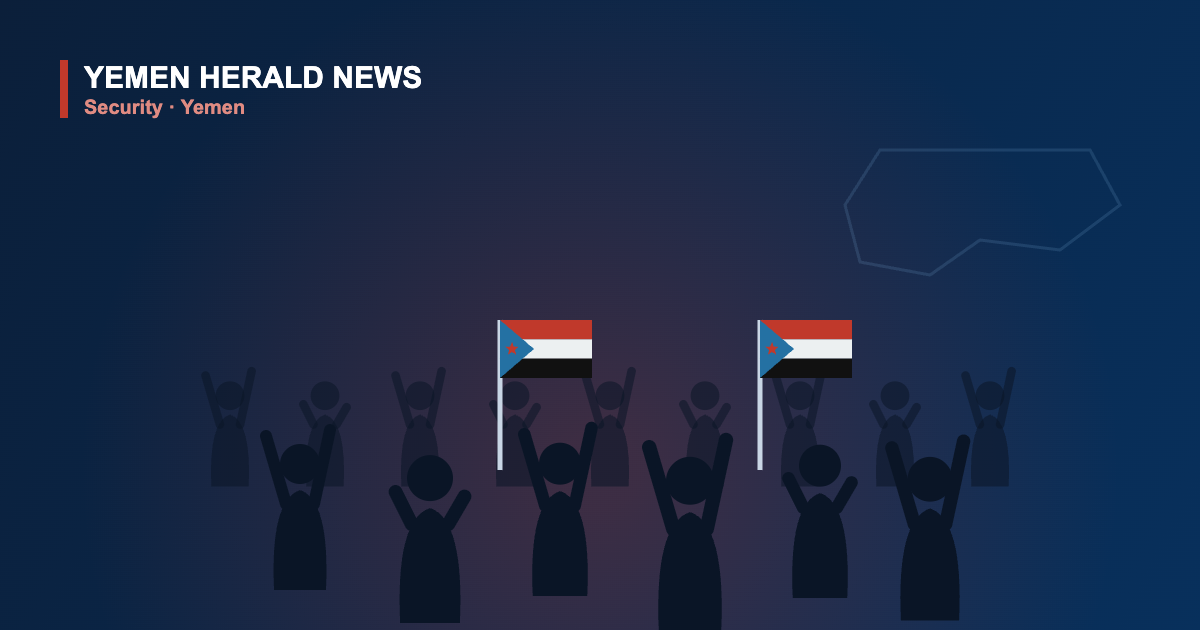
On a recent Wednesday, the district of Sar’ar in the Yafi area of Abyan governorate became the scene of a large demonstration in solidarity with the people of Hadramout, where security forces have intensified a campaign against peaceful protesters and political activists. The march reflected mounting anger across southern Yemen over reported violations targeting supporters of the Southern Transitional Council (STC) and the Southern Resistance, and it underscored how deeply the country’s long war has fractured local communities.
The procession moved through the busy central market of Yafi and drew a broad cross-section of the community. STC leaders and members marched alongside local sheikhs, prominent social figures, teachers and security personnel, while young people, university students, journalists and civil-society representatives filled out the crowd. Organizers presented the turnout as proof of a united southern front, and the scale of participation pointed to the strength of grassroots mobilization now visible across the south.
Demonstrators raised the flag of the former South and voiced their grievances in chants that condemned what they described as repression and the use of force to impose authority. Their slogans reinforced a distinct southern identity and rejected any settlement dictated from outside the region. For many in the crowd, the gathering was a reminder of long-standing aspirations for self-determination that predate the current conflict but have hardened during more than a decade of war.
At the central square, a series of speakers addressed the crowd with messages of unity and solidarity, calling for support for the people of Hadramout and for a political response to the region’s deepening hardship. Their appeals tied the local protest to a wider southern demand for greater political recognition, and to frustration that successive rounds of fighting have left civilians to bear the heaviest costs.
The Yafi march followed a deadly episode in Hadramout that has drawn national and international attention. In early April 2026, security forces opened fire on a peaceful STC demonstration in the port city of Mukalla, killing several protesters and wounding others. Rights groups reported a sweeping wave of arrests in the days that followed, with more than one hundred people detained, including a number of minors, and warrants issued for senior STC figures in the governorate on accusations of inciting the protests. The events in Mukalla turned a local grievance into a rallying point far beyond Hadramout.
The demonstration unfolds against the backdrop of a war that has gripped Yemen since the Houthi movement seized the capital, Sanaa, in 2014 and a Saudi-led coalition intervened the following year. The conflict has splintered the country into competing centers of power, pitting the internationally recognized government and its Presidential Leadership Council against the Houthis in the north and, at times, against the STC in the south. Shifting alliances among these forces have repeatedly redrawn the map of control and left southern cities caught between rival security agencies.
The STC itself has passed through a period of upheaval. After a southern offensive late in 2025 gave way to a counter-offensive backed by regional partners, the council lost ground across the south, and its chairman, Aidarous al-Zubaidi, long the movement’s most recognizable figure, left the country for the United Arab Emirates in January 2026. Council bodies then announced a decision to dissolve, throwing the STC’s formal leadership into question. Yet the continued demonstrations in places like Yafi suggest that the sentiment driving the movement has outlasted its command structure, as residents keep pressing demands for autonomy and accountability.
The protests also draw attention to a humanitarian emergency that continues to worsen. United Nations agencies estimate that more than 22 million people in Yemen will need humanitarian assistance and protection in 2026, with roughly 18 million facing acute food insecurity. Aid organizations have appealed for about 2.16 billion dollars to sustain relief operations this year, warning that chronic underfunding has already forced cuts to life-saving services. For many demonstrators, economic collapse and the daily struggle to secure food, water and healthcare are inseparable from political demands.
The reported targeting of media activists and STC officials has sharpened concerns about freedom of expression and civil liberties in the south. Journalists and organizers who documented or supported the Mukalla protests were among those detained, according to rights advocates, and the Yafi march repeatedly returned to the theme of protecting the right to peaceful assembly. Participants framed the crackdown not as an isolated incident but as part of a pattern that has pushed more southerners into the streets.
The stakes extend beyond any single town. Regional powers, chiefly Saudi Arabia and the United Arab Emirates, retain significant influence over the armed factions operating across southern Yemen, and their calculations will help determine whether southern grievances are absorbed into a broader settlement or left to fester. Analysts note that repeated crackdowns have so far failed to quiet the movement, and that each confrontation risks deepening mistrust between southerners and the authorities claiming to govern them.
For now, the gathering in Sar’ar and Yafi stands as a marker of both grievance and resilience. As solidarity spreads from Hadramout to Abyan and beyond, pressure is building on local leaders to address the demands of residents rather than suppress them. Whether that pressure leads to dialogue or further confrontation remains uncertain, but the demonstrations point to a southern public unwilling to stay silent about its rights and its future in a country still searching for a durable peace.
About the Author