Yemen and United States Hold Talks to Deepen Counterterrorism Cooperation
 Yemen Herald News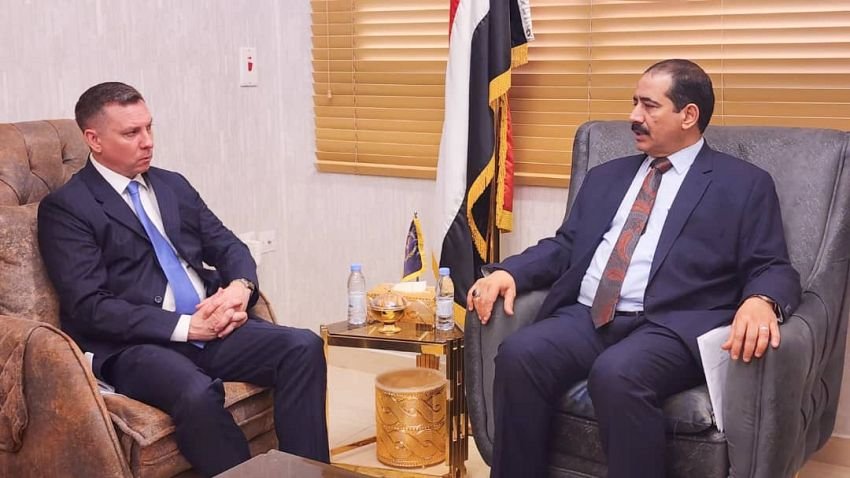
Yemen’s Minister of Interior, Major General Ibrahim Haidan, held talks on Monday with security officials from the United States Embassy, in a meeting that underscored the deepening security relationship between the two governments. The Yemeni side sat down with the embassy’s security attaché, David Schott, and its legal attaché, Karen Chastain, to discuss how bilateral cooperation might be strengthened. Counterterrorism dominated the agenda, reflecting a threat that has persisted throughout the civil conflict that has gripped Yemen since 2015 and that both sides regard as a shared priority.
The discussions focused on advancing joint counterterrorism efforts and on the practical steps needed to make Yemen’s security forces more capable. Particular attention was paid to training and professional development for personnel within the Ministry of Interior, an area both delegations identified as central to building durable institutions. Rather than treating security assistance as a one-off transfer of hardware, the talks emphasised the longer work of developing skills, procedures and leadership inside Yemen’s own agencies.
A significant portion of the meeting addressed the Yemeni Coast Guard, a force whose importance has grown as maritime security concerns have intensified along the country’s long and strategically sensitive coastline. The two sides discussed ways to strengthen the Coast Guard’s operational readiness and its ability to respond to emerging threats at sea, from smuggling and trafficking to the movement of weapons. With Yemen sitting astride some of the world’s most heavily travelled shipping lanes, the condition of its maritime forces carries implications that reach far beyond its territorial waters.
Major General Haidan attended the meeting alongside the Ministry’s inspector general, a signal of the seniority Yemen attached to the encounter. For a government still working to consolidate its authority across liberated areas, engagements of this kind serve both a practical and a symbolic purpose, demonstrating that the recognised leadership retains the confidence and support of international partners even as it contends with an entrenched armed movement and a fractured security environment.
For his part, Schott reaffirmed Washington’s intention to strengthen its collaboration with Yemen’s security apparatus. He underlined the United States’ commitment to supporting initiatives that build capacity within Yemen’s security institutions, describing that capacity as essential to the effective management of terrorism-related threats and organised crime. The message echoed a broader pattern in recent US engagement with Yemen, in which American officials have repeatedly framed institutional support as a cornerstone of any lasting stabilisation.
The partnership carries particular weight given the geopolitical complexities of the region. Yemen’s security landscape has been shaped by Iranian influence and by the activities of the Iran-aligned Houthi movement, whose reach and military capabilities have expanded during the war. As Washington seeks to protect its interests across the Middle East and to keep vital sea lanes open, closer ties with Yemen’s security forces offer one avenue for countering the threats posed by Iran-backed groups operating in and around the country.
Yemeni officials view the campaign against terrorism as inseparable from the wider effort to restore public confidence and rebuild a functioning state. Extremist networks have historically exploited ungoverned spaces and the breakdown of law and order, and the government argues that reasserting control over security is a precondition for almost every other form of recovery. Cooperation with experienced international partners, in this reading, accelerates a process that Yemen could not easily undertake on its own.
Yemen has long been a focal point of international counterterrorism concern. Al-Qaeda in the Arabian Peninsula, widely regarded as one of the network’s most dangerous branches, established a durable foothold in the country’s remote and contested regions, and a local Islamic State affiliate has also sought to exploit the disorder of the war. The collapse of central authority in parts of the country created precisely the kind of vacuum such groups seek out, which is why Yemeni and American officials alike treat the restoration of effective policing and border control as a matter of regional, not merely national, security.
The security dimension cannot be separated from the humanitarian emergency that continues to define daily life for millions of Yemenis. Years of conflict have left a large share of the population dependent on assistance, with basic services strained and livelihoods eroded. The interplay between insecurity, humanitarian need and regional instability means that progress in one area is often contingent on progress in the others, reinforcing the case for a coordinated approach rather than piecemeal fixes.
That interdependence formed a recurring theme in the way both sides framed the talks. Strengthening security institutions, officials suggested, is not an end in itself but a means of creating the conditions under which humanitarian access can widen and reconstruction can take root. A more capable and accountable security sector, the argument runs, makes it safer for aid to reach those who need it and for the fragile machinery of government to begin functioning again in areas long deprived of it.
Looking ahead, the trajectory of Yemen’s security landscape will depend heavily on the government’s ability to coordinate with international partners while steadily improving its own capabilities. Meetings such as this one are unlikely, on their own, to alter the balance of a long and complicated conflict. Yet with sustained dialogue and continued external support, Yemeni officials express cautious optimism that the country can begin to navigate its immediate challenges and move, however slowly, toward a more stable footing.
About the Author