UN Envoy Hans Grundberg Warns of Escalation After Houthi Attacks on Israel
 Yemen Herald News
The United Nations Special Envoy for Yemen, Hans Grundberg, has warned that Houthi attacks on Israel risk dragging the country into a wider regional war, cautioning that such an escalation could devastate an already fragile peace process and deepen the suffering of millions of Yemenis. His intervention came after the Houthi movement launched missile strikes toward Israel, a step that alarmed international observers and threatened to entangle Yemen’s decade-old civil war with the broader confrontation unfolding across the Middle East.
Grundberg framed the danger in stark terms, telling the UN Security Council that no party had the right to drag the country into a broader conflict that would bring more suffering to the Yemeni people. He argued that pulling Yemen into a regional war would not only jeopardize efforts to broker a lasting settlement but would also worsen the plight of a civilian population already enduring one of the world’s gravest humanitarian emergencies. The message was aimed squarely at the Houthis, but also at the regional powers whose rivalries shape the conflict.
The warning reflected long-standing fears that Yemen could become a theater for proxy confrontation. The Houthis have positioned themselves as part of a network of groups aligned with Iran and opposed to Israel and the United States, and they have cast their strikes as acts of solidarity with allies elsewhere in the region. Those characterizations are contested, and the precise extent of coordination with Tehran remains a matter of dispute, so the movement’s motives are best understood through the competing claims of the parties rather than as established fact.
Yemen’s war has ground on since 2015, when the Houthis seized the capital Sanaa and a Saudi-led coalition intervened on behalf of the internationally recognized government now based in Aden. Despite years of fighting, a fragile calm had largely held since a truce reached in 2022, and diplomats had hoped to build on that lull to revive stalled negotiations. Grundberg’s warning underscored how easily that tentative progress could unravel if the country were drawn into the fighting between Iran, Israel and their respective partners.
By striking Israel, the Houthis have raised the risk of retaliation that could fall on Yemeni territory and reignite active hostilities at home. Such a spiral would threaten not only the population but also the painstaking diplomatic groundwork laid over recent years. Grundberg has consistently argued that the path out of Yemen’s crisis runs through negotiation rather than force, and that any move widening the war makes that path harder to reach.
The envoy stressed that the immediate priority must be de-escalation and a return to dialogue, urging the parties to step back from actions that could tip the region into open conflict. He has repeatedly called for the warring sides to seize what he describes as a narrow window of opportunity for fresh talks, warning that the alternative is a return to full-scale violence with catastrophic consequences for civilians who have already borne a decade of war.
The Houthis’ military actions carry risks for the movement itself. While it emphasizes its alignment with regional allies, striking Israel could alienate potential partners and further strain its relations with the internationally recognized government and the Saudi-led coalition that has fought the insurgency for years. As the conflict evolves, the balance among these factions could shift in unpredictable ways, complicating an already tangled political landscape.
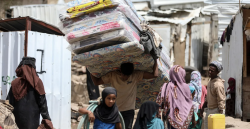
The humanitarian stakes are immense. The United Nations estimates that in 2026 more than 22 million Yemenis, over two-thirds of the population, require some form of assistance, while repeated outbreaks of cholera and other diseases have compounded a collapsing public health system. Years of conflict have shattered the formal economy, left public salaries unpaid across much of the country, and pushed basic goods beyond the reach of ordinary families, leaving the population acutely exposed to any renewed fighting.
Aid agencies have also warned of severe funding shortfalls, cautioning that budget cuts are forcing them to scale back services at a moment when needs are rising. Any escalation would place further strain on an aid operation already stretched thin, and could disrupt the delivery of food, water and medical care to communities that depend on it for survival. For humanitarian officials, the prospect of Yemen being pulled into a regional war represents a nightmare layered on top of an existing catastrophe.
Grundberg and other diplomats have argued that lasting stability requires more than a pause in the fighting. A durable settlement, in their view, must address the political grievances, economic collapse and fractured governance that underlie the conflict, alongside sustained humanitarian support and efforts at reconciliation. Without such a comprehensive approach, they warn, even a ceasefire would risk leaving the deeper drivers of the war intact and the country vulnerable to renewed violence.
For now, the trajectory of Yemen’s crisis is bound up with the wider confrontation across the Middle East, and much will depend on whether the broader conflict involving Iran, Israel and the United States intensifies or subsides. Grundberg’s appeal was, at its core, a plea to keep Yemen out of that fight, and to protect the fragile gains of recent years. Whether the parties heed that call, or allow the country to be swept further into a regional war, may determine the fate of millions in the months ahead.
About the Author