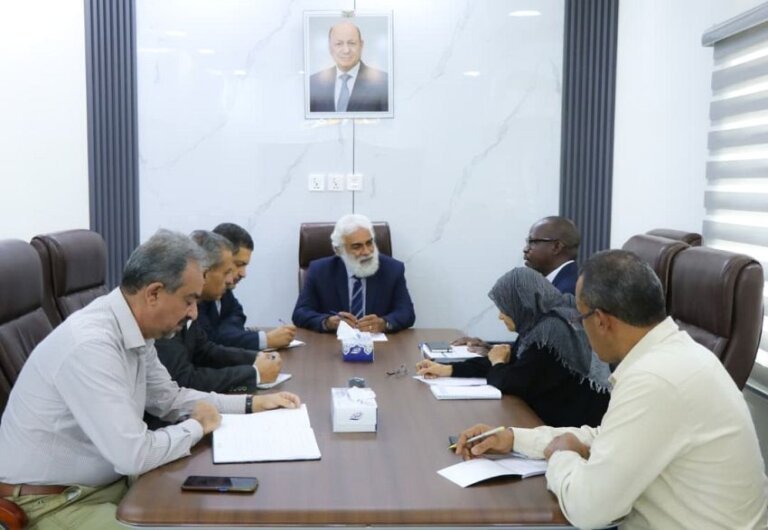
Al-Alimi checks on colleagues’ safety after Houthi attack on Aden presidential palace
 Yemen Herald News
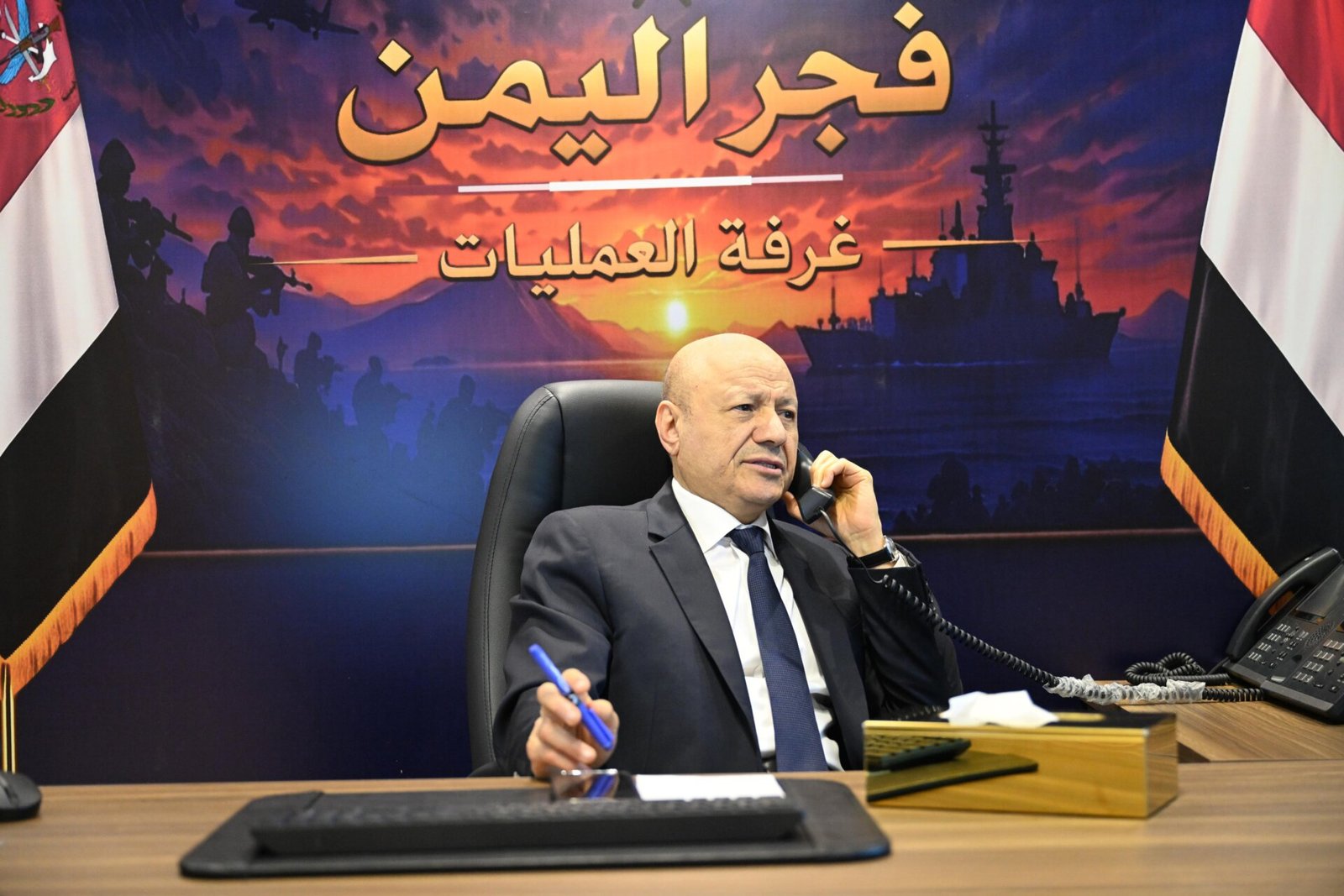
ADEN, Yemen — Yemen’s president telephoned two leadership council members and the prime minister on Thursday to check on their safety after a Houthi attack on the presidential palace.
Rashad al-Alimi, who chairs the Presidential Leadership Council and is supreme commander of the armed forces, called Lt. Gen. Abdulrahman al-Muharrami and Lt. Gen. Mahmoud al-Subaihi, both council members.
He also called Prime Minister Shaya al-Zindani, the state news agency Saba reported.
Missiles and drones struck the Maashiq Palace complex in Aden, the seat of the internationally recognised government.
Five people were killed and 16 wounded, Yemen’s health minister said, in figures reported by the Reuters news agency.
Information Minister Moammar al-Eryani said the prime minister and cabinet members were safe.
Earlier reports on the day of the attack put the death toll lower. The health ministry figure was given the following day.
Saree announces the movement’s operations in recorded statements.
The Houthi military spokesman, Yahya Saree, said the group had bombed what he called a Saudi military operations headquarters in Aden.
Saree said the attack was part of a policy of targeting Saudi reinforcements wherever they were located.
The Houthi-run news agency said the site was run by Saudi officers and held weapons depots. Reuters said it could not verify that account.
The government describes the complex as the presidential palace and the seat of its executive.
It was the first attack on the palace in the current round of the conflict. Houthi fighters briefly held the complex during an earlier phase of the war before withdrawing.
Al-Alimi received an initial briefing on the attack’s impact and on the response to it, Saba said.
He directed authorities to support the families of those killed and the people wounded.
He ordered investigations completed and security strengthened at state institutions.
Military and security agencies were told to protect state institutions, and to take lawful measures against the threat while safeguarding civilians.
Al-Alimi said the escalation reinforced the need to end what he called the Houthi coup, and to keep the use of arms under state authority.
In the same round of consultations he reviewed the course of the Dawn of Yemen offensive with senior commanders and the governors of Taiz and Lahj.
He was briefed by Defence Minister Taher al-Aqili, the chief of the general staff, Saghir bin Aziz, and the commander of the Fourth Military Region, Hamdi Shukri.
Briefings cited more than 17,000 air and ground strikes since the operation began, carried out with Saudi-led coalition support.
The strikes targeted Houthi positions, concentrations of fighters and military capabilities, according to the operational estimates given to him.
He said the operation would continue toward restoring state institutions and extending government authority across the country.
Its aim extended to reaching Sanaa, he said. The Houthis have held the capital since 2014.
Al-Alimi praised the armed forces and allied popular resistance units, and thanked Saudi Arabia and the coalition for their support.
Al-Alimi received reports on displacement and on emergency relief needs.
He was briefed on efforts to keep essential services and supply routes running in Taiz and Lahj.
He condemned reported forced recruitment in Houthi-controlled districts of Taiz, and said those responsible should be held to account.
The practices he cited included compulsory mobilisation and ideological instruction in schools and community institutions.
He described the attack on the palace as part of continued Houthi targeting of airports, oil facilities and civilian infrastructure in Yemen and in Saudi Arabia.
The government would keep carrying out its duties, he said.
Saree said a day earlier that the group had struck Aramco facilities in Dhahran and targets in Riyadh.
The Presidential Leadership Council holds the powers of the presidency. It has eight members, among them al-Muharrami and al-Subaihi.
The body was formed in April 2022, when President Abd Rabbu Mansour Hadi transferred his powers to it.
Aden has served as the interim capital since the government left Sanaa in 2015.
Al-Subaihi served as defence minister before the war. He was held by the Houthis for years before his release.
Al-Zindani was appointed prime minister in January and took office with a new cabinet the following month. He previously served as foreign minister.
Hans Grundberg, the UN special envoy for Yemen, told the Security Council on Oct. 9 that the country had slid back into full-scale war, with hostilities spreading across multiple frontlines.
He said heavy clashes were continuing in the uplands west and south of Taiz city and extending into Lahj.
Saba is run by the internationally recognised government from Aden. A separate agency of the same name operates in Houthi-held Sanaa.
Al-Aqili was named defence minister in the cabinet announced in February.
The council’s members include military commanders and political figures drawn from the groups opposed to the Houthis.
The Houthis have fired missiles and drones at Saudi territory repeatedly during the current escalation.
Yemen’s war has run since 2014, when the Houthis took Sanaa. A Saudi-led coalition intervened the following year.
Dawn of Yemen is the government’s name for the campaign it launched against Houthi-held areas.
Al-Alimi has been based in Riyadh for much of his tenure.
About the Author