Al-Zouba briefs EU ambassadors in Riyadh on Houthi push toward Bab al-Mandeb
 Yemen Herald News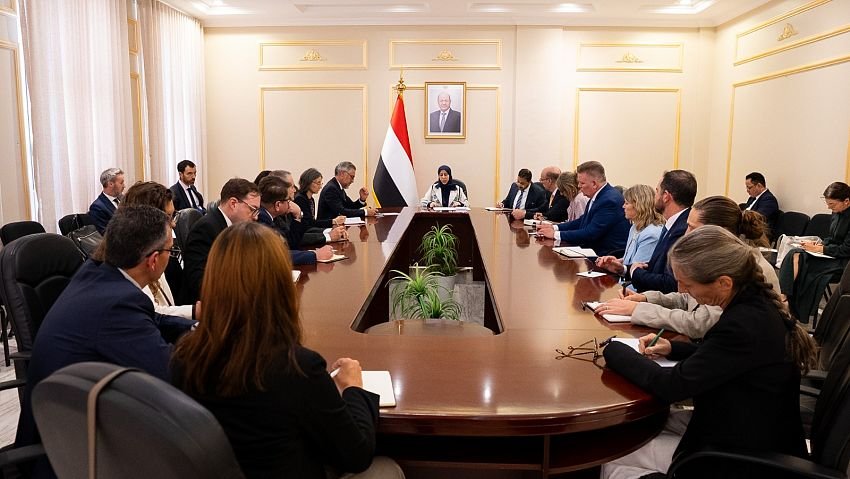
RIYADH, Saudi Arabia — Yemeni Foreign Minister Afrah al-Zouba briefed European Union ambassadors on Thursday on Houthi advances in Taiz and along the western coast, her ministry said.
Al-Zouba met Patrick Simonnet, head of the European Union mission to Yemen, together with ambassadors of EU member states accredited to the country. The talks were held in Riyadh.
She said the Yemeni state carries a constitutional and sovereign duty to protect its citizens, land, coasts, ports and territorial waters, according to Saba, the state news agency.
Enabling state institutions to discharge that duty is a central element of security at Bab al-Mandeb, in the Red Sea and for international navigation and trade, she said.
The account of the meeting rests on Saba, which is run by the internationally recognised government. Yemen Herald found no independent confirmation of the session or of the minister’s remarks.
Al-Zouba told the diplomats that Houthi forces were escalating in Taiz province and along the western seaboard, and were seeking control of the Bab al-Mandeb strait, Saba reported.
The Houthis reject that account. The group says its operations answer attacks on Yemeni territory by Saudi Arabia and by forces aligned with the government seated in Aden.
The briefing came as Houthi fighters consolidated their hold on Mocha, the Red Sea city they took on Thursday, north of the strait.
Government-aligned units withdrew south toward Dhubab, according to Al Jazeera and the Yemen Monitor. Tareq Saleh’s National Resistance, the Giants Brigades and the Nation’s Shield forces were among them.
The Houthis also took Jabal al-Nar, high ground that housed the National Resistance command on the west coast, Al Jazeera reported.
Saleh ordered what he described as a tactical withdrawal and repositioning, and told commanders to establish an alternative command centre, the broadcaster reported.
The offensive began on 3 September. Houthi units pressed from western Taiz, southern Hodeidah and Mocha itself, according to Al Jazeera.
Houthi forces also seized Zuqar Island in the southern Red Sea, using rocket fire and a ground assault mounted from boats, the same outlet reported.
Residents left Mocha for Aden province in large numbers as government forces redeployed, the Yemen Monitor reported.
Bab al-Mandeb links the Red Sea to the Gulf of Aden. Traffic through it feeds the Suez Canal.
Yemen’s Presidential Leadership Council said this week that it would not allow the strait to become a second Strait of Hormuz, according to the Yemen Monitor.
Yemeni officials made a similar case to Egypt, warning that the escalation threatened Bab al-Mandeb, maritime security and the canal, the same outlet reported.
Al-Zouba put the argument to the Arab League on 9 September, telling the body that Red Sea security rested on Yemeni sovereignty.
She was appointed foreign minister on 23 July. She is the first woman to hold the post, or any of Yemen’s most senior cabinet jobs.
She had served as minister of planning and international cooperation since February. Before entering government she spent more than 25 years in development and peacebuilding work.
Al-Zouba was first deputy secretary-general of the National Dialogue Conference, the transitional body set up after Ali Abdullah Saleh left power.
She trained as a pharmacist at Sanaa University, then took a master’s degree in community health and health economics in Malaysia and an MBA in Yemen.
The European Union’s delegation to Yemen works from outside the country. Much of the government’s diplomacy is conducted from Riyadh.
The European Union condemned Houthi attacks on Saudi Arabia this week and tied Yemen’s stability to Red Sea security.
Hans Grundberg, the UN special envoy for Yemen, told the Security Council that fighting had spread across Taiz, Hodeidah, Marib, al-Jawf and al-Bayda.
More than 11,400 households have been displaced since 3 September, Grundberg said.
He told the Council that Yemen faces a more serious risk of a return to large-scale conflict than at any point since the 2022 UN-mediated truce.
The Security Council met at the request of Bahrain and the United Kingdom, which holds the pen on Yemen.
Saudi Arabia and Yemen took part under rule 37, which lets states that are not Council members join a discussion.
The Saudi-led coalition said Houthi missile and drone attacks on 8 September wounded 73 people in the kingdom’s south, among them women and children.
The coalition said those attacks struck Khamis Mushait, Abha and Jazan, and set fires at energy installations.
The Houthis said the strikes answered an alleged Saudi attack that killed seven people in al-Jawf. Yemen Herald could not verify either account.
Saudi forces carried out at least 15 strikes on Houthi targets between 3 September and Monday, according to international news reports.
Grundberg has also called for an end to Houthi attacks on commercial vessels, which the Security Council has condemned.
The International Organization for Migration has recorded more than 30,000 people displaced inside Yemen this year, with fighting in Taiz a leading driver.
The United Nations says more than 22 million people in Yemen need humanitarian assistance.
Some 18.3 million are acutely food insecure and 5.2 million are internally displaced, according to the 2026 humanitarian needs and response plan.
More than 2.2 million children under five are acutely malnourished, including 516,157 with severe acute malnutrition.
The plan seeks $2.16 billion to reach 12 million people.
Saba did not say whether the European ambassadors responded to the minister.
About the Author