Amin al-Akeimi sworn in as governor of al-Jawf before al-Alimi in Riyadh
 Yemen Herald News
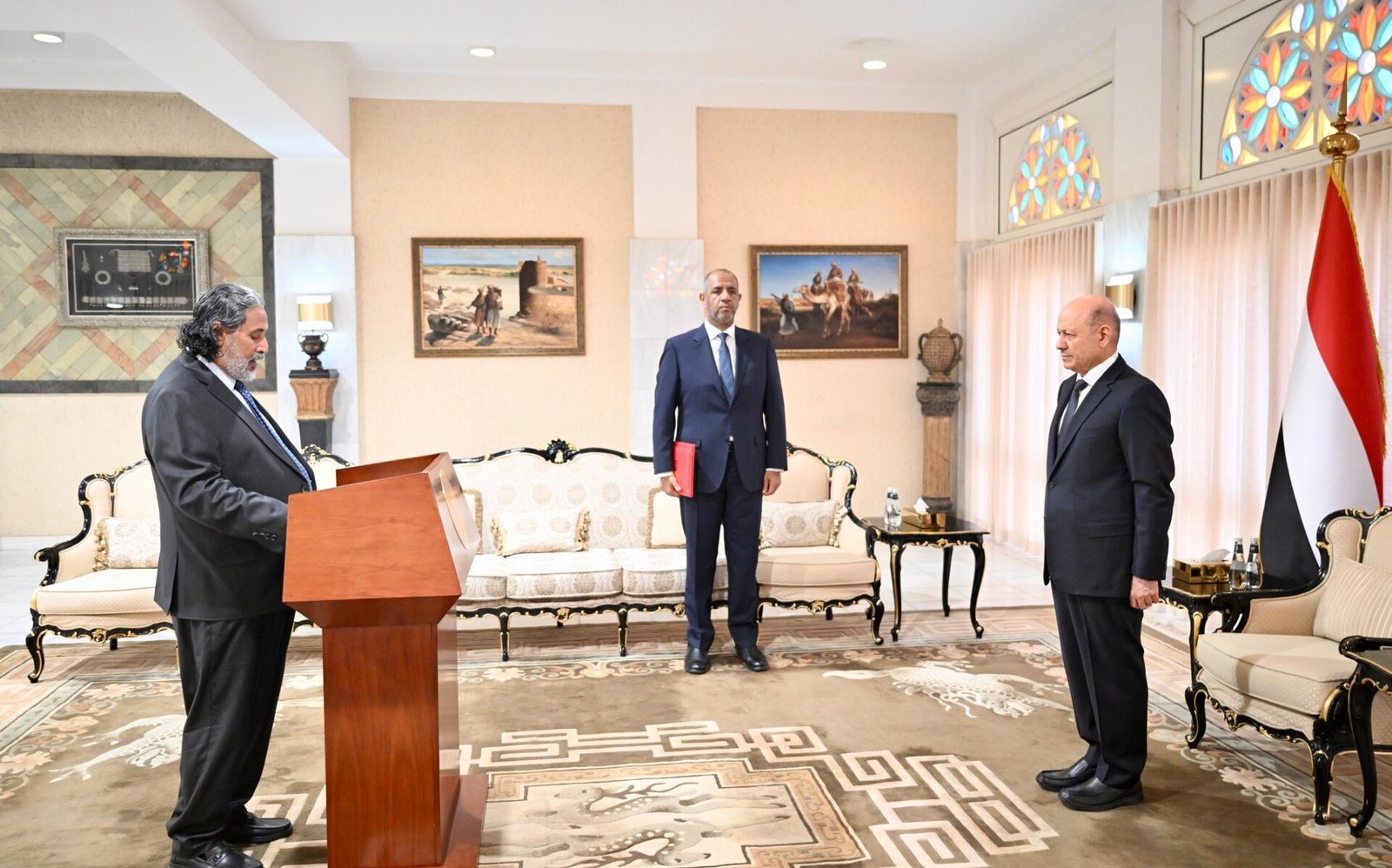
RIYADH, Saudi Arabia — Maj. Gen. Amin Ali al-Akeimi was sworn in as governor of Yemen’s al-Jawf governorate before the chairman of the Presidential Leadership Council on Sunday.
He took the constitutional oath before Rashad al-Alimi, the council’s chairman, the state news agency Saba said.
Al-Akeimi was also appointed commander of the al-Jawf military axis.
Saba is Yemen’s state news agency, and its report is the only published account of the ceremony. Yemen Herald found no independent confirmation of the appointment or of the remarks attributed to al-Alimi.
Al-Alimi met the new governor after the ceremony and congratulated him, the agency said.
The president said al-Jawf carried national and strategic weight in what he called the project of restoring state institutions.
He said the positions and sacrifices of its people in defending the republican system deserved loyalty, care and fairness.
Al-Alimi said the state and the local leadership should consolidate gains on the ground, recover the rest of the governorate and end residents’ hardship, according to Saba.
Those are the president’s characterisations. The Houthi authorities in Sanaa dispute government accounts of the front lines in al-Jawf.
He also said there was a duty to protect civilians and public and private property.
Al-Alimi urged the governor to unite the local authority and the community, to coordinate closely with military and security commanders, and to set aside differences, the agency said.
Al-Akeimi was born in 1959 in al-Jawf.
He has sat in the House of Representatives since April 27, 2003, serving three consecutive terms for constituency 276 in the governorate.
He belongs to the Islah party.
Al-Akeimi has held the governorship before.
President Abd-Rabbu Mansour Hadi appointed him governor of al-Jawf on Aug. 15, 2016, and he served until Oct. 10, 2022.
Hussein al-Aji al-Awadhi replaced him in that post.
Sunday’s appointment returns him to an office he left four years ago.
He was made a colonel in 1994 while commanding border guard battalions.
He became a brigadier general in 2015 while commanding the al-Nasr Brigade in al-Jawf.
He was promoted to major general on July 7, 2018, while commanding the al-Jawf axis alongside the governorship.
Al-Jawf covers 30,620 square kilometres and has 12 districts.
Its seat is al-Hazm.
It borders Hadhramaut to the east, Sanaa to the southwest, Amran to the west, Saada to the northwest and Marib to the south.
The governorate had a population of 772,645 in figures published by the Central Statistical Organisation for 2011, a density of about 25 people per square kilometre.
Houthi forces took al-Hazm on March 1, 2020, after government forces withdrew toward Marib.
The Houthi offensive in al-Jawf ran from Feb. 29 to April 29, 2020, and resumed from May 27, 2020, to Feb. 5, 2021.
The Houthis captured 11 of the governorate’s 12 districts and about 95% of its territory during that campaign.
They halted the offensive on Feb. 5, 2021, and began a push toward Marib city two days later.
By April 2020 Houthi forces held nearly all of al-Jawf, while al-Qaeda held Khabb wa ash Sha’af district.
Fighting resumed across several fronts on Sept. 3, when the Houthis launched an offensive that began with clashes in Taiz.
The council’s forces mounted a counter-offensive in al-Jawf and al-Bayda.
The council said on Sept. 8 that its operation aimed to take Sanaa.
On Oct. 5 it announced an operation it called Dawn of Yemen, which it described as aimed at retaking the capital and ending Houthi control.
The council said on Sept. 7 that its forces had taken the al-Labanat camp and were advancing toward al-Hazm.
The Houthis announced their own offensive in al-Jawf on Sept. 15, showing images of what they said were destroyed vehicles.
Homeland Shield Forces said they attacked Houthi infrastructure at the Labanat camp in early October.
Territorial claims by both sides in the governorate are contested, and Yemen Herald has not independently verified them.
Al-Alimi was born on Jan. 15, 1954.
He served as interior minister from April 2001 to May 2008, then as deputy prime minister for defence and security.
He advised President Hadi from 2014 until April 2022.
Hadi created the Presidential Leadership Council by decree on April 7, 2022, and transferred his presidential powers to it.
Yemeni and Saudi sources said at the time that Saudi Arabia, where Hadi was living, pressed him to cede power.
Al-Alimi’s position is disputed by Mahdi al-Mashat, who heads the Houthis’ Supreme Political Council in Sanaa.
The council’s vice presidents include Aidarus al-Zoubaidi, Tareq Saleh, Sultan Ali al-Arada and Abdullah al-Alimi Bawazeer.
The council and the government operate from Aden and from Riyadh.
The Houthis took the capital, Sanaa, in September 2014, and a Saudi-led coalition intervened in March 2015.
The United Nations humanitarian response plan for Yemen, issued in March, estimated that more than 22 million people need assistance.
It put the number facing acute food insecurity at 18.3 million and recorded 5.2 million internally displaced people.
More than 2.2 million children under five are acutely malnourished, the plan said, including 516,157 with severe acute malnutrition.
The plan sought $2.16 billion to reach 12 million of those in need.
Al-Akeimi headed the Bakil Tribal Council in 2010.
About the Author


 Adel Haddad