Bahrain Says Its Air Defences Have Destroyed 130 Missiles and 234 Drones Since Iranian Attacks Began
 Yemen Herald News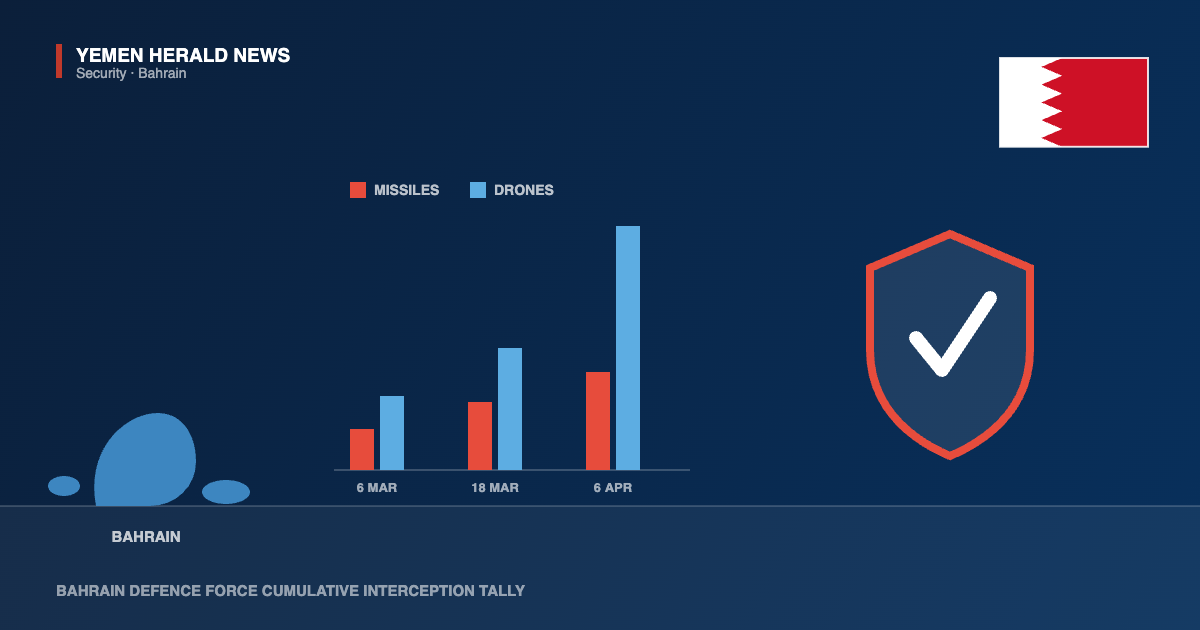
The General Command of the Bahrain Defence Force said its air defence systems had intercepted and destroyed 130 missiles and 234 drones since the start of the Iranian attacks on the kingdom, in a cumulative statement issued on Wednesday 18 March 2026. The figures covered the campaign to date rather than a single day’s engagements.
The command described the attacks as terrorist assaults and said the running total demonstrated the readiness and operational effectiveness of Bahraini forces. It framed the interceptions as evidence of combat preparedness directed at protecting the kingdom’s security and territorial integrity, language that recurred in almost identical form in each of its subsequent statements.
Alongside the tally, the command issued instructions to the public. Citizens and residents were asked to keep away from areas affected by military operations, to refrain from filming military activity or the debris left by interceptions, and to take their information from official channels rather than from material circulating online.
The instruction not to film was not incidental. Imagery showing where interceptions occurred and where debris landed allows an adversary to assess the accuracy of its own fire and the coverage of a defensive network, and to adjust accordingly. Several Gulf states issued near-identical requests during the same period, and the consistency of the wording across them suggests coordination on the point.
The trajectory of Bahrain’s cumulative figures is more informative than any single announcement. On 6 March the General Command put the total at 78 missiles and 143 drones. By 18 March it stood at 130 missiles and 234 drones. By 6 April the count had reached 188 missiles and 468 drones.
Read across those three points, the twelve days to 18 March brought roughly 52 further missiles and 91 further drones. The nineteen days that followed added around 58 missiles but more than 230 drones. The missile rate stayed broadly flat while the drone rate roughly doubled, which is the signature of a campaign leaning increasingly on cheap, mass-produced airframes rather than on scarce and expensive ballistic weapons.
That shift has a defensive logic behind it as well as an offensive one. Interceptors capable of engaging ballistic missiles are costly and held in finite numbers, and an attacker who can saturate a defensive network with slow, inexpensive drones forces the defender either to expend those interceptors on low-value targets or to find cheaper means of engagement. Gulf air forces increasingly used fighter aircraft and gun systems against drones for precisely that reason.
The command did not, in the 18 March statement, give a casualty figure or describe damage on the ground. Its published accounting through the period concentrated on what was detected and destroyed rather than on what got through, a framing common to the military communiqués issued by Gulf states during the conflict and one that leaves the fuller picture to be assembled from civil-defence and municipal reporting.
Bahrain’s geography magnifies the problem. The kingdom is an archipelago of roughly 780 square kilometres, among the smallest states in the region, with its population and infrastructure concentrated around Manama and the northern part of the main island. There is very little empty ground. Debris from an interception that would fall harmlessly in a desert elsewhere in the Gulf is likely, in Bahrain, to come down somewhere inhabited.
Short distances also compress warning times. Bahrain sits close to the Iranian coast across the Gulf, and the interval between detection and engagement for a weapon launched from that direction is measured in minutes rather than tens of minutes. That leaves little room for civil defence measures beyond sirens and standing public guidance, which is part of why the command’s statements combined operational figures with instructions to residents.
The kingdom’s strategic weight is out of proportion to its size. Bahrain hosts the headquarters of the United States Navy’s Fifth Fleet at Naval Support Activity Bahrain in Manama, a presence dating back decades and the principal American naval command for the Gulf, the Red Sea and the western Indian Ocean. That arrangement has long shaped how Bahrain is positioned in regional confrontations.
The engagements did not stop in the spring. The Bahrain Defence Force announced further interceptions through July 2026, reporting attacks countered on 12, 19 and 22 July among other dates, which places the campaign against the kingdom in a span of months rather than weeks. The cumulative accounting that began in early March continued to be updated across that period.
The figures carry the limits inherent in any self-reported military tally. They are the defence force’s own count of what it detected and what it destroyed, and the statements do not generally break out how many weapons reached their targets, where they landed, or what damage resulted. Independent verification of Gulf interception rates has been sparse throughout the conflict, and at least one neighbouring state scaled back publication of its own figures as the campaign wore on.
What the Bahraini statements do establish is scale and persistence. A state of well under two million people recorded several hundred incoming weapons over roughly a month, sustained a public accounting of them, and kept its civil guidance unchanged throughout: stay away from the debris, do not photograph it, and wait for the official statement.
About the Author