Bahrain Says Its Air Defences Intercepted 145 Missiles and 246 Drones
 Yemen Herald News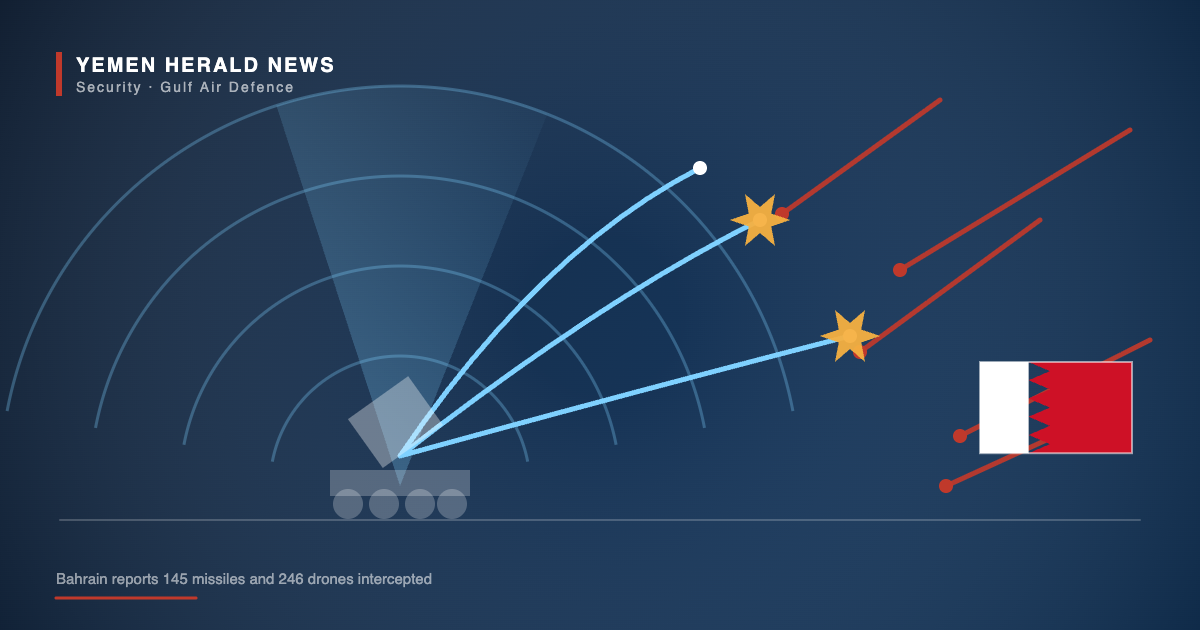
The General Command of the Bahrain Defence Force said its air defence systems had intercepted and destroyed 145 missiles and 246 drones directed at the kingdom, in a cumulative tally issued during the Iranian missile and drone campaign against Gulf states in March 2026.
The statement praised what it described as the combat readiness and vigilance of its personnel, and said their performance provided reassurance to citizens about the security of Bahraini airspace. Authorities accompanied the announcement with public safety guidance, urging residents to keep away from areas affected by military operations and to rely on official channels for information rather than unverified accounts circulating online.
Bahrain’s totals were smaller than those reported by the United Arab Emirates over the same period, where the defence ministry counted hundreds of ballistic missiles and more than a thousand drones. The difference reflects geography and target selection rather than any difference in the intensity of the defence: Bahrain is a small archipelago with a concentrated population and a limited number of high-value sites, and the volume of fire directed at it was correspondingly lower.
What Bahrain hosts, however, gives it particular prominence. The kingdom is the headquarters of the United States Naval Forces Central Command and of the US Fifth Fleet, whose area of responsibility covers the Gulf, the Gulf of Oman, the Red Sea and parts of the Indian Ocean. That presence has been in place in one form or another since 1948 and makes Bahrain one of the most significant American military locations in the region, a status that shaped its exposure during the conflict.
The Bahrain Defence Force operates a layered air defence built around Patriot batteries alongside shorter-range systems, and it is closely integrated with allied sensors and command arrangements. Gulf states have spent years attempting to knit their individual air pictures into a shared early-warning network under the Gulf Cooperation Council, work that had been slowed by political friction between members. The campaign gave that effort a practical urgency it had previously lacked.
Counting missiles and drones separately, as the Bahraini statement did, reflects the two distinct problems facing every defender in the region. Ballistic missiles arrive fast and on steep trajectories, demanding high-performance interceptors and very short decision cycles. Drones are slow and small, difficult to detect at low altitude, and cheap enough to be launched in volumes that make it uneconomic to answer each one with an expensive missile. The larger drone figure in Bahrain’s tally is consistent with that pattern across the Gulf.
Bahrain’s own domestic politics add a further dimension. The kingdom is ruled by a Sunni monarchy over a population with a Shia majority, and successive governments in Manama have accused Tehran of interference in its internal affairs, allegations Iran has consistently denied. That long-running mistrust framed how the attacks were presented officially and helps explain the emphasis in the statement on reassurance to citizens rather than solely on operational detail.
Bahrain did not publish a figure for weapons that evaded interception in the statement carrying these totals, nor did it detail damage or casualties in that announcement. As with all such claims issued by a party to a conflict, the figures represent the assessment of the Bahraini military rather than an independently audited count, and Iranian statements during the campaign gave a different account of the effectiveness of the strikes.
The disruption extended into civilian life. Airspace over the Gulf was repeatedly closed or restricted during the heaviest waves of attacks, affecting Bahrain International Airport and the wider network of regional hubs. Schools and workplaces adjusted schedules, and the population was directed to shelter guidance during alerts. Bahrain’s causeway link to Saudi Arabia, a major artery for commuters and freight, operated under heightened security through the period.
Bahrain also participates in the maritime security coalitions headquartered on its territory, including the combined task forces that patrol shipping lanes running from the Gulf through the Strait of Hormuz and into the Red Sea. Those routes carry a substantial share of the world’s seaborne oil, and their protection during a period of open regional conflict added to the demands placed on a small force already engaged in defending national airspace.
For a country of Bahrain’s size, sustaining that defensive effort over weeks placed real strain on stocks of interceptors and on the personnel operating them. Interceptor production rates internationally are measured in the hundreds per year, while the incoming volumes across the Gulf during March were counted in the thousands, and the resulting depletion became a recurring theme in defence commentary about the campaign.
The announcement should be read as a snapshot of a running total rather than the record of a single engagement. Similar cumulative statements were issued by defence ministries across the Gulf throughout the month, each adding to the picture of a sustained aerial campaign that Gulf air defences were largely, though not entirely, absorbing. The figures cited here are those Bahrain reported at the time, and later totals were higher as the campaign continued.
Taken together with parallel announcements from Kuwait, Qatar, Saudi Arabia and the UAE, the Bahraini figures formed part of the most comprehensive test of Gulf air defence networks since those systems were acquired. The operational lessons drawn from that period, particularly on interceptor stockpiles and on countering cheap drones at scale, are likely to shape regional procurement decisions for years.
About the Author