Being a Journalist in Yemen
 Yemen Herald News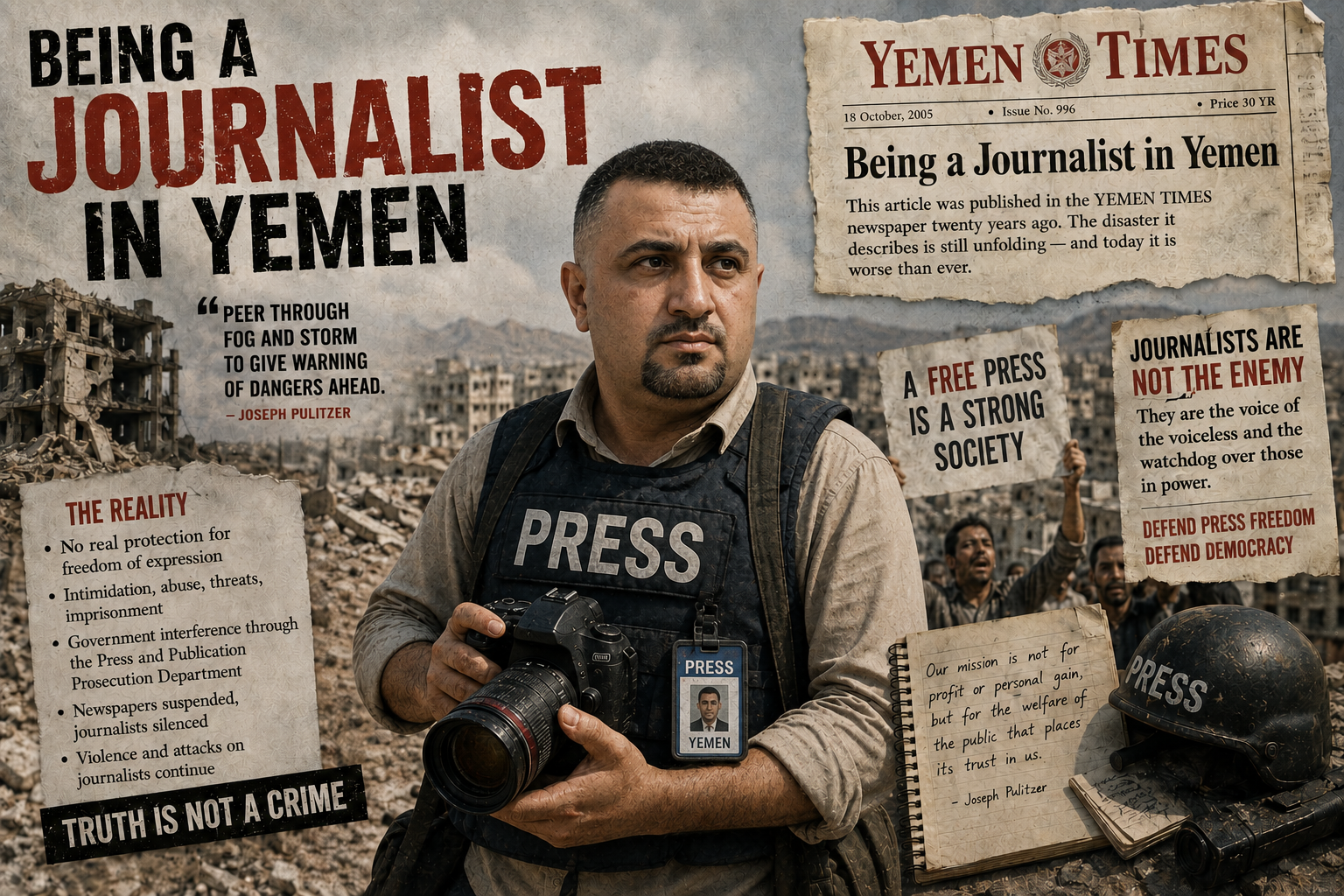
This article was published in the YEMEN TIMES newspaper twenty years ago. The disaster it describes is still unfolding — and today it is worse than ever.
The press plays an essential role in nurturing and protecting freedom of expression. Journalism gives a platform to social issues and a voice to those who are oppressed. Often called the Fourth Estate, it serves as both a watchdog over those in power and a critical friend to government, and its central duty is to scrutinize official performance and hold it to account.
A journalist is far more than a reporter or a writer; he or she carries a profound message of humanity. Journalists pursue their work with courage, undeterred by hardship or tragedy. Their mission goes beyond simply relaying events — it means advocating for the causes they believe in. As the American journalist Joseph Pulitzer observed, journalists “peer through fog and storm to give warning of dangers ahead.” Their concern is not personal gain or profit but the welfare of the public that places its trust in them.
In Yemen, however, the practice of journalism departs sharply from this idealized vision of the Fourth Estate. Official law does not truly empower Yemeni journalists to report freely on matters of public interest, and they face severe restrictions whenever they address the wrongful actions of government officials or influential figures.
To be a journalist in Yemen is to navigate one obstacle after another in the pursuit of truthful information. Criticizing corrupt high-ranking officials or reporting on sensitive political issues can put a reporter’s life at risk. The state does not adequately protect the right to free speech, and as a result journalists routinely encounter intimidation and abuse — including imprisonment and threats — stemming from government interference through the Press and Publication Prosecution Department.
This dynamic deepens the tension between the state and the press. When journalists question government policy, they invite backlash from authorities determined to control the media narrative. Despite these pressures, many journalists strive to resist government influence, and their defiance fuels an ongoing struggle over press freedom.
The former Indian Prime Minister Jawaharlal Nehru put it aptly: “I have no doubt that even if the government dislikes the liberties taken by the press and considers them dangerous, it is wrong to interfere with the freedom of the press.” Yemen’s current laws, unfortunately, remain oppressive and infringe upon the journalist’s right to criticize governmental actions. Prime Minister Abdulkader Bajamal has blamed state censorship directly on the violations he says journalists themselves commit.
Lately, the government has suspended newspapers and their reporters with alarming frequency, always on some pretext. Among the publications affected are Al-Ray A’am, the English-language Yemen Observer, Al-Wahdawi (affiliated with the Nasserite opposition party), Al-Hurya, and Al-Usbou.
In recent months, journalists in Yemen have endured disturbing levels of violence and intimidation. Khalid Salam, the Editor-in-Chief of Al-Thawri, was named in a defamation case and fined 50,000 YR. His colleague Qaed Al-Tairi was kidnapped on the outskirts of Sana’a and brutally beaten by unidentified assailants. Ibrahim Mugahed, Editor-in-Chief of Akhbar Al-Yoom, was assaulted with sticks and iron rods by unknown attackers. Haji Al-Jihafi, managing editor of Al-Nahar, is currently on trial for publishing an article that criticized Sheikh Mohammed Mansour and his abuses against his constituents; tragically, Al-Jihafi was injured when a booby-trapped envelope exploded upon contact.
The Deteriorating Standards of Journalism
The Yemeni press has yet to achieve international circulation or meet global standards of quality. Persistent government censorship stifles freedom of expression and contributes to a shortage of specialized newspapers and properly trained journalists — both key factors in the decline of Yemeni journalism. Many who work in the media are not true professionals; they often come from political backgrounds or masquerade as intellectuals. A significant number pursue journalism for fame or financial gain while serving as mouthpieces for their political affiliations, and in doing so they undermine media ethics, placing personal interest above professional integrity.
When financial motives and political agendas take command of journalistic practice, the fundamental role of the press — to serve the public interest — becomes compromised. Journalists end up operating within business constraints rather than pursuing truth and delivering credible information. As Pulitzer famously stated, “A journalist is a man of letters who sacrifices himself for the sake of the honest word.” Yet many business-oriented newspapers exploit their journalists to further the owners’ interests while neglecting public welfare.
This exploitation places journalists’ careers at risk as they are caught between their ethical responsibilities and their employers’ political demands. With unemployment rates exceeding 35%, many fear becoming another statistic in a precarious job market where legal protections are minimal. Criticizing the government can bring severe repercussions from state authorities and their affiliated media outlets.
Journalists also grapple with an internal conflict between their professional ethics and their employers’ political inclinations. Time and again, this struggle pushes them to prioritize job security over truthful reporting — a reality that echoes Nehru’s assertion that those without means have limited opportunities for self-expression.
The situation regarding violence against journalists in Yemen has reached critical levels, and the government’s indifference to the quality of the press only makes matters worse. A contentious Press Law now under discussion in Parliament threatens to grant the authorities still greater control over media freedoms — including the potential imprisonment of dissenting journalists — despite the essential role a free press plays in informing citizens.
The absence of this fundamental principle has already prompted the Millennium Challenge Corporation to suspend Yemen from its program. Freedom House’s 2005 Survey of Freedom in the World likewise designates Yemen as “Not Free” on press freedom and freedom of speech. In every context, the press is regarded as a vital mission among all professions. Yet Yemeni journalists face significant hardship and violence; their lives are inadequately protected in law, and their freedom of expression remains unguaranteed.
Despite these challenges, journalists in Yemen persist in their struggle for justice and truth. They understand the risks involved, but they remain committed to their mission, believing it transcends any danger they may encounter. With each new day, their determination continues unabated.
Adel Al-Haddad
Yemeni journalist specializing in Development Journalism
About the Author