Yemeni government reports artillery and drone strikes on Houthi positions in three governorates
 Yemen Herald News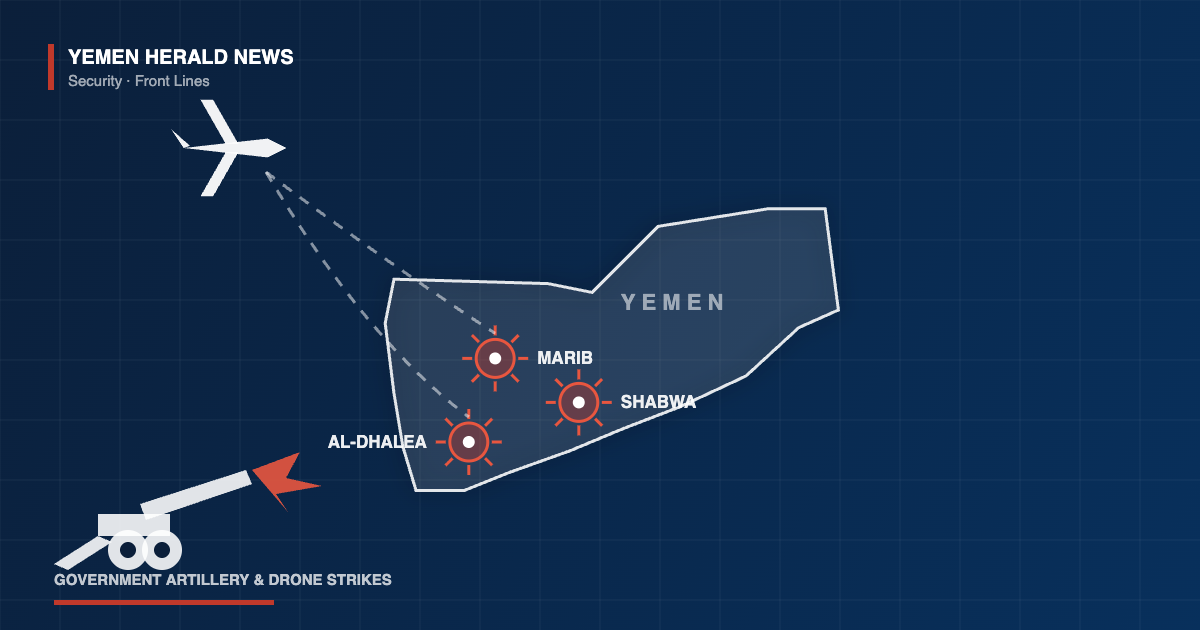
Yemeni government forces have carried out sustained artillery and drone strikes on Houthi positions across several governorates, inflicting what officials describe as heavy casualties on the group as fighting intensifies along fronts that had been comparatively quiet for much of the past four years. The strikes form part of a broader exchange that has escalated sharply since the beginning of August.
Fayyad al-Numan, Yemen’s deputy minister of information, told the German news agency dpa that government forces had conducted intensive shelling with heavy artillery and drones against Houthi reinforcements attempting to move up to front-line positions. He said the operations covered several fronts, including Marib and al-Jawf in the north-east, where the group has been massing men and equipment.
Yemeni state television reported that government artillery struck Houthi positions and gatherings near the al-Fakhir market in northern al-Dhalea governorate, killing and wounding a number of fighters. Al-Dhalea straddles the old boundary between north and south Yemen and has been an active front for years, with control of its highland passes determining access to the road network running down towards Aden.
The heaviest reported toll came further west. The National Resistance Forces, a government-aligned formation operating on the west coast and in Taiz, said more than 27 Houthi fighters were killed and 19 wounded in strikes on the al-Barh front in south-western Taiz over a three-day period. Government forces separately said they had repelled a Houthi assault on the al-Mafalis front, south of Haifan in south-eastern Taiz.
Armed drones now feature routinely on both sides of these fronts, a change from the early years of the war, when loitering munitions were largely the preserve of the Houthis and their external suppliers. The effect is that reinforcement columns and rear areas are exposed in ways they were not when the present front lines were first drawn.
None of these figures can be independently verified. Casualty counts issued by parties to the Yemeni conflict have historically diverged widely from one another and from the assessments of monitoring organisations, and both sides have a clear interest in overstating enemy losses and understating their own. Access for journalists and observers to active front lines is minimal, and the areas in question are largely closed to independent scrutiny.
The government operations follow a period in which its own forces absorbed serious losses. In early August, Houthi missile and drone attacks on government positions in Hadramout and Marib killed at least 30 soldiers and wounded 15 more, according to Yemeni officials, in what was described as the deadliest single episode of the conflict in several years. The Houthis put the figure considerably higher.
That exchange has continued to widen. Houthi forces have struck the government-held port of al-Mokha on the Red Sea coast with missiles and drones, killing soldiers and civilians, and a merchant vessel was hit in the Bab al-Mandab strait with the loss of several crew. Taken together, the land and maritime attacks constitute the most serious deterioration in Yemen’s security situation since the truce took hold.
The truce in question was brokered by the United Nations in April 2022. It formally lapsed months later, but its main provisions were observed in practice by both sides for four years, producing a period of relative quiet that stopped short of peace. Front lines froze roughly where they stood, large-scale offensives ceased, and civilian casualties fell substantially, even as skirmishing, shelling and sniping never entirely stopped.
What is unfolding now is a test of whether that arrangement can survive. Yemeni officials have framed the current strikes as a defensive response to Houthi escalation rather than the opening of a new offensive, and there has been no announcement of a general campaign to retake territory. Analysts watching the fronts note that the government has not so far attempted ground advances of the kind that would signal a shift from retaliation to offensive war.
Marib remains the pivotal front. The governorate holds Yemen’s principal onshore oil and gas facilities and hosts one of the largest displaced populations in the country, and a serious Houthi push there would have consequences far beyond the battlefield. The International Organization for Migration has recorded more than half of all new displacement in Yemen this year in Marib alone.
For civilians living near the fronts, the immediate effect of the exchanges is measured in shelter and access rather than in casualty tallies. Artillery duels close roads, suspend markets and interrupt the movement of aid, and humanitarian agencies have already begun curtailing operations. The International Rescue Committee has suspended field movements along the west coast, and other organisations are reviewing their own security arrangements.
Aid agencies and diplomats have repeatedly warned that a return to full-scale conflict would fall hardest on a population already at the limit of its coping capacity. More than 22 million Yemenis, roughly half the country, need humanitarian assistance this year, and 18.3 million face acute food insecurity, while the 2026 response plan is funded at less than a fifth of its requirement.
The United Nations envoy’s office has continued to press both sides to step back, and international statements have called for restraint and a return to negotiations. Whether those appeals carry weight will depend less on the volume of diplomacy than on whether either side concludes that it can gain more from fighting than from the frozen positions it has held since 2022.
About the Author