Health ministry seeks community support for measles and rubella vaccination campaign
 Yemen Herald News
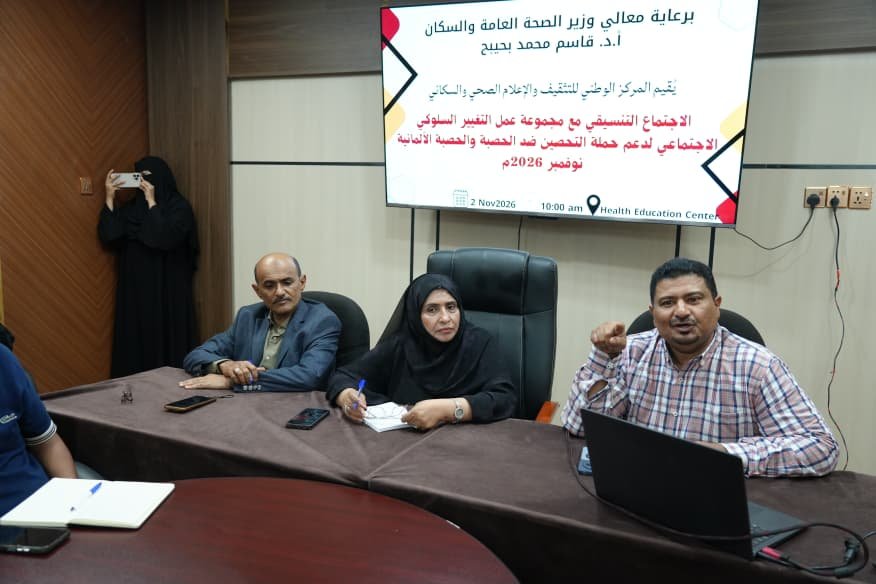
ADEN, Yemen — Yemen’s health ministry has called for stronger coordination with media and community groups to build public support for a measles and rubella vaccination campaign.
The Ministry of Public Health and Population set out the appeal at a coordination meeting in Aden, the state news agency Saba reported on Monday.
The meeting was organised by the National Center for Health and Population Education and Information, the ministry’s public information body.
The session was held under the patronage of the minister of public health and population, Qasem Buhaibeh, according to the banner displayed at the meeting. It identified those taking part as a working group on social and behavioural change.
Assistant Deputy Health Minister Ishraq al-Sabai told the meeting that the campaign would need coordinated work by government bodies, media outlets and community groups if it was to succeed, according to the agency.
The director general of family health, Mohammed Rajmanar, said the campaign’s success depended on public awareness and community engagement, Saba reported.
Arif al-Hawshabi, who directs the national centre, also took part.
Health officials and representatives of partner organisations attended, the agency said. It did not name them.
Participants discussed raising awareness of the vaccine, countering misconceptions about it and encouraging parents to have their children immunised, according to the report.
The bodies the ministry said it wanted to enlist included government agencies, civil society organisations, media outlets, vaccination teams, health workers, and community and religious leaders.
The ministry did not say when the campaign would begin or how long it would run.
It gave no target age group, no figure for the number of children it intended to reach and no list of the governorates to be covered.
The account of the meeting rests on Saba, which is controlled by the internationally recognised government. No independent confirmation of it has been published, and Yemen Herald could not verify the ministry’s account.
Yemen recorded 11,354 measles cases between October 2025 and March 2026, according to provisional World Health Organization data cited by Médecins Sans Frontières in July. The aid group said that was the second-highest national total worldwide for the period.
The health office in Taiz governorate reported 87 measles deaths and 14,470 suspected cases through the end of the first half of 2026. Tayseer al-Samei, the office’s health media officer, released the figures in July.
Those totals cover government-held areas only.
Taiz recorded 18 of the deaths and Aden 14, according to the release. Seiyun, in Hadramawt, recorded 12.
Abyan and Lahj each recorded 11. Marib recorded eight and al-Mukalla seven.
Al-Mahrah and al-Dhale’e each recorded two. Hodeidah and Socotra each recorded one.
The governorate figures in the release account for all 87 deaths. It gave no breakdown of the 14,470 suspected cases by governorate.
No comparable official data has been published for the areas held by the Houthis.
The Taiz office cited WHO reporting that about 70 percent of cases were outside government-held territory. It said that indicated the national caseload was larger than the reported total.
The same release said some parents were reluctant to have their children vaccinated, and attributed that reluctance to rumours and misinformation.
Médecins Sans Frontières described further obstacles in its July account. It said poverty and the cost of transport deterred families, particularly because the two-dose schedule requires two separate journeys to a clinic.
Long distances to health facilities and repeated displacement also kept children from being immunised, the organisation said. It said population movement made true coverage hard to measure.
It also cited misinformation, weakened basic health services and reduced humanitarian funding, which it linked to gaps in vaccination, treatment and disease surveillance.
The group recorded 314 measles patients at Mocha general hospital in Taiz governorate between January and April, in services it supports. It reported a similar pattern at a health centre in al-Khawkhah, in Hodeidah governorate.
At a health centre in Mafraq al-Mokha, in Mawza district of Taiz, the organisation said children were arriving for treatment from three separate districts.
More than 3,300 children were vaccinated in two weeks during campaigns in April and May in Tuban district of Lahj and areas around Mocha, the organisation said.
A separate emergency campaign began in Marib on Aug. 18 after local authorities declared a health emergency over a rise in suspected cases.
That campaign covered Marib city and the districts of Harib, Madghal and Ragwan, and targeted children aged six months to five years.
Teams screened 11,143 children and administered 13,775 doses, of which 10,624 were against measles and 3,151 were routine immunisations, the International Organization for Migration said in August.
The campaign was funded by European Union humanitarian aid and the United Kingdom’s Foreign, Commonwealth and Development Office. It was run with the Public Health and Population Office in Marib and the deputy governor’s office.
UNICEF supported 200 of the 309 outreach sessions and the migration agency supported the remaining 109.
Abdusattor Esoev, the agency’s chief of mission in Yemen, said that when children cannot reach routine health services, preventable diseases can spread quickly.
A WHO-UNICEF national immunization coverage estimate for 2022 found that 27 percent of children under one year old in Yemen had not been vaccinated against measles and rubella.
WHO said in 2023 that the ministry, working with the agency and other partners, had reached about 65 percent of children with both doses of the measles and rubella vaccine.
About the Author


 Adel Haddad