Houthis Claim Drone Strike on Aramco’s Jizan Refinery and Missile Attack on Yemen’s Mokha Port
 Yemen Herald News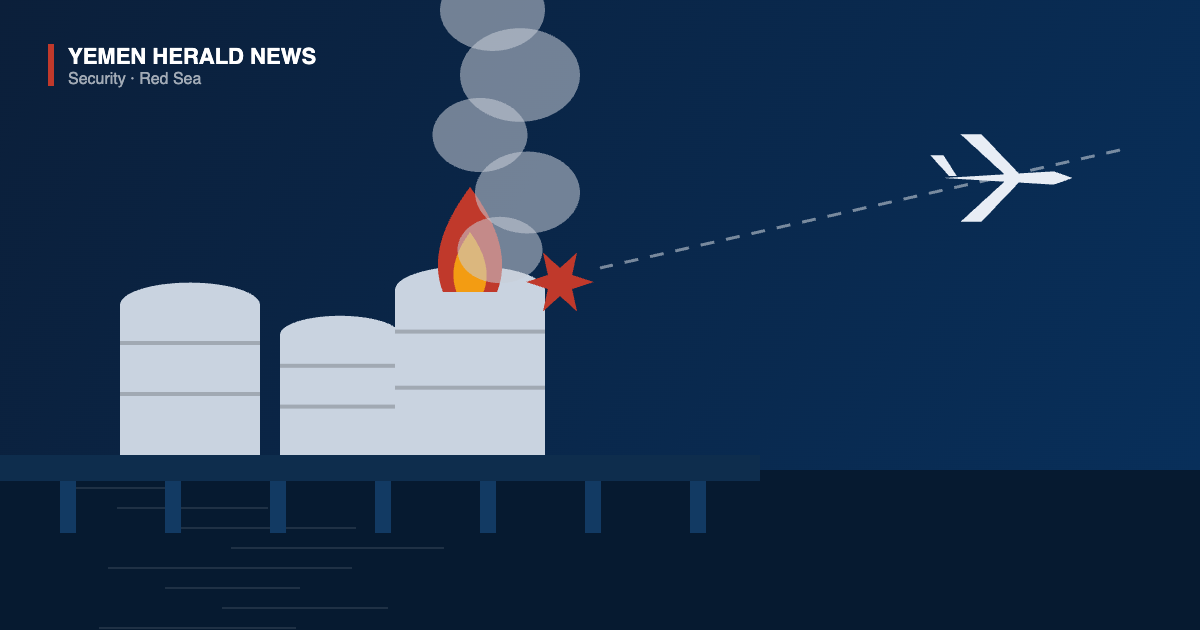
Yemen’s Houthi movement said on Sunday that it had struck targets on two fronts within hours of each other, claiming a drone attack on a Saudi Aramco refinery inside Saudi Arabia and a large missile and drone assault on Mokha, a government-held port on Yemen’s own Red Sea coast. Taken together, the two operations mark the most serious escalation since the calm that had broadly held along Yemen’s front lines since 2022 began to break down last month.
In Jizan, in south-western Saudi Arabia, a fire broke out early on Sunday at a refinery operated by Saudi Aramco. Saudi Arabia’s Ministry of Energy said firefighters brought the blaze under control and that nobody was injured. The Jizan complex is one of the kingdom’s newer downstream facilities and processes in the region of 400,000 barrels of crude a day, making it a significant node in Saudi Arabia’s refining network and a symbolically potent target given its position on the Red Sea coast, only a short distance from the Yemeni border.
The Houthis’ military spokesman, Yahya Saree, said the group had targeted the Jizan refinery with a drone and described the strike as precise. He framed the attack as retaliation for what he said were Saudi drone incursions into the airspace of Saada and Hajjah, two northern Yemeni provinces under Houthi control. Saudi officials have not publicly responded to that specific allegation, and the energy ministry statement did not attribute the fire to any party.
The second and deadlier attack fell on Yemeni soil. Mokha, a Red Sea port city in Taiz governorate, was hit by missiles and drones on the same day. A medical source in Mokha told AFP that eleven people were killed, three of them civilians and eight of them military personnel, and that a further thirty-two were wounded, six of whom were civilians. Earlier casualty figures circulated during the day were lower, and the toll was revised upward as casualties reached hospitals.
Abdulmalik al-Sharabi, the director of Mokha port, said the facility was attacked with roughly twenty-five drones. According to his account, the strikes hit economic facilities inside the port, housing used by port employees, and a customs hangar. Damage to customs and warehousing infrastructure is consequential well beyond Mokha itself, because the port is one of the few functioning maritime entry points on the Red Sea coast still under the control of the internationally recognised Yemeni government.
Saree characterised the Mokha operation as a large-scale action against what he described as Saudi military concentrations and weapons depots in the area, and said it involved both ballistic missiles and drones. That characterisation is contested. Mokha has for several years served as the principal base of the National Resistance Forces commanded by Tariq Saleh, a member of Yemen’s Presidential Leadership Council, and the port also handles commercial and humanitarian cargo. The Houthi account of what was struck cannot be independently verified, and the port director’s description of damage to civilian and commercial infrastructure sits awkwardly alongside it.
Geography explains why Mokha matters disproportionately to its size. The city sits close to the Bab al-Mandab Strait, the narrow passage linking the Red Sea to the Gulf of Aden through which a substantial share of the world’s seaborne trade and energy shipments passes. Any sustained fighting around the strait carries implications for commercial shipping that extend far beyond the Yemeni conflict, and shipping insurers and operators have repeatedly adjusted routing and risk pricing in response to episodes of this kind.
The timing of the attacks is also being read in a regional frame. They came two days after Saudi Arabia signed a defence agreement with Turkey and Pakistan, a pact presented by its signatories as a response to deteriorating regional security. That instability has been driven principally by the confrontation involving the United States, Israel and Iran, which has drawn in shipping lanes, air defences and energy infrastructure across the Gulf. Separately on Sunday, Iran denied that it was holding direct talks with Washington over reopening the Strait of Hormuz.
For Yemen itself, the significance is that the front lines have moved again. A United Nations-brokered truce agreed in April 2022 formally lapsed later that year but held in broad terms for a long period afterwards, with neither side mounting sustained offensives. That arrangement has visibly frayed over the past month, and Sunday’s strikes on a government-held port represent a direct assault on territory rather than the maritime harassment campaign that has defined much of the recent period.
The Houthis have a documented record of striking Saudi energy infrastructure, including claimed attacks on Aramco facilities at Jizan in 2021, and the group has consistently presented such operations as reciprocal responses to Saudi air activity over northern Yemen. Riyadh has generally sought to avoid re-entering an open air campaign in Yemen, having spent recent years pursuing a negotiated exit from the war through Omani-mediated contacts.
What follows is unclear. Neither the Yemeni government nor the Saudi-led coalition had announced a military response at the time of reporting, and there has been no indication that the Aramco fire affected the refinery’s output. The immediate cost, however, has been borne in Mokha, where a port that serves as a lifeline for imports into government-held areas has taken damage to precisely the customs and storage infrastructure that keeps goods moving.
About the Author