Oman and Yemen sign agreements to link Dhofar grid to al-Mahra
 Yemen Herald News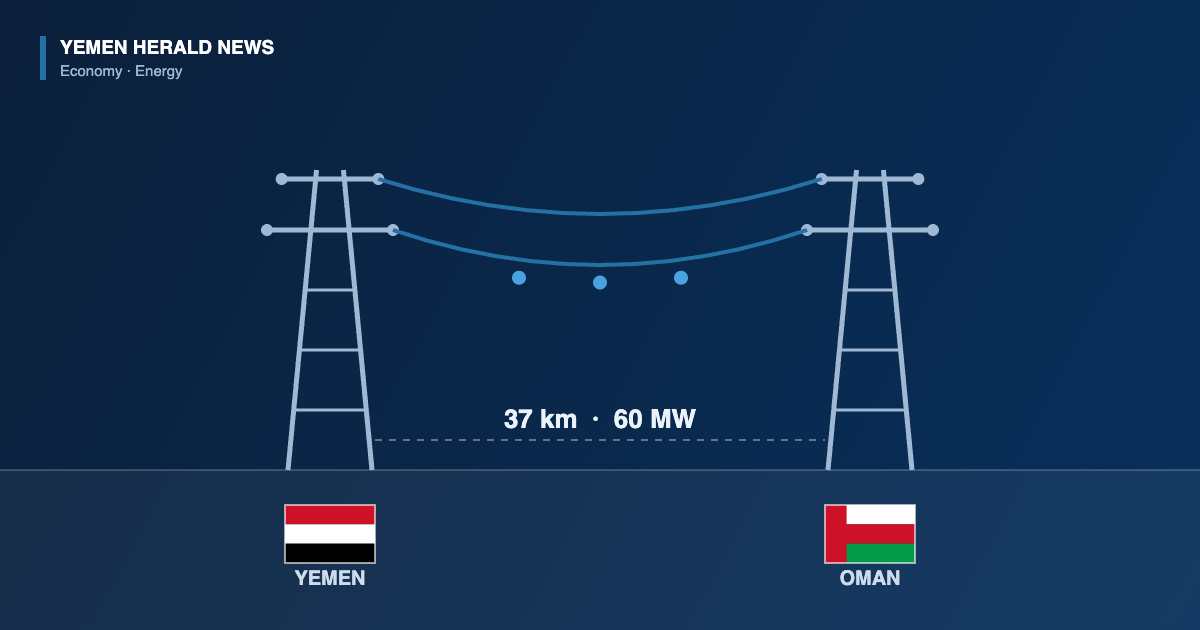
SALALAH, Oman — Oman and Yemen signed two agreements on Sunday to connect Oman’s Dhofar power grid to Yemen’s eastern governorate of al-Mahra.
The signing took place in Salalah, the Dhofar capital, Yemen Monitor reported.
The link will run about 37 kilometres. It will use an 11-kilovolt double-circuit transmission line with a total capacity of close to 60 megawatts, according to the same report.
Power is to reach al-Ghaydah, the al-Mahra capital, along with the districts of Shahan and Hawf. All three lie in the east of the governorate.
Hawf and Shahan come first. Planned loads are 3 megawatts for Hawf and 5 megawatts for Shahan, Asharq Al-Awsat reported.
Al-Ghaydah follows. Loads there are expected to reach up to 50 megawatts, according to the same report.
Each of the two documents carried a different pair of signatures.
Ali Issa Shammas, chief executive of Nama for Dhofar Services, signed the first for Oman. Othman Mohammed Owaid, director general of the Public Electricity Corporation in al-Mahra, signed for Yemen.
Ahmed Salim al-Abri, chief executive of Nama Power and Water Procurement, signed the second for Oman. Mohsen Ali Balhaf, director of the Yemen Petroleum Company in al-Mahra, signed for Yemen.
The project is expected to improve the reliability of supply in the areas it serves, steady the grid and meet part of a rising demand, Yemen Monitor said.
The agreement was framed as support for residential, service and economic activity across the governorate, according to the same report.
Yemen Monitor described the signing as taking place within a framework of cooperation in the electricity sector and the development of energy infrastructure.
Yemen Monitor said regional interconnection work of this kind is expected to strengthen energy security, improve the handling of emergencies and load swings, and widen the options for securing supply over the long term.
Neither report gave a construction timetable or a cost for the al-Mahra line. Neither said when power would begin flowing.
The signing follows more than a year of preparatory study.
In May 2025, the engineering consultancy Monenco said it had been awarded the Oman-Yemen power grid interconnection project by Oman Electricity Transmission Company under Tender No. 15/2025, the Oman Observer reported.
Monenco said its brief ran from the feasibility study through engineering services and supervision to energisation, according to the same report.
Oman Electricity Transmission Company is the majority state-owned operator of Oman’s national grid and part of Nama Group, the Oman Observer said. Both Omani signatories on Sunday head Nama companies.
The utility manages Oman’s links to neighbouring grids through the Gulf Cooperation Council Interconnection Authority.
Oman exported 775,637 megawatt-hours and imported 63,948 megawatt-hours over that connection in 2024, the Oman Observer reported, citing the transmission company.
Oman has been pursuing grid links with each of its land neighbours, the newspaper reported at the time.
Oman signed a memorandum with Iran in May 2025 to review a feasibility study on linking their grids, the Oman Observer reported. It was one of 18 agreements concluded during a visit to Muscat by President Masoud Pezeshkian.
A 400-kilovolt line between Oman and the Gulf network was then in design, scheduled for completion in the first quarter of 2027. It would raise transfer capacity between the two systems to 1,700 megawatts, the transmission company said.
The existing Oman link to the Gulf network has run since November 2011.
A separate proposal to connect Yemen’s grid to Saudi Arabia’s has also been revived this year, the Aden-based outlet South24 reported.
Al-Mahra lies at Yemen’s eastern edge. It borders Oman to the east and Saudi Arabia to the north, with Hadramawt to the west and the Arabian Sea to the south.
It is Yemen’s second-largest governorate by area and among its least populated.
The province has long run on diesel generation. Sixteen generators with a combined capacity of 11 megawatts were delivered there in December 2016 to cover a shortfall in supply.
In April 2020, the Saudi Development and Reconstruction Program for Yemen began rehabilitating electricity networks in the governorate. That work was set to serve 10,000 people in the al-Sadah and al-Souq areas of al-Ghaydah district, according to a report .
Supply elsewhere in government-held Yemen has been worse. Aden’s demand exceeds 600 megawatts, and generation falls well short of it.
Daily blackouts in the city passed 13 hours in May. Supply in some districts fell to about two hours after the PetroMasila plant stopped for want of fuel.
Saudi Arabia announced a 150 million dollar package of petroleum products at the end of May to keep diesel-fired stations running. An earlier grant this year covered the purchase of roughly 339 million litres of diesel and mazut.
Two solar plants, at Aden and Shabwa, were handed to the Public Electricity Corporation in January. They are rated at 120 megawatts and 53 megawatts.
The shortfall is put down to fuel costs, war damage, weak revenue collection, ageing networks and a heavy reliance on thermal generation.
The United Nations says more than 22 million Yemenis need assistance this year, and that 18.3 million are acutely food insecure. Its humanitarian plan sought 2.16 billion dollars to reach 12 million people.
Al-Ghaydah is the seat of the governorate’s administration.
About the Author