Pakistan condemns Houthi missile attack on Bab al-Mandab cargo ship that killed three Pakistanis
 Yemen Herald News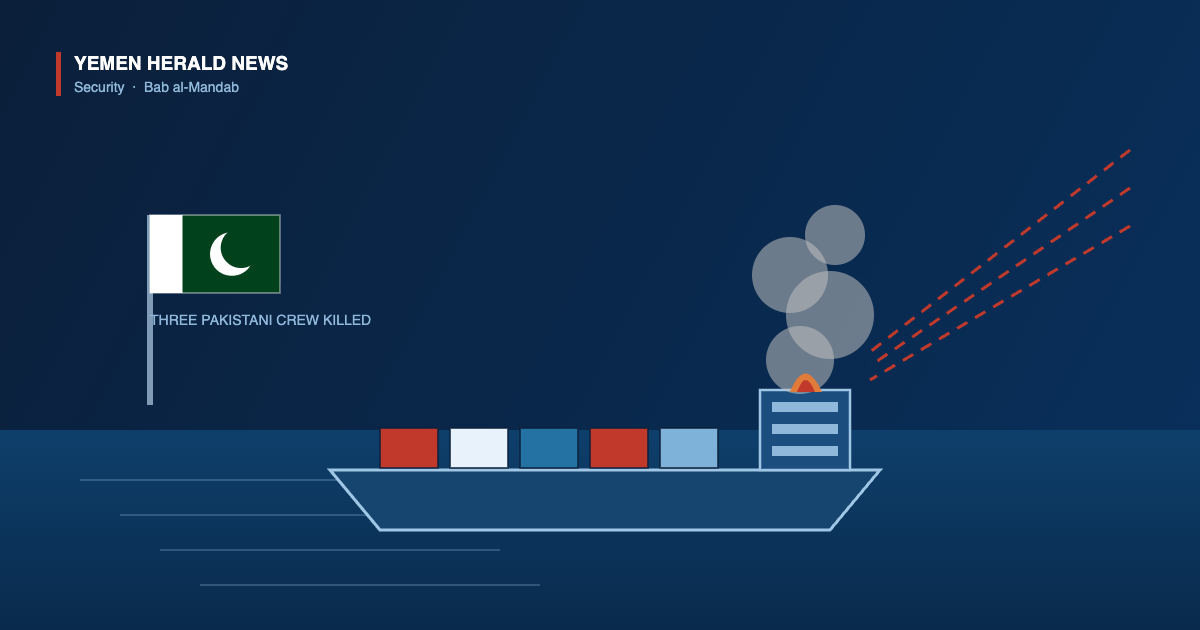
Pakistan has condemned the Houthi missile attack on a commercial vessel in the Bab al-Mandab strait that killed three of its nationals, calling the strike a flagrant violation of international law and a direct threat to freedom of navigation through one of the world’s most sensitive shipping corridors. Deputy Prime Minister and Foreign Minister Muhammad Ishaq Dar issued the condemnation after confirming that three Pakistani seafarers were among the dead, and said a further Pakistani national had been reported injured.
“Pakistan strongly condemns the Houthi attack on a non-combatant commercial vessel,” Dar said, adding that “such attacks endanger innocent lives, constitute a violation of international law, and pose a serious threat to freedom of navigation, maritime security, and the safety of commercial shipping in the Red Sea.” He extended condolences to the families of those killed and wished the injured a full recovery.
The vessel, the Tihamah, was struck while transiting the strait that separates Yemen from the Horn of Africa. Yemen’s transport ministry said the ship was hit by three successive ballistic missiles, which set it alight and caused extensive material damage, and that a further missile was fired as rescue teams tried to reach the crew. The ship was reported to have been carrying food supplies at the time.
Casualty figures were revised in the days after the attack, as is common in incidents at sea. Four crew members were confirmed killed in the initial reporting, three Pakistanis and one Indonesian, with several others injured. Yemen’s government subsequently put the total toll at six, a figure that included two members of a rescue team who died attempting to reach the burning vessel. Survivors were brought ashore and treated for burns and blast injuries.
The Tihamah’s ownership was described inconsistently in early reports, variously as Yemeni-flagged and as Egyptian-owned, a reflection of the layered registration and chartering arrangements common in regional coastal trade. What was not in dispute is that the ship was a civilian merchant vessel with a mixed international crew, carrying cargo rather than any military consignment, when it was hit.
Dar ordered Pakistani missions in the region to assist with the repatriation of the three men’s remains and to provide consular support to their families. Pakistan supplies a substantial number of officers and ratings to merchant fleets operating across the Gulf, the Red Sea and the Indian Ocean, and attacks of this kind have made the country an unwilling stakeholder in a conflict it has no part in.
Bab al-Mandab is a narrow gateway, roughly 30 kilometres across at its tightest point, linking the Red Sea to the Gulf of Aden and, beyond it, the Indian Ocean. It is the southern approach to the Suez Canal, and the volume of traffic passing through it has fallen sharply since Houthi forces began attacking merchant shipping in late 2023, pushing many operators onto the far longer route around the Cape of Good Hope.
The diversion carries a heavy cost. Rerouting around southern Africa adds thousands of nautical miles and roughly two weeks to a voyage between Asia and Europe, raising fuel bills, crew costs and delivery times, while war-risk insurance premiums for ships that still use the strait have climbed to levels that make some routes uneconomic. For Yemen itself, the effect is compounded, because the country imports the overwhelming majority of its food and fuel by sea.
The strike on the Tihamah came during a broader escalation along Yemen’s western seaboard. Houthi forces launched waves of missiles and armed drones at the government-held port city of al-Mokha on 9 and 10 August, killing soldiers and civilians and prompting the International Rescue Committee to suspend field movements across the west coast. Taken together, the land and sea attacks represent the most serious deterioration in the area for several years.
The Houthis have publicly acknowledged targeting al-Mokha port. They have not issued a comparable claim over the Tihamah; Yemen’s internationally recognised government attributes that attack to them, and the trajectory and timing described by the transport ministry are consistent with the wider campaign. Independent verification of individual maritime incidents in the strait remains difficult, and initial accounts frequently change.
The attack fits a pattern that has made the southern Red Sea one of the most dangerous stretches of water in the world for commercial crews. Since late 2023 Houthi attacks on merchant shipping have killed seafarers, wounded others, forced crews to abandon ship and sent at least two vessels to the sea floor, with the environmental consequences that follow when a laden hull sinks in a shallow, heavily trafficked waterway.
Governments and shipping bodies have repeatedly argued that crews of civilian vessels are non-combatants under international humanitarian law regardless of a ship’s flag, ownership or cargo, and that targeting them cannot be justified by any claimed connection to a party to a conflict. Pakistan’s statement echoed that position, framing the deaths of its nationals as a matter of maritime law rather than regional politics.
No timetable has been given for any formal investigation, and there is no international mechanism with a mandate to conduct one inside the strait. For the families of the three Pakistani seafarers, the immediate question is a practical one, and the foreign ministry has said the repatriation of their remains is being handled as a priority.
About the Author