Qatar Condemns Houthi Attack on Saudi Vessel as a Threat to Global Energy Security
 Yemen Herald News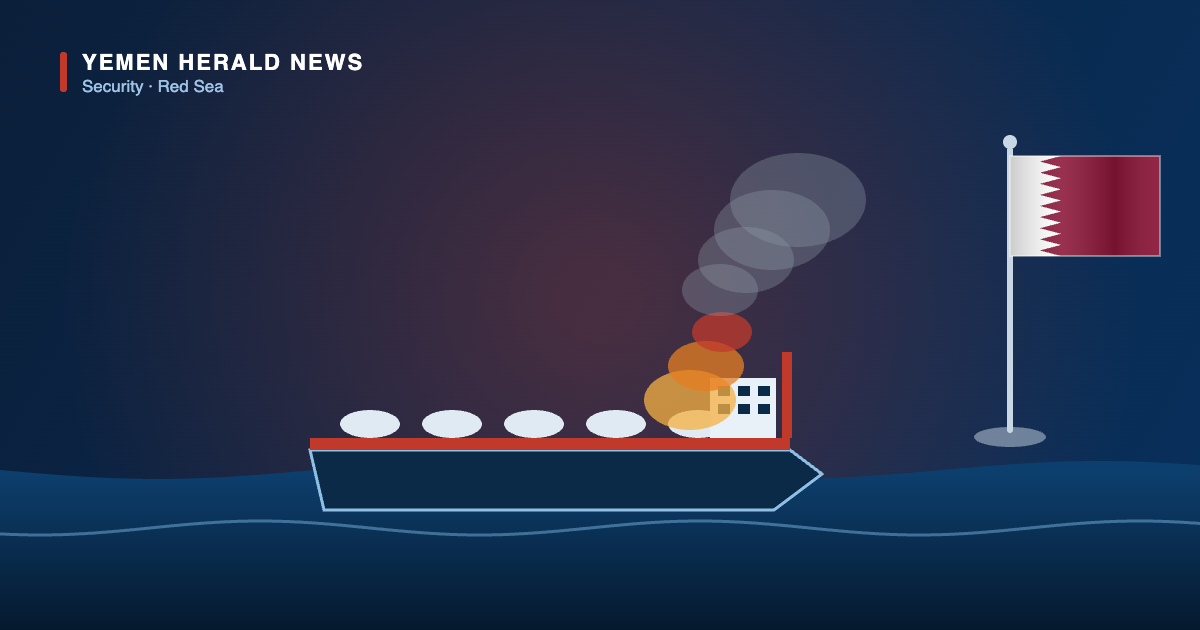
Qatar has strongly condemned the Houthi group’s targeting of a Saudi vessel in the Red Sea, calling it a serious violation of international maritime safety, a direct threat to global energy security and a clear and blatant breach of international law. In a statement issued in Doha on 23 July, the Ministry of Foreign Affairs said the continuation of such attacks represents a dangerous escalation that threatens the security and stability of the region and undermines efforts to consolidate it.
The ministry called on the international community to fulfil its responsibilities in implementing the relevant resolutions of the United Nations Security Council, naming two in particular. Resolution 2216, adopted in April 2015, imposed a targeted arms embargo on the Houthi leadership and demanded that the group withdraw from territory it had seized. Resolution 2722, adopted in January 2024 after the first wave of attacks on merchant shipping, condemned those attacks and affirmed the rights and freedoms of navigation in the Red Sea.
Doha also reiterated its full solidarity with Saudi Arabia and its support for the measures the kingdom takes to preserve its sovereignty, security and interests, stating that Saudi security is an integral part of the security of Qatar and of the Gulf Cooperation Council states. That formulation carries additional weight given recent history: Qatar spent three and a half years under a Saudi-led embargo that ended with the Al-Ula declaration in January 2021, and the two governments have since rebuilt working relations.
The statement responded to a sharp escalation off Yemen’s west coast. On 20 July the Houthis declared a maritime blockade of Saudi Arabia, informing shipping companies by email that vessels were banned from loading or unloading at Saudi ports. Two days later the group’s military spokesman, Yahya Saree, said its forces had struck two Saudi oil tankers, the Encelia and the Layla, with ballistic and cruise missiles and drones for violating that decision.
Saudi authorities confirmed that the Encelia, a products tanker that had sailed from Yanbu, caught fire after being hit and said all crew members were safe. The United Kingdom Maritime Trade Operations agency placed the strike about 70 nautical miles southwest of the Saudi coastal city of Al Shuqaiq. No casualties or pollution were reported, though at least seven vessels changed course to avoid the Bab al-Mandab Strait in the hours that followed.
The Houthis presented the embargo as retaliation for what they described as Saudi restrictions on Yemeni ports and for an airstrike on Sanaa International Airport that they attributed to the kingdom, accusations Riyadh rejects. Saudi Arabia has called the declared blockade a dangerous escalation, and condemnations followed from Bahrain, Kuwait, Lebanon, Pakistan, France, the European Union and the African Union within days.
Qatar’s emphasis on energy security reflects its own position in the market. The country is one of the world’s largest exporters of liquefied natural gas, and its cargoes leave through the Strait of Hormuz rather than the Red Sea, but vessels bound for European buyers must then transit Bab al-Mandab and the Suez Canal or take the far longer route around southern Africa. With confrontation between the United States and Iran concentrated at Hormuz and the Houthi threat at the opposite end of the Arabian Peninsula, both of the region’s principal export corridors are under strain at once.
Markets registered the combination quickly. Oil prices moved above 100 dollars a barrel on 23 July for the first time since late May, leaving crude roughly 40 per cent above its level in February. Analysts attributed the move to the risk that Saudi Arabia’s Red Sea export route could be interrupted, rather than to any actual loss of supply.
The commercial arithmetic behind those fears is well established. The Red Sea and Suez corridor is the shortest link between Asia and Europe and carries an estimated 12 per cent of world commerce. Routing around the Cape of Good Hope adds between ten days and two weeks to a voyage, along with fuel and charter costs, while war-risk premiums rise for anyone still transiting the southern Red Sea. The earlier Houthi campaign cut Suez Canal traffic roughly in half and reduced Egypt’s transit revenues to about 4 billion dollars in 2024 from a record 10.3 billion dollars the year before.
Inside Yemen the humanitarian consequences of the escalation are the more immediate concern. According to the United Nations 2026 Humanitarian Needs and Response Plan, more than 22 million people require humanitarian assistance and protection this year, including 5.2 million internally displaced people. Some 18.3 million Yemenis are acutely food insecure and more than 2.2 million children under five are acutely malnourished. Aid agencies appealed in March for 2.16 billion dollars to reach 12 million of the most vulnerable, and funding has lagged badly behind that target.
Because Yemen imports most of its food, fuel and medicine, higher freight and insurance costs pass almost directly into local prices. That happens in an economy where the rial has lost much of its pre-war value and public salaries are paid irregularly across much of the country.
Qatar has previously played a mediating role in regional disputes, and its statement leaves room for that. But the immediate question is narrower than diplomacy: whether the Houthis attempt to enforce the blockade against further vessels, and how Saudi Arabia and its partners answer if they do.
About the Author