Qatar Blames Technical Malfunction for Military Helicopter Crash That Killed Seven
 Yemen Herald News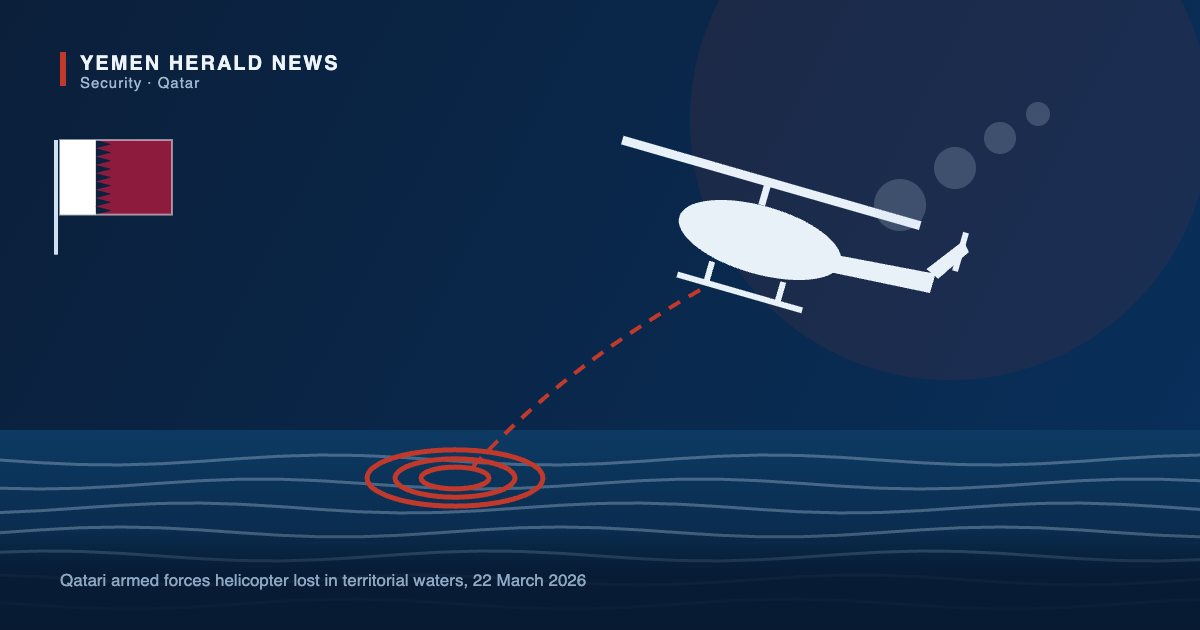
A Qatari armed forces helicopter came down in the country’s territorial waters on Sunday 22 March 2026 during a routine mission, and the Ministry of Interior said that night that search teams had recovered six of the seven people on board, all of them dead. The seventh crew member was still missing when that statement was issued. All seven were subsequently confirmed killed.
The Ministry of Defence attributed the crash to a technical malfunction. That attribution matters, because the accident happened three weeks into a regional confrontation in which Gulf states were being struck by missiles and drones, and an unexplained military aircraft loss at sea would otherwise have invited the assumption of hostile action. Qatari officials stated the cause promptly and did not link the crash to the fighting.
Search and rescue teams worked through the night in the area where the aircraft went down. The Ministry of Interior described the operation as intensive and said specialised units were involved, without initially giving details of the aircraft type or the identities of those aboard. Recovery operations at sea are complicated by depth, currents and the break-up of an airframe on impact, and Qatari authorities released information in stages as bodies were recovered.
Those killed were later identified as four members of the Qatar Armed Forces, one officer of the Qatar-Türkiye Joint Forces and two Turkish technicians. Qatari announcements named the pilot as Captain Mubarak Salem Daway al-Marri, alongside Captain Saeed Nasser Samekh, Sergeant Fahad Hadi Ghanem al-Khayarin and Corporal Mohammed Maher Mohammed. The joint forces officer was named as Major Sinan Taştekin, and the two Turkish personnel as Süleyman Cemre Kahraman and İsmail Enes Can.
The presence of Turkish personnel on board reflects a defence relationship that dates to the middle of the last decade. Turkey established a military presence in Qatar under agreements signed in 2014 and expanded it sharply after the 2017 blockade of Qatar by Saudi Arabia, the United Arab Emirates, Bahrain and Egypt, when Ankara moved troops and supplies to Doha in a public show of support. The Qatar-Türkiye Joint Forces Command grew out of that period and involves training, joint exercises and technical cooperation.
Technical malfunction remains one of the more common causes of military helicopter losses worldwide. Rotary-wing aircraft operating over water on training and patrol missions face a narrow margin for recovery when a mechanical failure occurs: autorotation to a ditching is possible in principle, but at low altitude and over sea there is little time, and survival then depends on escaping a submerged and often inverted airframe. Investigations into such losses typically take months and are not always published.
The staged release of information was itself notable. The Interior Ministry led the public communication because search and rescue at sea falls under its remit, while the Defence Ministry addressed the cause, and the two announcements arrived within hours of one another. Splitting the messages that way allowed the authorities to confirm a mechanical failure without waiting for the recovery operation to conclude, and it kept the count of confirmed dead separate from the question of what brought the aircraft down.
Reporting in the region initially carried differing figures, with some outlets giving six deaths and one missing while others moved to seven once the final crew member was recovered. That discrepancy reflects the sequence of official statements rather than any dispute about the facts, and it is a common feature of coverage of accidents where casualty confirmation is incremental.
The timing nonetheless placed the crash in a difficult information environment. Since 28 February 2026, when the United States and Israel began strikes on Iran, Iranian retaliation had reached targets in several Gulf states. Missile and drone attacks had been reported against sites in the United Arab Emirates, Bahrain and Kuwait, and air defences across the peninsula were engaging regularly. Rumour attaches quickly to military losses in those conditions, which is a plausible reason for the speed of the Qatari statement on cause.
Qatar occupies a particular position in the region. It hosts Al Udeid Air Base, the largest United States military installation in the Middle East and the forward headquarters of United States Central Command, while simultaneously maintaining working relations with Tehran, with which it shares the world’s largest natural gas field. Doha has spent years building a role as a mediator, hosting talks on Afghanistan, Gaza and other files, and has generally sought to keep itself out of direct confrontation.
That balance was under strain throughout March 2026. The threat to shipping through the Strait of Hormuz affected liquefied natural gas exports on which the Qatari economy depends, and the presence of a major American base made the country a potential target in a war it had no part in starting. A conditional ceasefire was declared on 8 April 2026.
The loss of seven personnel in a single accident is severe for a military the size of Qatar’s, which numbers in the low tens of thousands across all branches. Deaths of this kind are recorded publicly, and the naming of the dead in official announcements, including the Turkish personnel, followed the standard practice of both countries.
No findings from a technical investigation into the crash were made public in the period covered by this report. The Ministry of Defence’s initial attribution to a technical malfunction remained the official account of the cause.
About the Author