Qatar Says Its Air Defences Intercepted Iranian Missiles in a Week of Barrages
 Yemen Herald News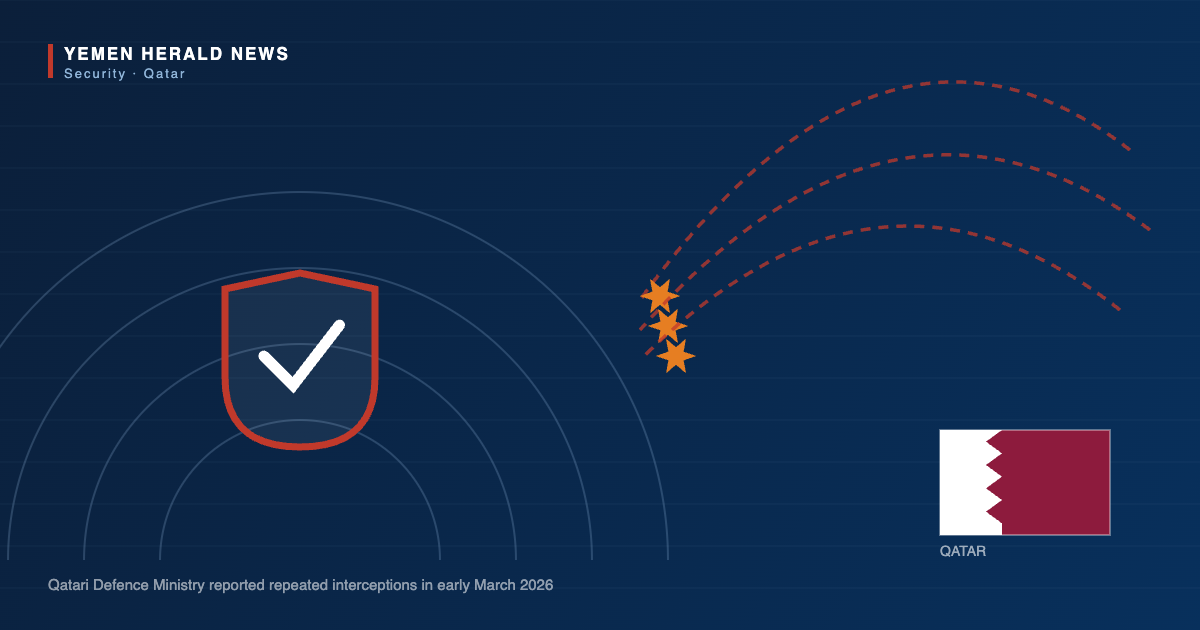
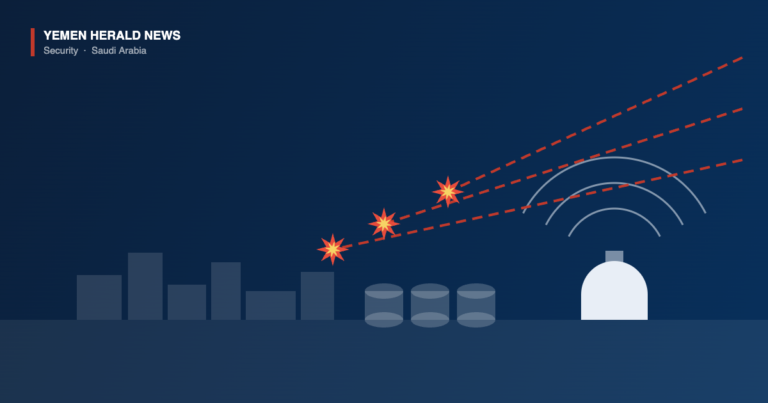
Qatar’s Ministry of Defence said in early March 2026 that the country had been targeted by missiles launched from Iran and that its armed forces had intercepted much of the incoming fire. In a statement posted on its official account, the ministry described an attack involving twelve missiles—ten ballistic and two cruise—and said six of the ballistic missiles were intercepted, two came down in Qatari territorial waters and two landed in an uninhabited area, causing no casualties. Both cruise missiles, it said, were brought down.
That account should be read as the ministry’s own, issued at the height of a fast-moving air campaign. Qatari statements in this period were released almost daily and the tallies in them varied considerably from one to the next; the figures were not independently verified at the time, and no comprehensive reconciliation of them has been published since.
The barrages were part of a wider Iranian campaign against Gulf states hosting United States military assets, which began after US and Israeli strikes on Iran at the end of February 2026. Qatar, Saudi Arabia, Bahrain, Kuwait, the UAE and Jordan all reported incoming missiles or drones during the same weeks, and several of them activated air defences repeatedly.
The scale across the Gulf as a whole was substantial. Bahrain’s representative at the United Nations said in mid-March 2026 that the Gulf Cooperation Council states had collectively intercepted more than 954 Iranian missiles, some 2,500 drones and 17 aircraft since the campaign began. Those are figures supplied by the defending governments, and no independent audit of them exists, but they give a sense of the volume of fire the region’s air defences were being asked to absorb.
The sequence in Qatar was dense. On 1 March the Defence Ministry said it had detected 65 ballistic missiles and 12 drones, and reported intercepting 18 ballistic missiles. On 2 March Qatar announced that it had downed two Iranian fighter aircraft, and described a combined assault involving Su-24 aircraft, ballistic missiles and drones in which the Emiri Navy took part in the engagements alongside the air force—an unusual public acknowledgement of naval participation in air defence.
Not everything was stopped. On 3 March an Iranian ballistic missile penetrated Qatari defences and struck Al Udeid Air Base, the largest American military installation in the Middle East and the forward headquarters of US Central Command. Qatar’s Defence Ministry said two missiles had been launched towards Qatari territory, that one was intercepted and the other impacted the base, and that there were no casualties. On 4 March the ministry announced the interception of ten drones and two cruise missiles.
By 7 March, interceptions were being reported simultaneously over Saudi Arabia, Qatar, the UAE and Bahrain as the campaign widened across the Gulf. On 15 March the Qatari ministry said that all missiles targeting the country that day had been intercepted.
Al Udeid is central to understanding why Qatar was targeted at all. The base hosts the forward element of CENTCOM and has been the launch and coordination point for American air operations across the region for two decades. Iranian officials have consistently framed strikes on Gulf territory as responses to US military action mounted from those facilities rather than as attacks on the host states themselves—a distinction the host governments have rejected.
For Doha the episode was diplomatically awkward in a way it was not for some of its neighbours. Qatar has maintained working relations with Tehran, shares the world’s largest natural gas field with Iran, and has spent years positioning itself as a mediator in regional disputes, including between Washington and Tehran. Being struck by Iranian missiles while hosting the American command that Iran was retaliating against placed those roles in direct tension.
There was an economic dimension too. Qatar is the world’s largest exporter of liquefied natural gas, and its cargoes leave through the Strait of Hormuz. Reporting during the same period indicated that QatarEnergy production facilities had sustained damage. European and Asian gas prices moved sharply on the combination of shipping risk and supply disruption, transmitting the consequences of the Gulf fighting well beyond the region.
The intensity of the campaign also placed strain on interceptor stocks across the Gulf. Ballistic missile defence relies on expensive munitions held in limited numbers, and a defender expending several interceptors against each incoming missile is trading at a ratio that favours the attacker. Sustained barrages of the kind reported through March 2026 test magazine depth as much as radar coverage.
Qatar’s air defence architecture was built for precisely this scenario, layering ground-based interceptors with allied radar coverage and, as the March statements made clear, naval assets. The record of those weeks suggests it performed as designed against most of what was fired at it, while also confirming what defence planners have long argued: no integrated system achieves complete coverage against saturation attacks combining ballistic missiles, cruise missiles and drones on the same axis.
What remains unclear is the full accounting. The Qatari statements were issued in the middle of an active campaign, when air defence claims are rarely precise and when governments have obvious reasons to project competence. The broad shape of events—repeated Iranian launches, largely successful Qatari interceptions, and at least one missile reaching Al Udeid—is corroborated across multiple independent outlets. The specific numbers in any single ministry statement, including the one that prompted this report, are not.
About the Author