Saudi coalition says it downed drones aimed at Mecca as Houthis deny targeting the city
 Yemen Herald News
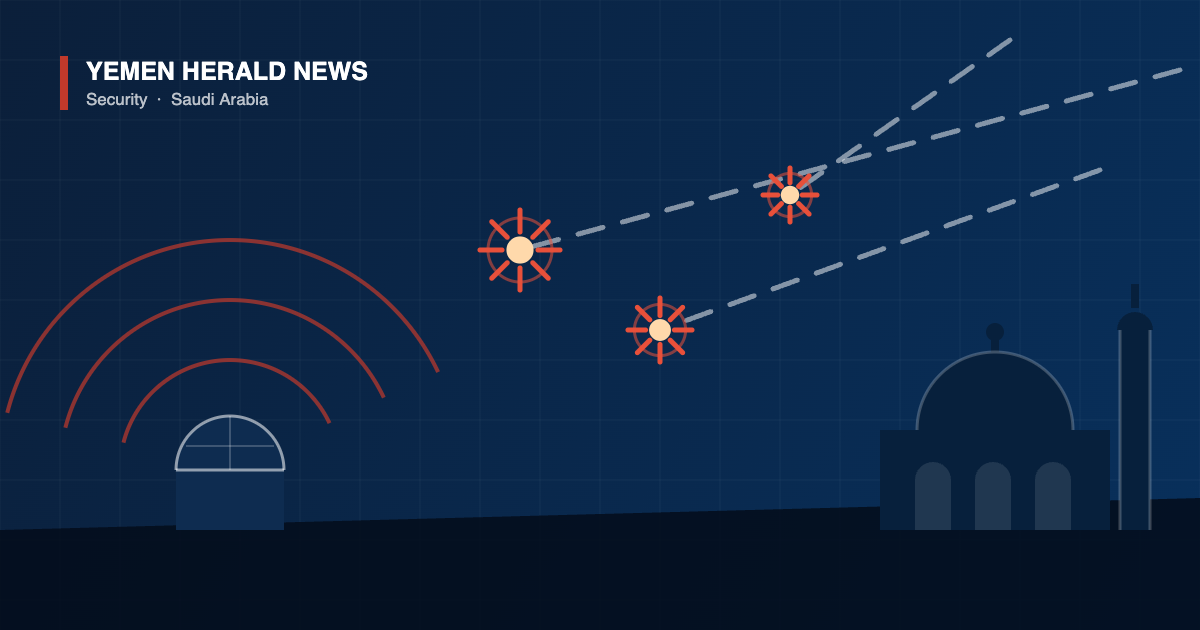
RIYADH, Saudi Arabia — Saudi Arabia said it intercepted seven Houthi missiles and drones on Wednesday, including two drones it said were aimed at Mecca.
The Houthis denied sending a drone at the city.
The Saudi-led military coalition fighting the group said it destroyed three cruise missiles headed for the Riyadh region, two drones directed at Mecca and southern areas, and two missiles aimed at the west of the kingdom, Reuters reported.
It was the second consecutive day the coalition said it had brought down missiles over the Riyadh region.
Yahya Saree, the Houthi military spokesman, denied that the group had targeted Mecca. Its operations are directed at oil facilities and military bases, he said.
Saree said the Houthis had struck a pumping station at Yanbu, a Red Sea port that handles Saudi crude routed away from the Strait of Hormuz, which Reuters described as blocked.
There was no Saudi confirmation of that claim, the agency said. Saree’s statement carried no damage assessment for Yanbu.
Saudi civil defence issued alerts for Taif, Yanbu and Khamis Mushait later on Wednesday, then said the danger had passed, according to Saudi state television.
Yanbu appears in both accounts. The civil defence named it among the areas it warned, and Saree named it as a target.
Each side’s account of its own operations rests on that side alone. Yemen Herald could not independently verify what happened at Yanbu, or whether any weapon was directed at Mecca.
The coalition named no spokesman for Wednesday’s statement and reported no casualties or damage. It did not say where the intercepted weapons came down.
Mecca is the site of the Grand Mosque and the destination of the annual hajj pilgrimage.
Saudi Arabia has accused the Houthis of firing toward Islam’s holiest sites before, and the group has denied it each time.
On Oct. 28, 2016, the coalition said it intercepted a ballistic missile about 65 kilometres from Mecca that had been launched from Saada province in northern Yemen. Al Jazeera reported at the time that the weapon had travelled more than 500 kilometres across the border.
Mohammed al-Bekheity, a Houthi leader, denied the city was the target. “We do not target civilians and, in turn, we would not target holy areas,” he said at the time, according to Al Jazeera.
Houthi-run media said that missile had been aimed at King Abdulaziz International Airport in Jeddah. An airport official told Al Jazeera there had been no strike there.
The Houthi-run Saba news agency said the missile had hit the airport directly and caused heavy destruction. Flight tracking showed no significant delays that morning, Newsweek reported.
Earlier that month, on Oct. 9, 2016, the coalition said it intercepted a missile near Taif, a city about 70 kilometres from Mecca that hosts a Saudi air base. Taif was among the three places Saudi civil defence warned on Wednesday.
Bahram Ghasemi, then a spokesman for Iran’s foreign ministry, called the 2016 allegations ridiculous.
Hisham Al-Omeisy, an independent analyst based in Yemen, said in 2016 that the Saudi allegations were a means of stoking religious anger against the Houthis.
Wednesday’s exchange followed a run of attacks on Saudi territory.
The coalition said that on Tuesday it downed a ballistic missile and a cruise missile fired toward Riyadh. Maj. Gen. Turki al-Maliki, the coalition spokesman, said a second ballistic missile was brought down over southern Saudi Arabia.
He set out that account in a series of posts on X. Explosions were heard in Riyadh and residents received text-message alerts telling them to take shelter, AFP reported. Saudi civil defence raised warnings for Riyadh, Abha and Khamis Mushait, then lifted them. No deaths or injuries were reported.
A Houthi attack on Sunday damaged an Aramco administrative building in Riyadh’s financial district, Reuters reported.
An attack last month on King Khalid International Airport in Riyadh killed 13 people and wounded more than 300, according to Reuters.
Fighting has intensified since September, when Houthi forces advanced toward the Bab al-Mandab strait, the agency said. The group has stepped up strikes on Saudi airports, ports and oil installations, and Saudi Arabia has increased air strikes on Houthi targets in Yemen.
The Houthis are aligned with Iran and hold most of Yemen’s populous areas, according to Reuters.
Yanbu lies on Saudi Arabia’s Red Sea coast, north of Jeddah. Khamis Mushait, in the south-west, lies near the Yemeni border.
The war inside Yemen has widened over the same period. The UN Human Rights Office has verified 281 civilian casualties since early August, 69 of them deaths and 212 injuries, with children accounting for more than a third.
The UN Office for the Coordination of Humanitarian Affairs put displacement at more than 313,000 people since the beginning of August, with Taiz governorate taking in more than two in five of them.
The FAO-WFP Hunger Hotspots report published on June 17, 2026 kept Yemen at its highest level of concern. It projected about 5.4 million people in government-controlled areas at crisis level or worse between October and December 2026, with the number in the emergency band rising 9 percent to 1.8 million. Armed conflict is a primary driver in 12 of the 13 hotspots the report names.
That report’s data cutoff was June 5, 2026.
About the Author


 Adel Haddad