Saudi-led coalition warns against use of traditional boats to smuggle weapons to Houthis
 Yemen Herald News
RIYADH, Saudi Arabia — The Saudi-led coalition in Yemen warned owners of traditional boats on Monday not to carry weapons for the Houthis, its Joint Forces Command said.
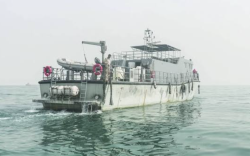
The command named four types of traditional craft — za’ima, huri, jalbah and sanbuq — and said the Houthis use them to move weapons, missiles and military equipment by sea, Asharq Al-Awsat reported.
Photographs of the four boat types accompanied the statement.
The command called on all owners and operators of such vessels to refrain from dealing with the Houthis.
It said avoiding involvement in the shipments was necessary to protect crews, vessels and property.
It said the traffic endangers Yemen’s security as well as regional and international stability, and puts civilian lives at risk.
The command said organised crime groups working with the Houthis carry out the smuggling.
The account of the warning rests on the coalition’s own statement. Yemen Herald found no independent confirmation of the specific shipments it describes, and the Houthis had published no response to it.
The coalition also released footage it said showed the tracking and targeting of smuggled weapons and of vessels used to carry them off Yemen’s coast, Asharq Al-Awsat reported on Tuesday. The coalition did not say what was destroyed or where.
Al Jazeera reported, citing a coalition forces source, that the coalition had intercepted and destroyed a shipment of smuggled weapons off the Yemeni coast. The report gave no date, location or quantities.
The Joint Forces Command said the shipments threaten security in Yemen and beyond.
Gulf Cooperation Council foreign ministers met on Oct. 18 and called for freedom of navigation and safe passage through Bab al-Mandab and the Strait of Hormuz, Al Arabiya reported. They condemned continued Houthi attacks on Saudi Arabia.
The United Nations has restricted arms transfers to Yemen for more than a decade. The Security Council imposed a targeted arms embargo in 2015 on the Houthis and allied forces.
In March 2022 the council expanded that embargo to cover the Houthi movement as a whole. It described the group as a terrorist group for the first time in the same resolution.
The wider pattern the coalition describes has been examined by the United Nations. The UN Panel of Experts on Yemen reported continued violations of the arms embargo in its final report to the Security Council, including concealment and misdeclaration of cargo.
The panel said detections rose after airstrikes damaged Hodeidah port and vessels were diverted to Aden.
It reported that the Yemeni government seized 750 tons of illicit materiel and weapons in June 2025.
That seizure included cruise, anti-ship and anti-aircraft missiles, the panel said. It said several items resembled Iranian-made weapons, among them the Ghadir anti-ship cruise missile, the Shahed drone, the AM-50 Sayyad anti-materiel rifle and the Misagh man-portable air defence system.
The panel also found that the Houthis used intermediaries and front companies in the region to evade sanctions.
It said it was investigating Houthi ties with al-Shabaab in Somalia, including weapons smuggling, training and logistical support.
Iran has denied arming the Houthis.
The panel reports to the Security Council’s Yemen sanctions committee, which monitors compliance with the embargo.
Its findings are compiled from member-state submissions, site inspections and documentary evidence rather than from any party to the war.
A Security Council report in 2021 identified supply routes that used dhows.
Dhows transfer cargo from larger ships in Omani and Somali waters to smaller boats, which deliver to southern Yemeni ports or pass through Bab al-Mandab, according to Wolf-Christian Paes of the International Institute for Strategic Studies. Paes served on the UN Panel of Experts on Yemen from 2018 to 2023.
Conflict Armament Research analysed components seized from the dhow Al-Sherwa on June 25, 2025, in a report published this year. It found that about 5 percent of the documented components were Iranian-made.
Hundreds of the components were linked to at least a dozen weapon systems and bore the marks of companies in at least 16 countries or territories, the group said.
US forces boarded the unflagged dhow Yunus in the Arabian Sea off Somalia on Jan. 11, 2024, and seized Iranian-made ballistic missile and anti-ship cruise missile components and a warhead. Two US Navy SEALs drowned during the operation.
Paes has said seizures are “only the tip of the iceberg,” which he attributes to corruption.
The coalition spokesman, Maj. Gen. Turki al-Malki, said last week that coalition forces had destroyed 127 Houthi weapons storage sites in mountainous areas, along with missile launchers, Al Arabiya reported.
The Houthi military spokesman, Yahya Saree, said on Monday that the group had attacked energy facilities, two airports and military sites.
The Yemeni government’s armed forces said they had carried out 1,164 targeting missions over 24 hours. Yemen Herald did not independently verify that figure, and the government gave no breakdown of the targets.
The Bab al-Mandab strait, between Yemen and the Horn of Africa, links the Red Sea to the Gulf of Aden.
The coalition intervened in Yemen in March 2015, after the Houthis forced the government from the capital, Sanaa.
Its Joint Forces Command issues its statements from Riyadh.
About the Author