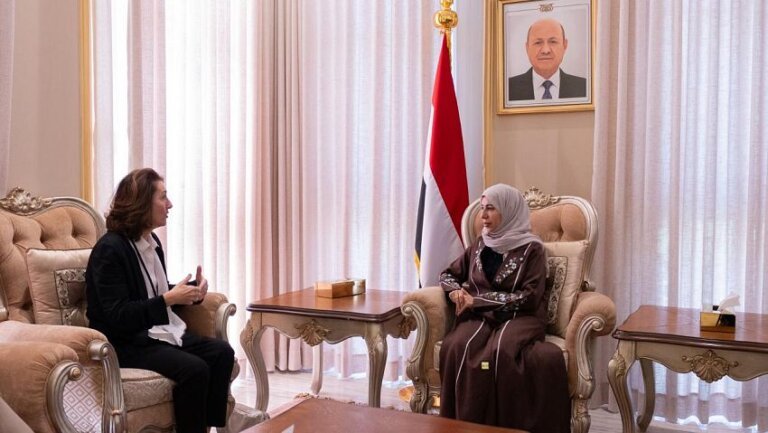
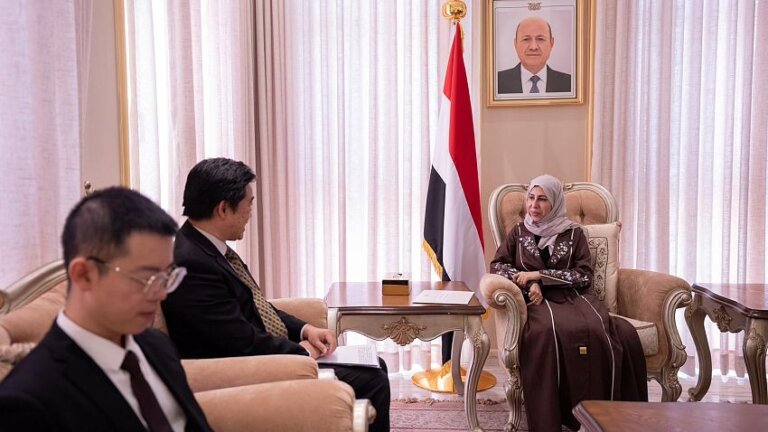
Shura Council chairman Ahmad Obaid bin Daghr praises Kuwait’s aid in Riyadh talks
 Yemen Herald News
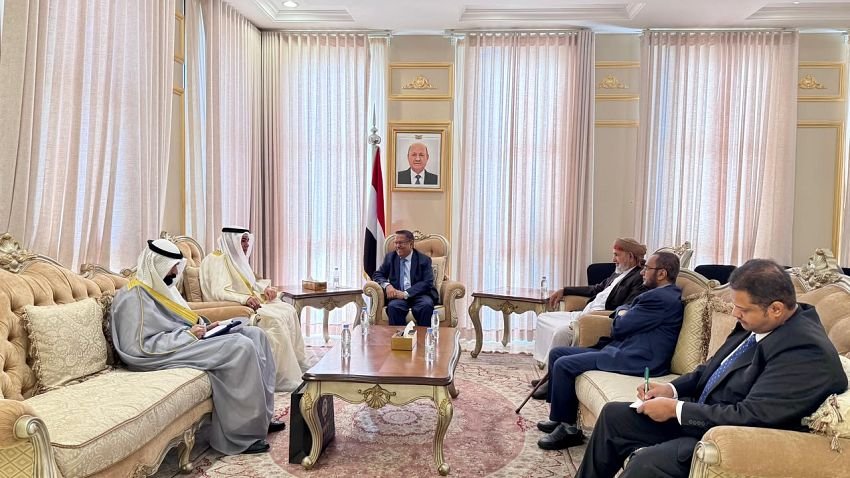
RIYADH, Saudi Arabia — Yemen’s Shura Council chairman praised Kuwait’s aid to Yemen in a meeting with Kuwait’s ambassador on Tuesday, the state news agency Saba reported.
Ahmad Obaid bin Daghr, chairman of the Shura Council, received Falah al-Mutairi, Kuwait’s ambassador to Yemen, in the Saudi capital, the agency said.
The two discussed relations between the two countries and cooperation across several fields, according to Saba.
Yemen Herald could not independently verify the account. Saba is the Yemeni government’s own news agency, and no independent confirmation of the meeting has been published.
Bin Daghr praised Kuwait’s humanitarian, relief and development assistance, Saba reported. He said it reflected long-standing ties between the two countries.
He commended the Saudi-led Coalition to Support Legitimacy in Yemen for backing the government’s effort to end what he called the Houthi coup, the agency said.
He condemned Houthi attacks on civilian facilities and on Saudi airports.
He also condemned an attack this month on the al-Alam Training Center in Shabwa governorate, which killed security recruits, Saba said.
The Associated Press reported on Monday that the toll from the strike on the training camp had risen to 73. Earlier counts had put the number at 53, 58 and 60 as bodies were recovered over several days.
Multiple news organisations, including The Associated Press, reported the strike as a Houthi attack. The Yemeni government has said the Houthis carried it out.
Bin Daghr urged Gulf Cooperation Council states to strengthen solidarity and coordination against the Houthis, whom he described as a tool of Iranian expansion in the region, according to Saba. The Houthis reject that characterisation and present themselves as an independent national movement.
Al-Mutairi reaffirmed what he called the historical ties between the two countries, the agency said. He added that Kuwait would continue its humanitarian and development support for Yemen.
It was the second meeting between the Kuwaiti ambassador and a senior Yemeni official in Riyadh in three days. Sultan al-Barakani, speaker of Yemen’s House of Representatives, met al-Mutairi in the city on Sunday and also praised Kuwait’s aid, Saba reported at the time.
Times Kuwait carried an account of the bin Daghr meeting on Wednesday, also citing Saba. That version placed the talks in Aden rather than Riyadh. The location given here follows the originating agency report.
Bin Daghr, 73, was Yemen’s prime minister from April 2016 until October 2018, when President Abdrabbuh Mansour Hadi dismissed him. He had served as minister of communication from 2011 to 2014 and as deputy prime minister before that.
Bin Daghr was born in 1952 in Shibam, in what was then the Aden Protectorate. He succeeded Khaled Bahah as prime minister and was followed in the post by Maeen Abdulmalik Saeed.
He was appointed chairman of the Shura Council in January 2021. The Southern Transitional Council criticised the appointment at the time.
The Shura Council has 111 members, appointed by the president under Yemen’s constitution. It is an advisory body and has no legislative role, though it sits with the House of Representatives to confirm presidential nominees and to vote on budgets and treaties.
The war has left two bodies claiming the name. Bin Daghr heads the council aligned with the Presidential Leadership Council, while a separate council in Sanaa under Houthi control is headed by Muhammad Hussein al-Aidarous.
Yemen’s internationally recognised government and several of its institutions have operated from Riyadh and Aden since the Houthis took the capital, Sanaa, in 2014.
Kuwait has a record in Yemen diplomacy. It hosted UN-brokered talks between the Yemeni government and the Houthis that began in April 2016 and ended that August without an agreement.
Kuwait was also among the states that joined the Saudi-led coalition when it intervened in Yemen in March 2015, after the Houthis forced the government from Sanaa.
Gulf Cooperation Council foreign ministers met on Oct. 18 and called for freedom of navigation through Bab al-Mandab and the Strait of Hormuz, Al Arabiya reported. They condemned continued Houthi attacks on Saudi Arabia.
Kuwait is one of the council’s six member states.
Aid needs in Yemen remain among the largest the United Nations tracks. The humanitarian needs and response plan for 2026, published by OCHA in March, put the number of people requiring assistance at more than 22 million.
The plan recorded 18.3 million people as acutely food insecure. It counted more than 2.2 million children under five as acutely malnourished, 516,157 of them severely.
It put the number of internally displaced people at 5.2 million, and sought 2.16 billion dollars to reach 12 million people.
Funding has lagged behind those figures. OCHA reported that Yemen’s 2025 response plan was 25 percent funded.
It also reported that 453 health facilities across 22 governorates had faced partial or imminent closure since January 2025. The list included hospitals, primary health centres and mobile clinics.
OCHA described Yemen’s health system as on the brink in that update.
Times Kuwait listed health, education and humanitarian relief as the sectors Yemeni officials cited in praising Kuwait’s support. Neither that account nor the Saba report gave figures for Kuwait’s contributions.
Times Kuwait gave the ambassador’s full name as Falah Fahad al-Mutairi.
Kuwait’s embassy to Yemen operates from Riyadh, as do several foreign missions accredited to the Yemeni government.
About the Author