Taiz Launches Rehabilitation of the 26-Kilometre Nashmah-Hawban Qadas Road
 Yemen Herald News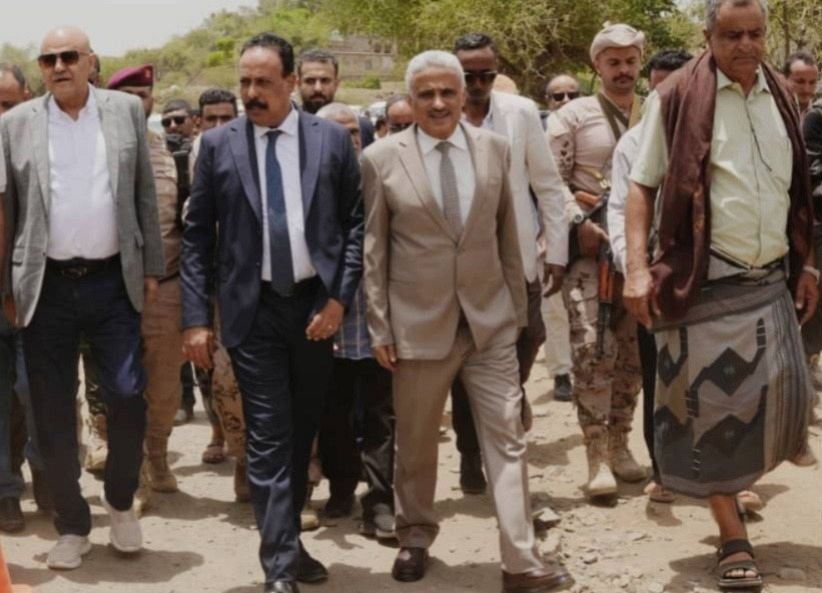
The minister of public works and roads, Hussein al-Aqrabi, and the governor of Taiz, Nabil Shamsan, inaugurated work on Saturday on the rehabilitation of the Nashmah-Hawban Qadas road, a 26-kilometre route in Taiz governorate that the local authority describes as one of its priority infrastructure projects.
The project is financed by the Road Maintenance Fund and carried out by the General Corporation for Roads and Bridges. According to the launch announcement, it covers maintenance and rehabilitation along the length of the route together with the installation of road safety measures, rather than the construction of a new alignment.
Shamsan said the road was one of the governorate’s key infrastructure projects and would significantly improve mobility while serving thousands of residents. He described the route as an important transport corridor linking several areas and population centres, and said upgrading it would support economic activity and make it easier for people living along it to reach essential services.
Al-Aqrabi has held the public works and roads portfolio through a period in which the ministry’s work has been dominated by repair rather than expansion. Much of Yemen’s paved network was built decades ago and has had little systematic maintenance since the war began, and the ministry’s project list is weighted towards restoring corridors that already exist and reopening routes that fighting closed. The Taiz launch fits that pattern: a rehabilitation of an existing road on which traffic already depends.
Roadworks carry a weight in Taiz that they would not carry elsewhere. The governorate has been among the most heavily affected by the war that began in 2015, and for years front lines ran directly across the main routes into and around Taiz city. Drivers were forced onto long detours over unpaved mountain tracks, turning journeys that had taken minutes before the war into trips of several hours and adding cost and risk to the movement of everything from fuel to medical supplies.
Hawban, on the eastern approach to Taiz city, is the governorate’s main industrial area and the location of much of its manufacturing capacity. The principal road between Taiz city and Hawban was reopened in 2025 after years of closure, a step reported at the time as easing civilian movement and the passage of goods, although residents and local reporting have continued to describe the wider network as degraded.
The economic case for maintenance work of this kind is straightforward. Yemen imports the great majority of its staple food and its fuel, and the cost of moving those goods inland from the ports forms a meaningful part of what households eventually pay. Where surfaces are broken and detours are long, transport costs rise, vehicles wear out faster and traders pass the difference on. Restoring a usable surface on a corridor that links population centres therefore has effects well beyond the convenience of the drivers who use it.
The Road Maintenance Fund, which draws on revenues earmarked for road upkeep, has operated under severe constraints during the conflict, as have the other institutions of the internationally recognised government. State revenues have been fragmented between rival authorities, the currency has lost much of its value in areas under government control, and the ministry has at times had to suspend projects for lack of funding. The public works ministry has previously discussed stalled projects in Taiz with the governorate, and has also reviewed cooperation on road maintenance with the United Nations Office for Project Services, which has implemented infrastructure work in Yemen on behalf of donors.
No completion date or cost figure was published at the launch. Projects of this type in Yemen have frequently taken longer than announced, held up by funding shortfalls, currency depreciation that erodes budgets between approval and execution, and security incidents along the route.
There is also a governance dimension. For a government that controls part of the country and is competing for legitimacy with the Houthi authorities in the north, visible public works in the areas it administers are a way of demonstrating that it can still deliver services. Infrastructure announcements have accordingly become a regular feature of official communications, and are watched by residents less for the ceremony than for whether the work is finished.
The humanitarian argument runs alongside the economic one. Road condition determines how quickly ambulances can reach hospitals, whether relief convoys can move without transferring loads to smaller vehicles, and how far farmers can carry produce before it spoils. Aid agencies operating in Taiz have consistently identified access constraints, including the state of roads, as a factor limiting the reach of their programmes.
Taiz remains one of Yemen’s most populous governorates and, before the war, was a centre of commerce and light industry. Much of that activity has been disrupted, but the Hawban industrial zone has continued to function, and the roads connecting it to markets and to the port routes are part of what determines whether it can operate at scale.
For now the announcement marks a start rather than a result. The governorate says the corridor will serve thousands of people once the work is complete; the test will be whether the rehabilitated surface is delivered on the ground and maintained afterwards, in a governorate where earlier repairs have often not survived long.
About the Author