
Houthi Levy Campaign Widens to Sanaa Small Businesses as Revenues Tighten
 Yemen Herald News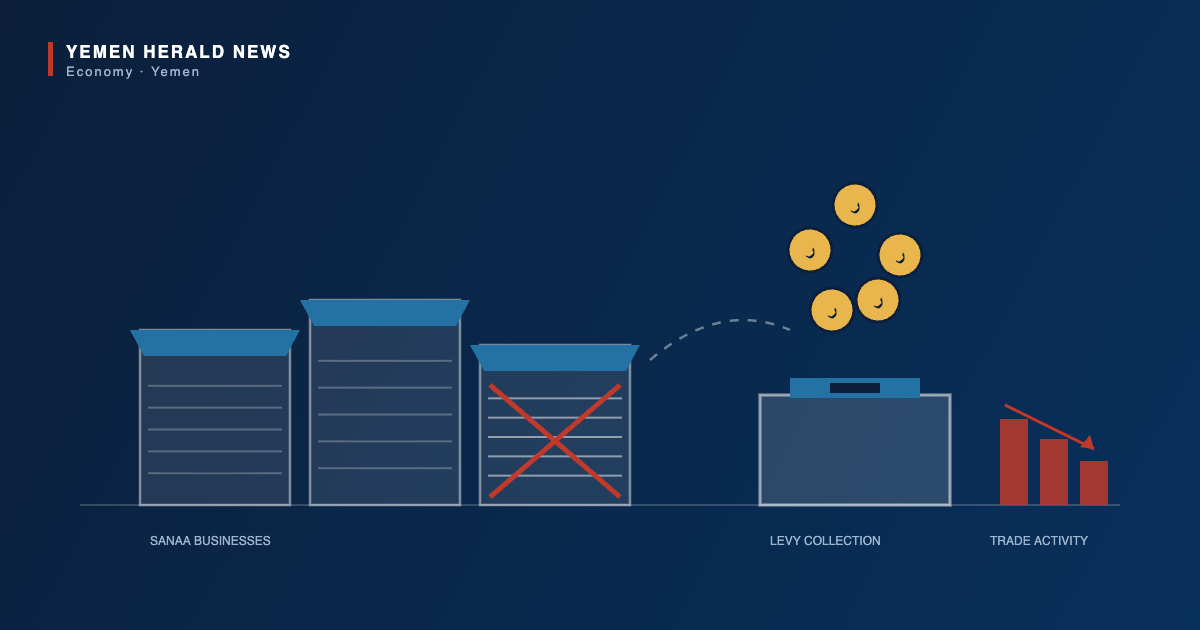
In the months around Eid, businesses in Sana’a faced a renewed round of financial demands from the Houthi authorities that control the capital, collected under the banner of an “Eid Convoy” campaign. Directives circulated at the time urged citizens and traders to transfer money through a commercial bank and a widely used mobile wallet, with the proceeds presented as support for fighters on the front lines. Traders in the city described the contributions as compulsory in practice, whatever their formal framing.
Reporting by Yemeni outlets and accounts from business associations described collections in both cash and kind. Around Eid al-Adha, traders said they were pressed to hand over livestock for sacrifice alongside cash payments. Wholesalers and retailers said collection teams visited premises directly, and that refusal carried consequences: threatened closure, revocation of trading licences, fines set at levels traders called punitive, and in some accounts detention.
What businesses reported as new was the reach of the campaign rather than its existence. Levies had previously fallen mainly on larger importers and wholesalers. Business circles said this round extended to small and medium enterprises, workshops and single-owner shops that had not been targeted before, widening the base at a point when many of those businesses were already operating on thin margins.
Economists cited in Yemeni coverage read that expansion as a sign of fiscal strain rather than strength. Reliance on exceptional, ad hoc levies, they argued, indicates that ordinary revenue is falling short: commercial activity in Houthi-held areas has slowed, household purchasing power has weakened and investment has contracted. A tax base that has to be widened repeatedly by decree is usually one that is shrinking.
Religious and seasonal occasions have become a recurring vehicle for these collections. Yemeni outlets have documented similar drives tied to the Mawlid observance, and have reported comparable levy campaigns outside the capital, including in Ibb governorate, where the group is said to have widened the categories of business and property covered. The pattern suggests a template applied across areas under the movement’s control rather than a measure specific to Sana’a.
The Houthi authorities have not published accounts for the campaign, and no independent audit of the sums raised exists. The internationally recognised government, which has made the group’s finances a recurring theme in its diplomacy, describes the collections as extortion, and officials including Information Minister Muammar al-Eryani have raised the issue publicly. Those are the government’s characterisations; the Houthis reject them and present the contributions as voluntary community support.
The dispute plays out against a fiscal landscape divided since 2016, when the central bank’s operations split between Aden and Sana’a. Public sector salaries in the north have gone largely unpaid, or paid only in part, since then, leaving households dependent on remittances, informal work and assistance. In that setting, an additional charge on shops and workshops feeds quickly into retail prices.
The government has also alleged designs on revenue beyond Yemen’s land borders. Information Minister al-Eryani has said the group intends to establish a body to collect fees from commercial vessels transiting the Red Sea, a claim carried by regional media and not independently confirmed. Whether or not that scheme materialises, it reflects how central the search for new revenue streams has become to the movement’s administration.
Merchants have occasionally pushed back. Traders in Sana’a have staged strikes and closures over Houthi financial and customs measures, shutting markets in protest at tax and fee decisions. Those actions have tended to be short and localised, but they indicate that a commercial sector historically cautious about open confrontation has been willing to register objections.
The business community in the capital occupies an awkward position. It cannot easily relocate: import licences, warehousing and customer bases are tied to the areas the group controls, and moving operations south means entering a different monetary regime, since the two zones circulate banknotes of sharply different value. That immobility is part of what makes the sector a dependable source of revenue.
Yemen imports the large majority of its food, fuel and medicine, so costs imposed at the wholesale level pass down the chain quickly. Traders have said that levies, alongside customs charges applied at internal crossings between the two zones, are among the reasons identical goods carry noticeably different prices in Sana’a and in government-held cities.
Whether the campaign marks a durable change in how the group finances itself, or a response to one difficult year, is not clear from the available reporting. What can be established is the direction of travel: the demands have become more frequent, the categories of business covered have widened, and the framing has moved from appeal towards directive.
For the businesses concerned, the practical question is narrower than the political one. Each round of collection reduces working capital in a sector already contending with currency depreciation, irregular electricity and an import chain exposed to disruption in the Red Sea. The cumulative effect is a commercial base that is smaller and more fragile with each passing year.
Aid organisations working in the north have faced their own frictions with the authorities over access, staffing and administrative charges, and in 2025 several United Nations premises in Sana’a were raided and staff detained. Those disputes are formally separate from the levies on traders, but they contribute to the same operating environment, in which commercial and humanitarian actors alike report growing administrative pressure.
About the Author




