Southern Transitional Council Marks Ninth Anniversary of Aden Declaration
 Yemen Herald News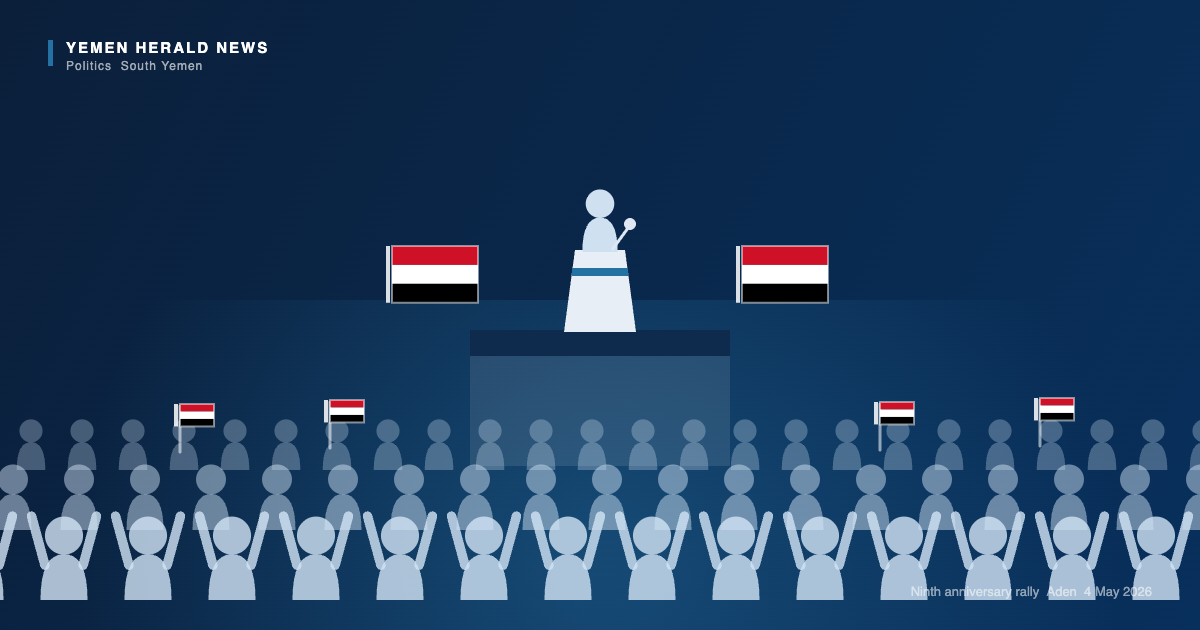
On 4 May 2026 the Southern Transitional Council marked the ninth anniversary of what it calls the Aden Historic Declaration with a mass rally in Aden, a demonstration the movement presented as a renewal of the popular mandate granted to its president, Aidarous al-Zubaidi. The council staged parallel events in Mukalla and Seiyun, but the main gathering was held in the southern port city that has served as the interim seat of Yemen’s internationally recognised government since 2015. Organisers framed the turnout as evidence that the demand for southern self-determination remains a dominant political current across the territory of the former South Yemen, and used the occasion to restate the council’s claim to speak for that constituency in any future settlement.
The declaration being commemorated dates to 4 May 2017, when a large crowd assembled in Aden’s Freedom Square, in the Khormaksar district, to hear a speech by al-Zubaidi delivered shortly after President Abd Rabbuh Mansur Hadi had dismissed him as governor of the city. The gathering mandated him to form a southern political leadership, and one week later, on 11 May 2017, he announced the establishment of a twenty-six-member Southern Transitional Council with himself at its head. The council has since described that sequence of events as its founding moment, and the anniversary has become the movement’s principal annual set-piece.
The context in which the council emerged is the war that has fractured Yemen since 2014, when Houthi forces took control of Sanaa and subsequently pushed the Hadi government south and then into exile. A Saudi-led military coalition intervened in March 2015. Over the following decade the conflict drew in a widening set of regional actors and produced a fragmented map of authority in which the Houthi administration, the internationally recognised government, and a range of southern and coastal forces each hold territory. The council’s armed component, which includes the Security Belt forces, became one of the more capable formations in the south.
The council’s relationship with the government it nominally sits inside has been uneasy for most of its existence. In August 2019 units aligned with the council seized government facilities in Aden, an episode that opened a second front inside the anti-Houthi camp and required external mediation to contain. The Riyadh Agreement, signed that November under Saudi auspices, was intended to resolve the confrontation by folding the council into a power-sharing cabinet and placing southern forces under government command structures. Implementation was repeatedly delayed, and several of its security provisions were never fully carried out.
The governing arrangement changed again in April 2022, when Hadi transferred his powers to an eight-member Presidential Leadership Council chaired by Rashad al-Alimi. Al-Zubaidi was named among its members, giving the Southern Transitional Council a seat inside the executive it had previously confronted. That left the movement in an unusual position: a participant in the internationally recognised government while continuing to campaign publicly for separation from it. Managing that duality is much of what the annual rally does, allowing the leadership to demonstrate street support for independence without withdrawing from the national institutions in which it holds a place.
Speakers at anniversary events in recent years have concentrated on three themes: the renewal of the mandate given to al-Zubaidi in 2017, the council’s demand for representation in international forums in its own right rather than as part of a government delegation, and the argument that the southern political entity that existed before the 1990 unification should be restored. The council’s public statements consistently present the southern question as a matter to be settled by referendum, a position that has not been accepted by the government in which it participates.
Southern politics is less uniform than the council’s framing suggests. Political currents in Hadhramaut, Mahra and Socotra have at various points advanced their own governance demands, and authorities in those areas do not universally accept the council’s claim to represent the whole south. Observers have noted that any settlement addressing southern status would need to accommodate those competing centres rather than treat the region as a single bloc.
The southern question has not been formally resolved in the United Nations-led process, which has concentrated on a nationwide ceasefire, the payment of public sector salaries, the reopening of roads and the operation of Sanaa airport and the port of Hodeidah. A truce that took effect in April 2022 substantially reduced front-line fighting, and although it lapsed formally later that year, the reduction in major offensives largely held. Successive UN envoys have described the constitutional shape of a future Yemeni state as a matter for a later negotiating phase, which leaves the council’s central demand outside the immediate agenda.
Economic conditions in Aden form part of the backdrop to these gatherings. Residents of areas under government control have faced sustained depreciation of the Yemeni riyal, prolonged electricity cuts during the summer months and irregular delivery of basic services, and aid agencies have repeatedly identified those pressures as drivers of public discontent. Rally organisers have cited that discontent as evidence of government failure, while officials have pointed to the interruption of oil exports after attacks on export terminals in late 2022 as the principal cause of the fiscal shortfall.
For the council, the anniversary functions as an annual measure of its capacity to mobilise and as a signal that the southern file remains live. Whether that mobilisation converts into a place at the negotiating table is a question the process has so far deferred.
About the Author