Two shipping trackers give conflicting readings on Bab al-Mandab traffic
 Adel Haddad
LONDON, United Kingdom — Two independent shipping trackers published conflicting readings of traffic through the Bab al-Mandab strait this month, differing on direction and on scale.
Lloyd’s List Intelligence recorded 1,363 transits of the strait in October, carrying 112.3 million deadweight tonnes, in a Red Sea brief published Nov. 12.
Its Maritime Intelligence Unit put September at 1,215 transits and 95.7 million dwt, making tonnage 17% higher month on month.
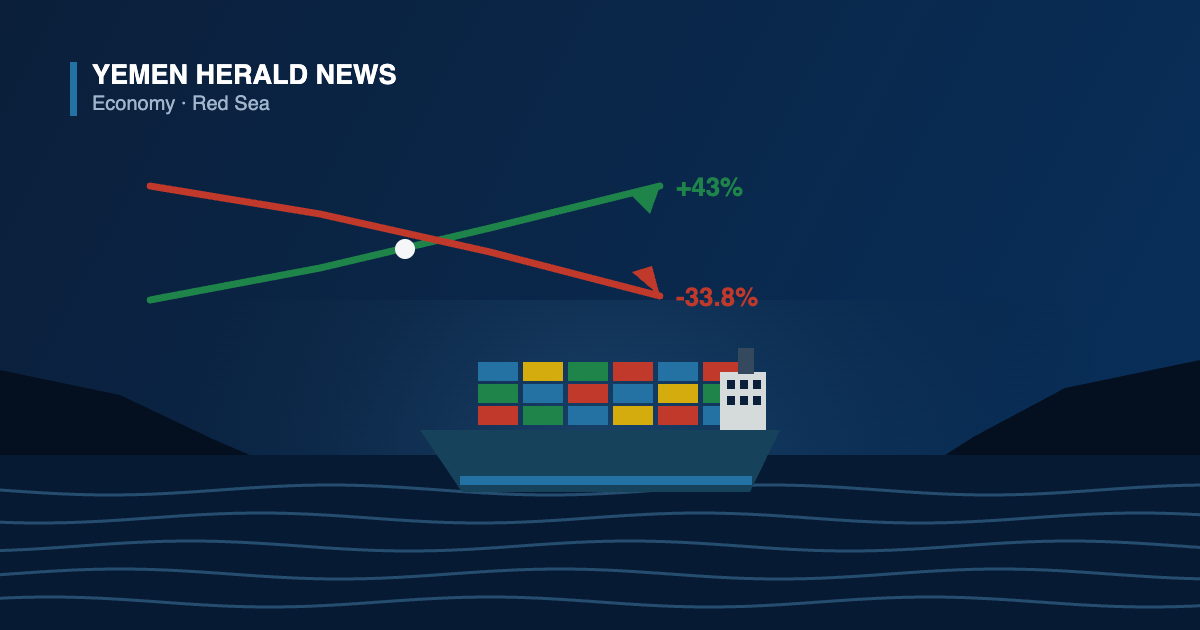
October traffic through the strait was 43% above the same month last year and 46% below the level recorded before the Houthi campaign against shipping began, the brief said.
IMF PortWatch, which counts vessels from automatic identification system signals, gives a different reading.
That dataset put the strait at 26 transits a day on a seven-day average for the week ending Nov. 8, down 33.8% against the same week of 2025 and down 3.4% against the previous 28-day average.
For October it recorded a monthly average of 28 transits a day, up 4.9% on September.
That is a smaller monthly gain than the 17% rise in tonnage Lloyd’s List reported for the same month.
The two counts also differ in level. PortWatch’s October average works out at roughly 870 transits across the month, about a third fewer than Lloyd’s List recorded.
Neither publisher explains the gap. The documented reason is what each one counts.
Lloyd’s List says its analysis covers cargo-carrying vessels above 10,000 deadweight tonnes. PortWatch counts cargo ships and tankers from satellite signals and excludes ferries, fishing vessels and small craft.
The windows differ too. Lloyd’s List reports complete calendar months, while the PortWatch figure for November is a seven-day average.
So do the baselines. Lloyd’s List measures against average monthly traffic from January to November 2023. The PortWatch page carries no pre-crisis baseline, comparing instead with the year-earlier week, the previous 28 days and a monthly series that begins in November 2024.
The methodology note accompanying that dataset says its count is not the official statistic of the waterway’s authority. It put estimated cargo capacity at 914,208 tonnes a day for the week to Nov. 8, and the past twelve months 1.3% above the twelve before them.
The two accounts sit closer together on security.
Lloyd’s List said the threat to shipping remains substantial but that no recent incidents had been reported. It said the UK Maritime Trade Operations had logged more vessel interactions with what it called claimed Yemeni authorities, and no attacks since Aug. 24.
The Joint Maritime Information Centre reported one suspicious-activity incident in the southern Red Sea, logged as MSCIO 168/26, and no confirmed attack on a merchant vessel in a Nov. 5 advisory distributed by UKMTO. The centre said the area remains volatile.
Lloyd’s List recorded suspicious activity and a large explosion observed in the strait on Nov. 6. It said the cause was not known.
Houthi statements have continued to indicate that non-Saudi commercial vessels may transit safely, following a selective embargo the group announced July 20.
One vessel taken earlier in the year is still held. The Tanzanian-flagged product and chemical tanker MT Asana was seized on July 17 about 65 nautical miles southwest of Mukalla.
Further east, the fishing vessel Azini was hijacked off northeastern Somalia on Oct. 29 and reported freed on Nov. 2.
At the Suez Canal, Lloyd’s List recorded 1,338 transits in October carrying 125.6 million dwt, against 1,228 transits and 106.3 million dwt in September. It called the tonnage figure a post-crisis high for the fifth consecutive month.
It put Suez traffic 63% above the same month last year and 34% below pre-crisis levels. The baseline it printed for that comparison, an average of 2,009 monthly transits and 182 million dwt across January to November 2023, works out at a shortfall closer to 31% in tonnage.
Crude tanker traffic has passed its earlier mark. The brief recorded 47.13 million dwt of crude moving through Suez in October against a pre-crisis monthly average of 44.35 million.
It attributed the rise to loadings at Yanbu and Russian crude moving south to India, with tankers returning north in ballast, and said the pattern was not a return to pre-crisis trading.
More than a third of large crude tanker passages through the canal involved sanctioned ships, according to the brief.
Container traffic has climbed more steeply. The brief recorded 426 containership transits in October, against 315 in September and 230 in October last year. About half were made with tracking systems switched off.
Evergreen is resuming Suez transits after a near three-year absence, the brief said, leaving it the last Ocean Alliance partner to return. It said the released capacity, set against slowing demand, risks pushing the trade towards oversupply.
European governments have not added warships to Operation Aspides, the EU naval mission in the region, despite warnings that it lacks vessels, according to the brief. It said the mission has communicated its force requirements.
The brief carries one inconsistency of its own. Its summary of key points refers to renewed Houthi attacks, while its security section records no recent incidents and no attacks since August.
Lloyd’s List said the brief will now appear fortnightly unless circumstances change.
About the Author