UAE Air Defences Intercepted Seven Ballistic Missiles and 27 Drones on 13 March 2026
 Yemen Herald News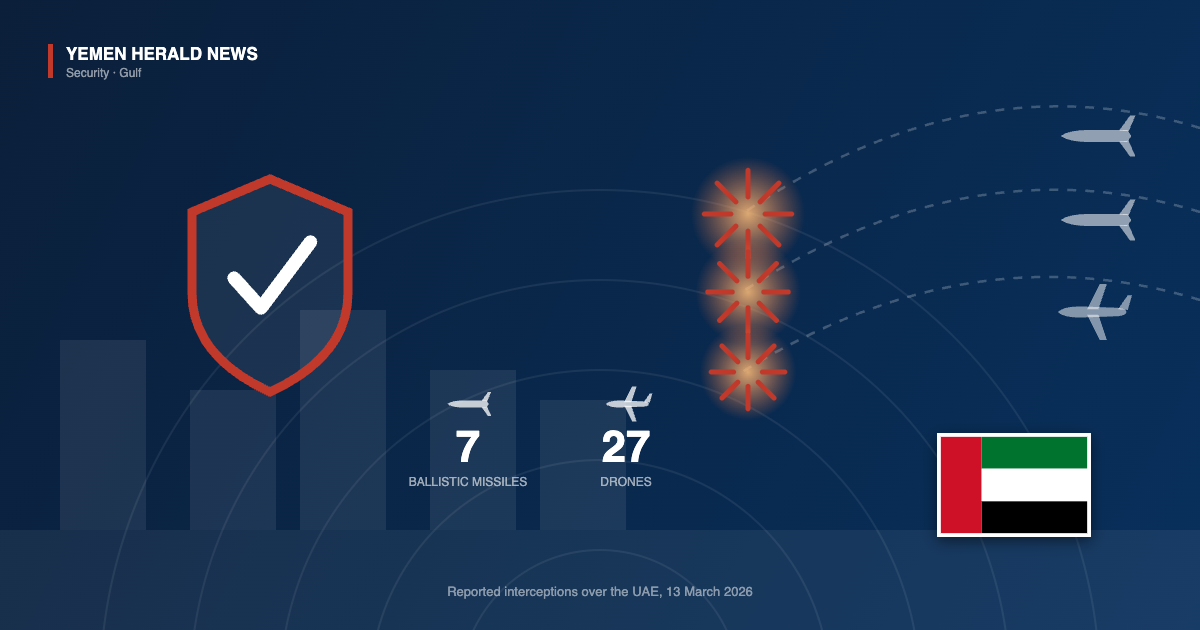
The United Arab Emirates’ Ministry of Defence said on Friday 13 March 2026 that its air defence systems had intercepted and destroyed seven ballistic missiles and 27 drones launched from Iran. The announcement came in the third week of an aerial campaign that had settled into an exhausting rhythm of nightly launches and nightly interception counts.
The ministry put its running campaign total at 285 ballistic missiles, 15 cruise missiles and 1,567 drones engaged since the attacks began. Those cumulative figures, published alongside each daily statement, were among the few consistently quantified accounts available at the time, and they show the mid-March period as one of the campaign’s more intense phases rather than a lull.
The casualty profile reported by the ministry was strikingly international. Six people had been killed by that date, described as Emirati, Pakistani, Nepalese and Bangladeshi nationals. A further 141 had been injured to varying degrees, drawn from residents of more than 25 nationalities, among them Egyptians, Sudanese, Ethiopians and Filipinos. That spread is a direct reflection of the country’s demography: Emirati citizens are a minority in their own country, and the industrial districts, ports and labour accommodation blocks that sat near several impact sites are overwhelmingly populated by migrant workers from South Asia, East Africa and the wider Arab world.
The confrontation had opened on 28 February 2026, when Iran began firing at Gulf states hosting United States military assets in retaliation for an American and Israeli campaign against Iranian targets. The first days were the heaviest. Researchers at the Foundation for Defense of Democracies’ Long War Journal estimated that Iran launched at least 247 ballistic missiles and 230 drones at the UAE, Bahrain and Qatar on the opening day, with the Emirates absorbing the largest share, while Kuwait, Iraq, Jordan and Saudi Arabia also came under attempted strike.
By 13 March the pattern was well established. On 5 March the ministry had reported detecting seven ballistic missiles and destroying six, with one falling inside the country, and intercepting 125 of 131 drones. On 10 March it said it had downed eight of nine ballistic missiles and 26 of 35 drones detected. The following day, 14 March, it announced nine ballistic missiles and 33 drones destroyed. Read in sequence, the statements describe a defence that was holding but not sealing: the ministry consistently distinguished between what was detected and what was intercepted, and acknowledged rounds that fell inside Emirati territory or into the sea.
The same week saw the heaviest single day of Saudi engagement of the war to that point. On 12 March the Saudi Ministry of Defence said its air defences had intercepted and destroyed 31 drones and three ballistic missiles, including five drones brought down over the Empty Quarter as they tracked toward Aramco’s remote Shaybah oil field, and others aimed at the Eastern Province. The kingdom’s Ras Tanura refinery had already been struck by drones on 2 March.
Energy and heavy industry were a recurring theme of the target set, and the pattern would sharpen later in the month. On 28 March, Emirates Global Aluminium said its Al Taweelah site at the Khalifa Economic Zone Abu Dhabi had sustained significant damage, with six employees injured and an emergency shutdown across production units. Iran’s Islamic Revolutionary Guard Corps said it had struck that facility and Aluminium Bahrain in response to attacks on two Iranian steel plants. The company subsequently warned that a full restoration of primary aluminium production could take up to twelve months.
In its 13 March statement the ministry restated its readiness to counter any threat to the country’s security and stability, language it repeated with little variation throughout the campaign. Civil defence messaging ran in parallel through the National Emergency Crisis and Disaster Management Authority, which issued shelter guidance, explained warning procedures and on occasion moved to correct public alarm by confirming that particular threats had been engaged beyond Emirati borders.
Diplomatically, the Emirates had moved quickly to frame itself as a bystander to someone else’s war. A joint statement issued through the Ministry of Foreign Affairs on 2 March condemned the missile and drone attacks across the region, and Gulf representatives argued in international forums that states hosting foreign military infrastructure should not become the arena for a confrontation between other powers. That argument carried limited practical weight while the launches continued, but it shaped how Gulf capitals presented the conflict to their own populations and to the wider international community, emphasising civilian harm over military alignment.
The figures continued to climb steeply after 13 March. By 22 March the ministry’s cumulative count stood at 345 ballistic missiles and 1,773 drones, and by 31 March at 433 ballistic missiles, 19 cruise missiles and 1,977 drones. Individual days in early April were heavier still, with 18 ballistic missiles, four cruise missiles and 47 drones reported on 3 April.
The seven missiles and 27 drones of 13 March 2026 therefore mark neither a peak nor a turning point. Their interest lies in the cumulative line they sit on, and in the casualty list published alongside them, which recorded the war’s cost falling disproportionately on people who had no stake in the quarrel and no say in where the munitions were aimed.
About the Author