WHO targets 957,196 children in southern Yemen measles drive as OCHA counts 600,000 reached
 Adel Haddad
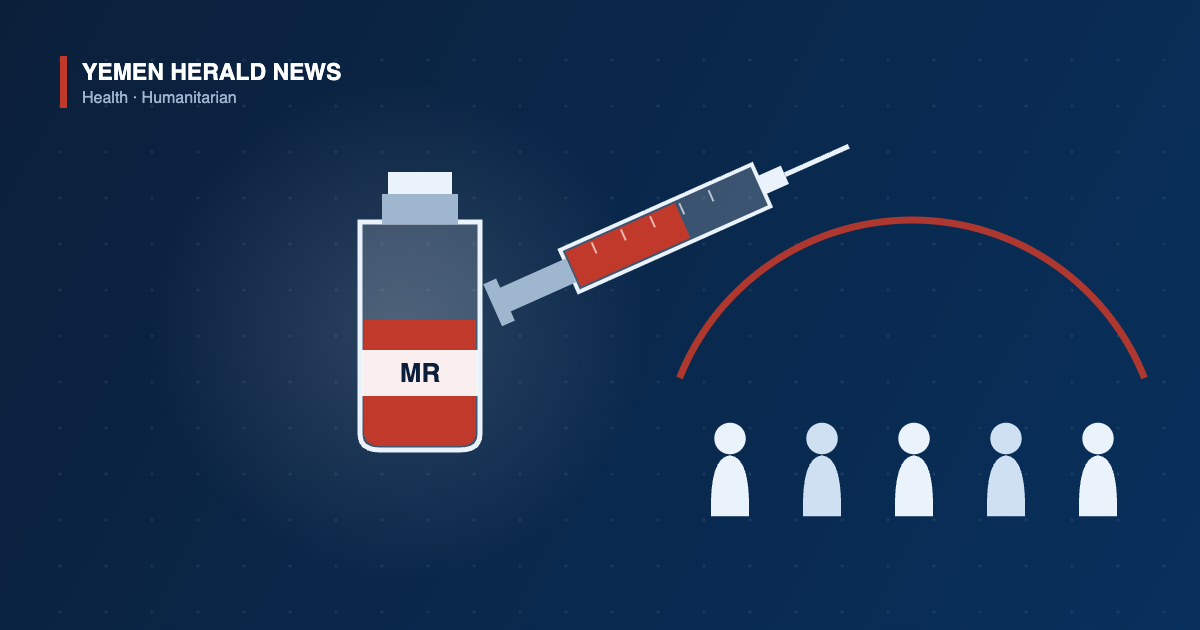
ADEN, Yemen — The World Health Organization is vaccinating 957,196 children against measles and rubella across 11 governorates in southern Yemen, the agency said this month.
The campaign opened on 7 November, according to the UN Office for the Coordination of Humanitarian Affairs. OCHA said in a report dated 16 November that more than 600,000 children had been immunised by then.
WHO said the drive covers children aged six to 59 months.
It has deployed 2,291 vaccination teams, according to WHO. Of those, 643 are fixed teams working from health facilities and 1,648 are mobile teams sent into communities.
Gavi, the Vaccine Alliance, is funding the campaign, WHO said.
“Every child deserves protection from vaccine-preventable diseases, regardless of where they live or the challenges their families face in accessing health services,” said Syed Jaffar Hussain, the WHO representative in Yemen.
WHO said teams would give particular attention to people displaced in recent months, to families living in displacement sites and to communities it described as underserved. Mobile teams are intended for remote and hard-to-reach areas.
The two figures measure different things. WHO set its target before the campaign opened, while OCHA counted children reached in the first nine days.
Yemen Herald found no published final total for the campaign, and neither body has stated how many of the targeted children remain unvaccinated.
The drive is running as displacement rises. The International Organization for Migration recorded more than 347,000 people displaced since early August, Asharq Al-Awsat reported on 17 November, citing IOM data.
IOM logged 18,780 people, or 3,130 families, displaced between 8 and 14 November, according to the same report.
Taiz governorate accounted for 143,130 of the displaced, or 41 percent. Lahj accounted for 91,314, or 26 percent, and Aden for 70,404, or 20 percent.
The counts have not aligned. OCHA’s 16 November report put cumulative displacement above 340,000, IOM’s mid-November data put it above 347,000, and OCHA’s 20 November statement put it above 353,000.
OCHA put the running total higher days later. Nearly 24,000 people were newly displaced in the week to 20 November, it said, taking the figure past 353,000 since early August.
“Displacement continues to rise amid ongoing hostilities and growing insecurity in Yemen,” OCHA said.
Taiz, Lahj and Aden hold the largest displaced populations, according to OCHA.
WHO has tied the outbreak risk to those movements, saying measles and rubella remain public health threats in Yemen as displacement pushes more people into crowded camps.
Aid has reached part of that population. OCHA said more than 270,000 displaced people had received emergency assistance, with more than 202,000 given emergency cash and health services reaching more than 103,000.
OCHA also reported access restrictions affecting about 1.3 million people across five areas, and said cooking gas had been barred from entering since early October.
Médecins Sans Frontières delivered a second consignment of medical supplies to hospitals in Taiz, OCHA said, following a delivery to Al-Thawra Hospital on 12 November.
Repeated strikes on fuel facilities in Hudaydah, including the Ras Isa terminal, have cut port activity, according to OCHA.
The UN Human Rights Office has verified more than 300 civilians killed or wounded since early August, including more than 70 deaths. Children account for more than a third of those casualties and close to half of the dead, the office said, adding that the real toll is likely higher.
UNHCR has reported concern over clashes near the Kharaz refugee camp in Lahj, where about 9,600 refugees face heightened risk and hundreds of families have left.
Yemen’s health system was under strain before the current escalation. More than 770 health facilities are at risk of closure, affecting nearly 7 million people, OCHA said in its 2025 country assessment.
That assessment put the number of people needing humanitarian help at 19.5 million, against requirements of $2.5 billion that were 28.8 percent funded.
OCHA reprioritised that plan to $1.4 billion targeting 8.8 million people. It said about 6 million more people risked falling into emergency food insecurity, that nearly 2 million faced critical gaps in protection services and that more than 1.3 million children could drop out of school.
“Yemen’s humanitarian crisis has further deteriorated: needs are rising, access is contracting,” said Ramesh Rajasingham, head of OCHA’s Geneva office, speaking on behalf of Tom Fletcher, the UN under-secretary-general for humanitarian affairs.
Yemen accounted for a quarter of global cholera cases in 2024, according to the same assessment.
The current campaign is smaller than the last comparable one. WHO and UNICEF ran a six-day integrated measles and rubella drive from 23 September 2023 that targeted 1,267,082 children in the same age bracket.
That campaign covered 121 districts across 13 governorates and deployed 3,025 teams, of which 847 were fixed and 2,178 mobile, WHO said at the time.
It combined the vaccinations with vitamin A supplementation and COVID-19 doses for priority groups.
The Ministry of Public Health and Population in Aden implemented the 2023 drive with WHO and UNICEF. Gavi, the United States Agency for International Development and the World Bank funded it.
“Measles can kill, but vaccinating children against measles will save their lives,” Peter Hawkins, then the UNICEF representative to Yemen, said at the launch of that campaign.
“The vaccine is safe and is effective,” he said.
About the Author