Yemen Network of Victims records 18 civilian casualties in Marib, Taiz and Hodeidah in one week
 Yemen Herald News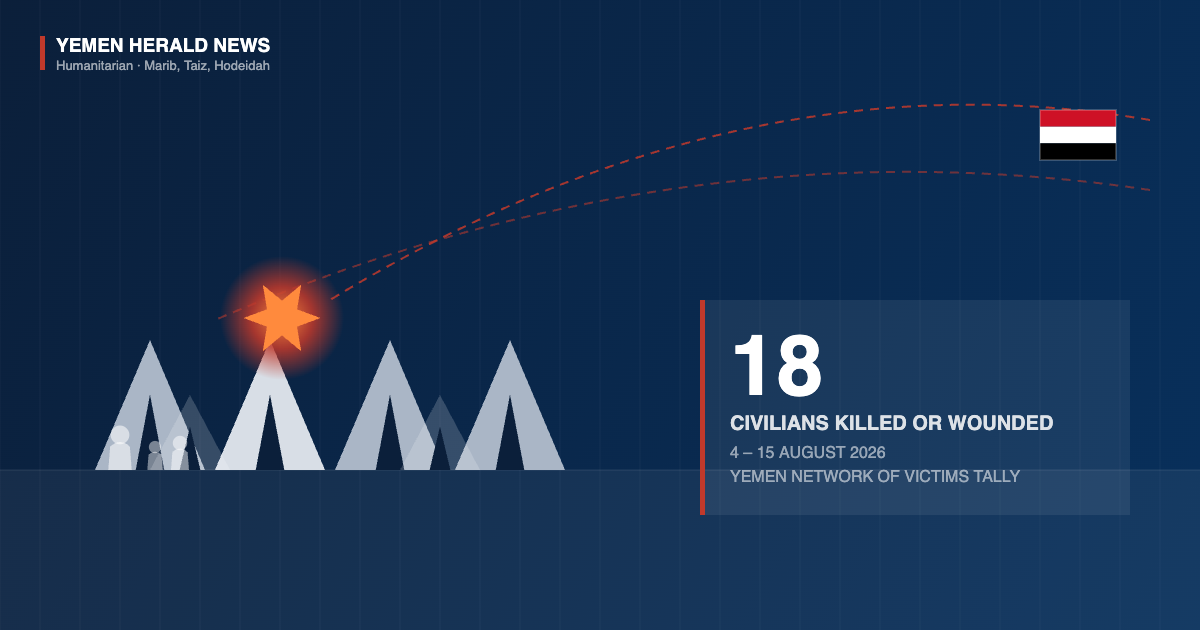
The Yemen Network of Victims says it documented 18 civilian casualties across three governorates in the space of a single week, in what the monitoring group describes as one of the sharpest escalations against non-combatants since front-line calm began to fray this summer. Presenting its findings at a press conference in the government-held city of Marib, the network said the dead and wounded were recorded in Marib, Taiz and Hodeidah between 4 and 15 August, in attacks it attributed to Houthi missile, drone and artillery fire.
The deadliest incident in the network’s tally came on 7 August, when ballistic missiles and drones struck the Jaw al-Naseem displacement camp on the outskirts of Marib. Two people were killed and 14 wounded, among them women and children. Yemen’s government reported the same casualty figures that day, and international news agencies covering the strike described missiles and drones falling on displacement camps and residential neighbourhoods in the city. The network said the blasts also damaged water and sewage lines and a number of shelters.
Marib has become the focal point of the current escalation. The city and the desert around it host one of the largest concentrations of internally displaced people anywhere in Yemen, most of them in improvised camps that offer no protection against blast or shrapnel. Aid agencies have warned for years that strikes landing near those sites carry a disproportionate risk, because families are packed into tents pitched only metres apart with nowhere to shelter.
The pressure on Marib did not ease after the network closed its count. Provincial authorities said the city was hit by four ballistic missiles and four drones on Saturday 15 August, injuring several people and damaging homes, vehicles and property, with a fifth missile later the same day wounding another person and a sixth launched overnight. Al Jazeera reported the government’s account of strikes on residential areas; the Houthi leadership generally frames its operations as directed at military targets.
The network’s tally also covers Yemen’s west coast. On 9 August it recorded bombardment of Mokha and of al-Khokha, a district south of Hodeidah. The following day the Yemeni military said a Houthi missile and drone attack on the Red Sea port city of Mokha killed seven people, four members of the armed forces and three civilians, and wounded about 30, with air defences reporting the interception of 11 drones. The military said residential neighbourhoods in Mokha were among the areas hit.
In Taiz, the network recorded continued shelling of populated districts through the first half of the month, including an attack on 8 August in which women and children were among the injured. Fighting on the province’s front lines has intensified in parallel: on 13 August, government forces said they repelled a Houthi assault on positions along the al-Mafalis front, south of Haifan in south-eastern Taiz.
The Yemen Network of Victims characterised the pattern of attacks as amounting to war crimes and crimes against humanity, arguing that the repeated use of ballistic missiles and armed drones against camps and residential districts reflects a systematic disregard for the distinction between combatants and civilians required under international humanitarian law. Those are the network’s own legal characterisations; no court has ruled on them, and the Houthi movement rejects allegations that it deliberately targets civilians.
Its call for an independent international investigation landed in a week when the conflict was already high on the Security Council’s agenda. Briefing the Council on 13 August, the UN Special Envoy for Yemen, Hans Grundberg, said the country faced its highest risk of a return to large-scale war since the UN-brokered truce of April 2022, citing intensified military activity in Marib, Hadramawt, Mokha and elsewhere that had produced both military and civilian casualties.
The same period saw at least 30 government troops killed in strikes on military camps in Marib and Hadramawt, among the deadliest single episodes in months, alongside a renewal of attacks on commercial shipping in the Red Sea and the Gulf of Aden. In July the Houthis announced what they called a naval blockade of Saudi Arabia in the Red Sea, presenting it as a response to what they described as a Saudi siege of Yemen.
Grundberg warned the Council that the relative calm of recent years cannot hold indefinitely without progress on a political settlement, pointing to state institutions fragmented by more than a decade of war, an economy with little capacity to absorb another shock, and a wider region already consumed by conflict. He urged the parties to halt the escalation and to protect civilians in Mokha, Marib and beyond.
The humanitarian backdrop is severe. UN estimates have for several years put the number of Yemenis needing some form of assistance above 18 million, with more than four million displaced from their homes. Camps of the kind struck at Jaw al-Naseem sit at the intersection of those two figures: populations already dependent on aid, living in the areas most exposed to renewed fighting, and least able to move again if the front lines shift.
For the network, the immediate demand is narrower than a political settlement. It wants an independent inquiry into the missile and drone strikes recorded this month, and a mechanism capable of attributing responsibility for them, something Yemen’s civilian monitoring groups have pressed for repeatedly and which the Council has so far not established.
About the Author