Yemen’s foreign ministry welcomes European Council conclusions condemning Houthi escalation
 Yemen Herald News
ADEN, Yemen — Yemen’s foreign ministry welcomed European Union leaders’ conclusions condemning Houthi escalation and strikes on Saudi Arabia, in a statement on Sunday.
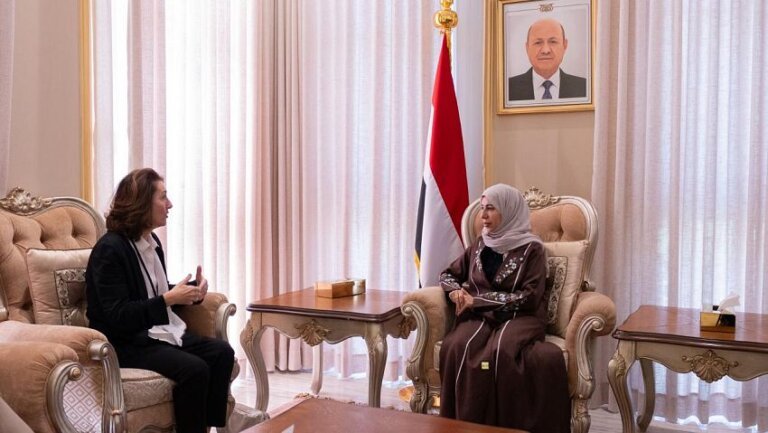
The Ministry of Foreign Affairs and Expatriates said European support for the Yemeni government mattered at the current stage, the state news agency Saba reported.
Strengthening state institutions and their capacity to carry out their responsibilities was a central factor in confronting Houthi escalation, the ministry said, according to the agency.
It also welcomed the bloc’s emphasis on avoiding any worsening of Yemen’s humanitarian situation, and its call for more international aid, Saba said.
Saba, which the internationally recognised government runs, was the only outlet to report the ministry’s statement, and Yemen Herald found no independent account of it. The European conclusions the ministry referred to are published in full by the bloc.
EU leaders met in Brussels on Oct. 15 and 16 and issued their conclusions on the second day. Antonio Costa chairs the European Council.
The text says the bloc strongly condemns what it calls the Houthis’ continued military escalation in Yemen and their strikes against Saudi Arabia.
It calls on the group to immediately cease all military action and all attacks against civilian shipping.
The conclusions also recall the role of the EU naval operation Aspides and call for its reinforcement in line with its mandate.
The Council decided to create Aspides in February 2024 and the operation began the same month. The EU describes it as purely defensive, escorting merchant ships and building maritime awareness rather than striking targets.
Its area covers Bab al-Mandab and the Strait of Hormuz, along with international waters in the Red Sea, the Gulf of Aden, the Arabian Sea and the Gulf of Oman.
Saba’s report named the operation as Atalanta. That is the bloc’s counter-piracy mission off the Horn of Africa. Aspides is the separate operation protecting merchant shipping in the Red Sea and the Gulf of Aden.
The Houthis reject calls to designate them a terrorist group and present their attacks as part of the war with the Saudi-led coalition.
Leaders at the same summit condemned Iranian attacks in the Middle East and urged Tehran and what they described as its proxies to halt further attacks and destabilising activity, Iran International reported.
EU foreign ministers had taken up Yemen three days earlier.
At the Foreign Affairs Council on Oct. 12 they discussed what the Council described as the deteriorating situation in Yemen, and stressed support for the internationally recognised government.
The ministers jointly condemned a Houthi attack on Riyadh airport, the Council said. They raised severe humanitarian needs in Yemen and the Horn of Africa, and discussed strengthening Aspides.
The bloc’s diplomatic service had issued its own statement a month before that.
On Sept. 17 the spokesperson for foreign affairs and security policy said the EU strongly condemned the Houthis’ military campaign in Yemen and their strikes against Saudi Arabia, including an attack targeting Mecca.
Targeting civilians and civilian infrastructure was unacceptable, the statement said, and it urged the Houthis to cease all military action.
Yemen’s foreign minister is Afrah al-Zouba, appointed in July. She is the first woman to hold the post.
Al-Zouba asked member states of the Organization of Islamic Cooperation to designate the Houthis a terrorist group at a session in Baghdad last week, Al Jazeera reported.
The bloc had raised Yemen publicly the day before the summit opened. On Oct. 14 it said it was following the situation in Taiz with grave concern and called on the Houthis to lift their siege of the city.
It asked that food, water, medicine and fuel be allowed in, and stressed protecting civilians and letting humanitarian partners deliver aid.
Al-Zouba wrote the same day to senior UN officials and the president of the International Committee of the Red Cross, urging the Security Council to act to end a siege she said threatened more than 4 million people, Arab News reported.
She named displaced people from Al-Shamayatayn, Al-Mawasit and Jabal Habashi among those affected, and called for all access routes into Taiz to be reopened.
The humanitarian position the ministry raised is set out in the UN response plan published in March 2026.
That plan said more than 22 million Yemenis needed assistance, and put the number facing acute food insecurity at 18.3 million.
It said more than 2.2 million children under five were acutely malnourished, 516,157 of them severely, and recorded 5.2 million internally displaced people.
The plan sought $2.16 billion to reach 12 million of those in need.
European money has continued to reach Yemeni institutions through UN agencies.
The bloc’s delegation and the UN Development Programme announced a 9 million euro agreement on Oct. 8, worth about $10.4 million, for a local governance programme covering seven governorates and more than 25 districts.
The programme funds local authority planning, budgeting and service delivery, and work on transparency in public financial management and procurement, UNDP said.
It follows an earlier EU-funded project that UNDP said delivered 177 public service projects and reached more than 7 million people.
Patrick Simonnet, the EU ambassador to Yemen, signed the agreement with Noura Hamladji, who heads the UNDP country office.
About the Author