Yemen’s foreign minister and French ambassador discuss Houthi escalation in Riyadh
 Yemen Herald News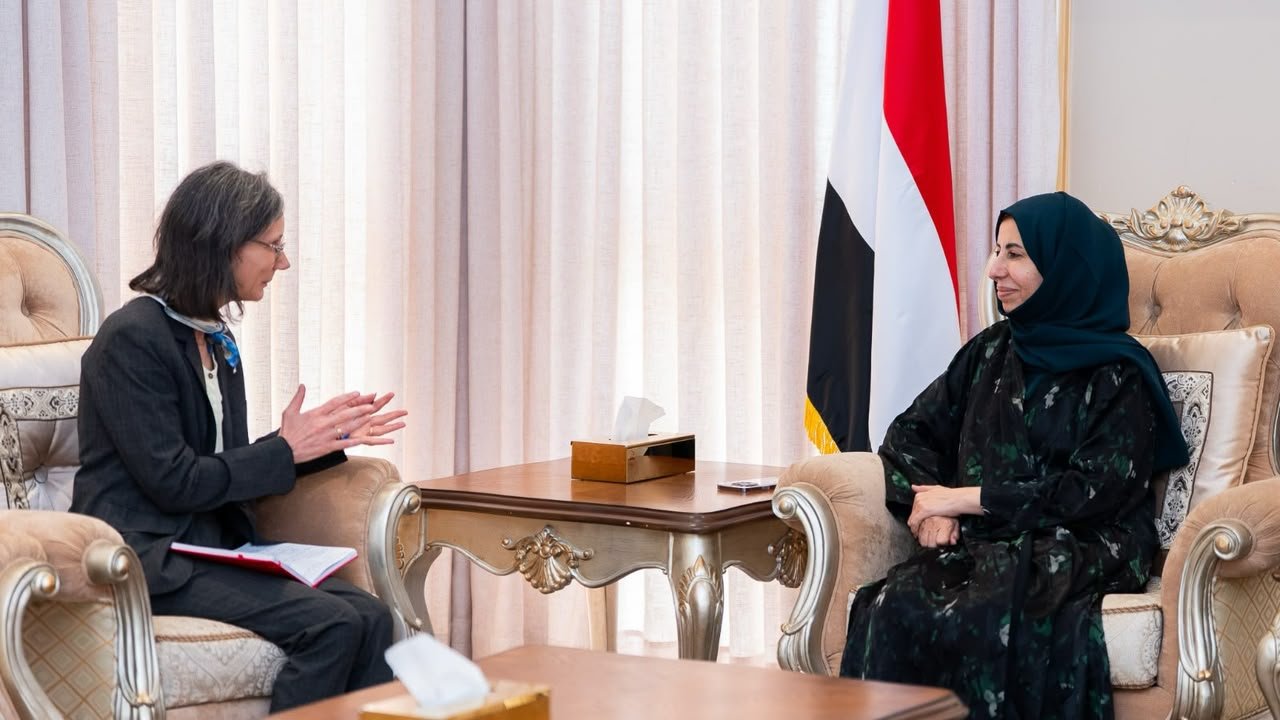
RIYADH, Saudi Arabia — Yemen’s foreign minister discussed Houthi escalation with France’s ambassador in Riyadh on Monday, the state news agency Saba reported.
Afrah al-Zouba met Catherine Corm-Kammoun, France’s ambassador to Yemen. The two reviewed bilateral relations and cooperation, and developments in Yemen and the wider region, Saba said.
Al-Zouba praised relations between the two countries and France’s role in the United Nations Security Council, along with Paris’s support for the Presidential Leadership Council and the government, according to the agency.
Corm-Kammoun confirmed France’s continued support for the council and the government, Saba said.
She said France condemned Houthi escalation at sea and attacks on Yemen and Saudi Arabia, the agency reported.
Corm-Kammoun also restated her country’s opposition to Iranian support for the Houthis and to any role that destabilises Yemen and the region, according to Saba.
The account of the meeting rests on Saba, the news agency of the internationally recognised government. No independent confirmation of the talks has been published.
France has set out similar positions on the record at the United Nations.
Jay Dharmadhikari, France’s deputy permanent representative to the UN, told the Security Council on Aug. 13 that Yemen was experiencing “the most serious escalation of tensions since the 2022 truce.” He said the Houthis bore full responsibility, having multiplied attacks on the Yemeni government and Saudi Arabia.
He said France condemned the resumption of Houthi attacks in the Red Sea, which the secretary-general set out in a letter to the Council on Aug. 10.
A strike on the cargo vessel Tihamah on Aug. 11 killed several crew members who were Pakistani and Indonesian nationals, Dharmadhikari said. He extended condolences to their families and to Pakistan and Indonesia.
The attacks undermine regional security and freedom of navigation, which the Council demanded be respected in resolution 2722, he said, adding that the Houthis must end them immediately and unconditionally.
France would continue working to protect the route through the European Union operation EUNAVFOR Aspides, in a defensive posture and in coordination with European and international partners, he said.
Dharmadhikari said the escalation began on July 3, when an Iranian aircraft landed in Sanaa without authorisation from the internationally recognised authorities.
He said Tehran was fuelling the crisis and failing to meet its obligations under the arms embargo set out in resolution 2216, and that France expected Iran to end all transfers of military equipment to the Houthis. Iran has consistently denied arming the group.
He also demanded the immediate and unconditional release of United Nations staff, aid agency employees and diplomatic personnel held by the Houthis, saying the detentions breached resolution 2730 and international humanitarian law.
There is no military solution to the conflict, Dharmadhikari said. He said France supported the government and the UN special envoy, Hans Grundberg, and that only an inclusive political process involving women and all parts of Yemeni society could end the crisis.
France is one of the five permanent members of the Security Council.
At a Council meeting in July requested by Bahrain, France, Britain and the United States, most members condemned Houthi attacks on Saudi Arabia, according to Security Council Report. France, Britain and the United States said Iranian flights into Sanaa might breach resolutions 2216 and 2140.
France had already raised the arms embargo at an emergency Council session on July 13, Dharmadhikari said.
The European Union launched EUNAVFOR Aspides in 2024 to protect commercial shipping against Houthi attacks, according to Security Council Report.
France’s foreign ministry has issued repeated condemnations of Houthi attacks on commercial vessels in the Red Sea since the campaign began, including statements in January 2024 and July 2025.
Rashad al-Alimi, chairman of the Presidential Leadership Council, held separate talks in Riyadh the same day with Nils Bolter, secretary-general of the German Ministry of Defence, Saba reported. He called there for firmer international pressure on Tehran and for support to protect the Red Sea and Yemen’s ports.
Al Jazeera reported that Houthi attacks on Aug. 9 killed seven people in Yemen and that a fire broke out at an Aramco facility in Jizan, southern Saudi Arabia, in an attack the group claimed.
Al-Zouba took office in July as Yemen’s first female foreign minister, Al Jazeera reported at the time.
She told reporters in Riyadh in late July that the government was “prepared for any escalations,” France 24 reported, and said it was concerned the Houthis were copying Iranian tactics in the Strait of Hormuz to gain control over Bab al-Mandab.
Al Jazeera reported on Aug. 16 that Houthi forces had launched fresh attacks on al-Makha and Marib.
The Houthi movement, which has held Sanaa since 2014, rejects the legitimacy of the Riyadh-based government and gives a different account of the fighting.
Yemen’s internationally recognised government has operated from Aden and Riyadh since the Houthis took the capital.
Saba also reported that Abdullah al-Alimi, a member of the Presidential Leadership Council, met Corm-Kammoun the same day to discuss developments on the national scene.
Al-Zouba met the secretary-general of the Gulf Cooperation Council in early August, the GCC said on its website.
Saba did not say whether the two sides set a date for further talks.
About the Author