
Yemen’s Water Minister Reviews Sanitation Projects with UNHCR and Local Partner HAWK
 Yemen Herald News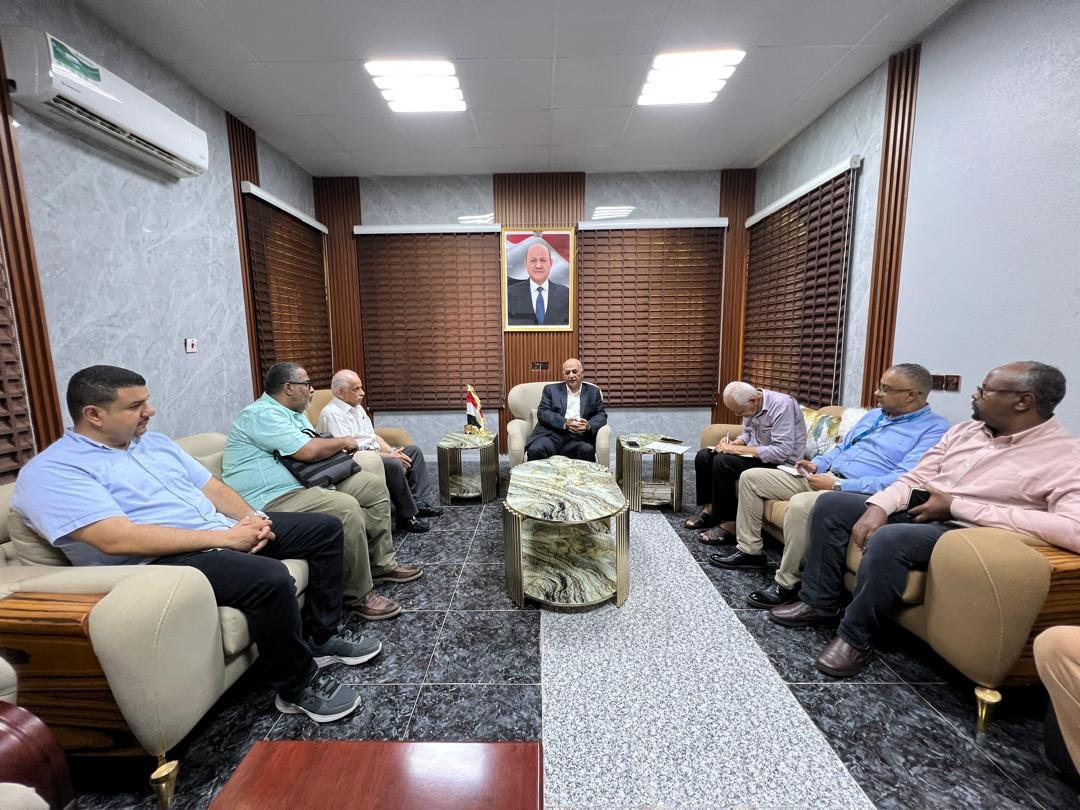
Yemen’s Minister of Water and Environment, Engineer Tawfiq al-Sharjabi, has reviewed progress on water and sanitation projects in a meeting with representatives of the United Nations refugee agency (UNHCR) and the local implementing firm HAWK Company, focusing on ways to overcome the obstacles that have slowed delivery. The talks examined work completed so far and the technical and operational challenges that continue to affect projects intended to improve essential services for communities strained by years of conflict.
During the discussions, representatives of UNHCR and HAWK Company set out the main difficulties facing the projects and reaffirmed their commitment to working with the ministry and other partners to see them completed successfully. Both sides framed the goal not simply as finishing individual schemes but as delivering lasting improvements in water supply and sanitation, the kind of durable services on which public health and daily life depend. Al-Sharjabi, for his part, stressed that stronger coordination among all parties involved was essential to ensure that sanitation services are reliable and sustainable rather than temporary.
The minister’s emphasis on coordination reflects a wider reality of relief and development work in Yemen, where numerous government bodies, United Nations agencies, international donors and local contractors operate in the same space and where overlapping mandates can complicate delivery. Aligning these actors around shared priorities, clear responsibilities and agreed timelines is widely seen as a precondition for turning funded plans into functioning infrastructure on the ground.
Water and sanitation sit close to the centre of Yemen’s humanitarian needs. Even before the current conflict, Yemen was among the most water-scarce countries in the world, with limited renewable resources and heavy pressure on groundwater. Years of war have compounded those underlying problems, damaging pipes, pumping stations and treatment facilities, interrupting power supplies needed to run them and leaving many communities reliant on trucked or untreated water. The result is that millions of people lack consistent access to safe drinking water and adequate sanitation.
The consequences for public health have been severe. The breakdown of water and sanitation systems has been closely linked to recurring outbreaks of waterborne disease, including some of the largest cholera epidemics recorded in modern times, alongside other illnesses that spread where clean water and proper sanitation are absent. Restoring and maintaining these services is therefore not only a matter of convenience but a direct factor in preventing disease and reducing avoidable deaths, particularly among children and other vulnerable groups.
UNHCR’s involvement reflects the particular vulnerability of refugees and internally displaced people, who are among those most affected by the collapse of basic services. Large numbers of Yemenis have been forced from their homes by the fighting, and many live in camps or crowded host communities where water and sanitation provision is stretched. Improving these facilities is central to protecting displaced families from health risks and to making their living conditions more bearable while longer-term solutions remain out of reach.
HAWK Company, as a local partner, is responsible for executing the physical aspects of the projects, the construction and rehabilitation work that translates plans and funding into wells, networks and sanitation facilities. The involvement of domestic firms can add capacity and local knowledge to the effort, but it also requires close coordination with government authorities and international organisations to ensure that work meets standards, stays on schedule and reaches the communities most in need.
The meeting takes place against the backdrop of a humanitarian crisis that has persisted since the escalation of Yemen’s war in 2015, a conflict that has left more than eighteen million people in need of some form of assistance and displaced millions from their homes. In that environment, even routine progress reviews carry weight, because the difference between a stalled project and a completed one can be measured in the availability of clean water to households that have little margin to spare.
The scale of need is substantial. Humanitarian assessments have consistently found that a large share of Yemen’s population lacks reliable access to safe water and sanitation, making water, sanitation and hygiene one of the most heavily prioritised areas of the international response. Projects that rehabilitate networks, restore pumping capacity or build new facilities can therefore benefit not only individual neighbourhoods but also the broader effort to contain disease and stabilise living conditions across affected regions.
Funding remains a persistent concern. Aid operations in Yemen have repeatedly faced shortfalls as international appeals fall short of their targets, forcing agencies to set priorities and at times scale back programmes. In that climate, ensuring that the resources available are spent efficiently and without duplication becomes all the more important, which helps explain the minister’s focus on coordination and on completing projects already under way rather than leaving them unfinished.
For the Ministry of Water and Environment, engagements of this kind are part of a continuing effort to keep essential services functioning and to expand them where possible despite funding constraints and logistical hurdles. The success of the projects discussed will depend on sustained cooperation between the ministry, UNHCR and HAWK Company, on adequate and predictable financing, and on the ability of all parties to navigate the practical obstacles that conflict places in the way of even the most basic infrastructure work.
About the Author




