Ambassador Balfaqih Presses for a Broader Indonesian Role in Yemen’s Development
 Yemen Herald News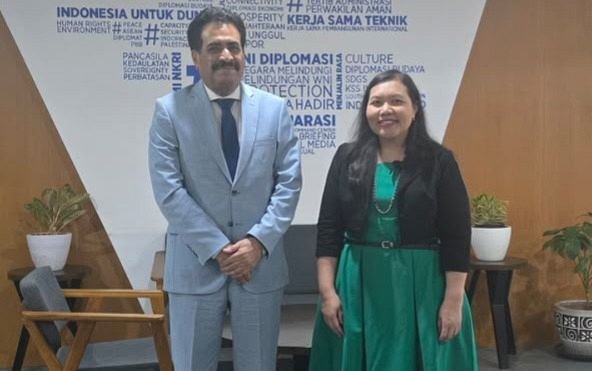
Yemen’s ambassador to Indonesia, Salem Balfaqih, met on Monday with Rena Sitiwati, director of international development cooperation at the Indonesian foreign ministry, for talks on expanding development cooperation between the two countries. The meeting reflects a wider Yemeni effort to broaden the circle of partners supporting the country’s recovery as its humanitarian and economic crisis grinds on.
According to Yemen’s state news agency Saba, Balfaqih pressed for greater Indonesian participation in development projects through the programmes of Indonesia’s international aid agency, which manages Jakarta’s growing portfolio of assistance to developing states. He set out Yemen’s need for diverse forms of support to confront the consequences of a conflict that has devastated the country for more than a decade.
Both sides acknowledged the importance of activating cooperative programmes that serve the interests of the two countries, and they agreed that regular dialogue would be needed to turn general goodwill into projects on the ground. The meeting is one of a series of contacts between Yemeni and Indonesian officials in recent months aimed at reviving joint mechanisms that fell dormant during the war years.
Those contacts have included discussions on reactivating the joint Yemeni-Indonesian committee, resuming political consultations between the two foreign ministries, and expanding cooperation in higher education, culture and trade. Balfaqih has separately met Indonesia’s minister of higher education, science and technology, Brian Yuliarto, to explore scholarships, scientific research and academic exchanges linking Yemeni and Indonesian universities, building on a long tradition of Yemeni students studying in Indonesia.
The push for Indonesian engagement comes against the backdrop of one of the world’s most severe humanitarian crises. United Nations agencies estimate that more than 18 million Yemenis need humanitarian assistance and that roughly 4.5 million people remain displaced inside the country. The conflict between the Houthi movement and the internationally recognised government, which escalated sharply in 2015, has collapsed public services, driven repeated outbreaks of cholera and measles, and left much of the population dependent on aid.
Indonesia brings to the relationship a long-standing tradition of development diplomacy. Jakarta has positioned itself as a voice for developing countries, hosting international conferences on South-South cooperation and channelling assistance through its dedicated aid fund. Engagement with Yemen offers Indonesia a way to demonstrate that role in practice while contributing to stability in a region that matters to its own interests.
Those interests are not abstract. The Red Sea and the Bab al-Mandab Strait, which Yemen overlooks, rank among the world’s most important corridors for trade and energy shipments, including routes used by Indonesian exporters. Attacks on shipping in the Red Sea in recent years have shown how instability in Yemen can raise costs and disrupt supply chains far beyond the Middle East, giving trading nations across Asia a direct stake in the country’s future.
Recent exchanges have identified agriculture, health, education and infrastructure as practical avenues for Indonesian involvement, sectors where Yemen’s needs are acute and where Indonesian institutions have relevant experience. Yemeni officials argue that development projects in these areas can deliver visible improvements for communities even before a comprehensive political settlement is reached, and can help prepare the ground for reconstruction when one arrives.
The two countries also share cultural and historical ties that predate the modern states. Centuries of trade and migration across the Indian Ocean carried Yemeni merchants and scholars, particularly from Hadramout, to the Indonesian archipelago, and communities of Hadhrami descent remain a visible part of Indonesian society. Officials on both sides frequently invoke this heritage as a foundation for closer contemporary cooperation.
For Yemen’s internationally recognised government, diversifying sources of support has become a strategic necessity. Traditional donors have scaled back funding as global crises compete for attention, and UN humanitarian appeals for Yemen have been persistently underfunded. Sector-specific partnerships with countries such as Indonesia, Malaysia and South Korea offer a complementary track: narrower in scope than large multilateral programmes, but often quicker to implement.
Stronger ties could also enhance Indonesia’s standing as a potential contributor to international discussions on the Yemeni conflict. As the largest Muslim-majority country and a member of the G20, Indonesia carries diplomatic weight in forums where Yemen’s future is debated, and Yemeni officials have welcomed engagement from states seen as impartial voices.
No specific agreements were announced after Monday’s meeting, and any expansion of Indonesian programmes in Yemen would still have to work through the practical difficulties that complicate all development work in the country, from insecurity and fragmented governance to weak banking channels. Yemeni diplomats argue, however, that establishing frameworks now will allow cooperation to scale up quickly as conditions permit.
Indonesia has contributed to relief efforts in Yemen before, sending humanitarian assistance during earlier phases of the crisis and supporting appeals through the Organisation of Islamic Cooperation, to which both countries belong. Yemeni officials hope this record of episodic help can now become a more structured development partnership, with agreed priorities, dedicated funding channels and measurable results over several years.
The meeting between Balfaqih and Sitiwati therefore signals intent rather than immediate change: a commitment to build the institutional connections through which future support can flow. For a country facing needs as deep as Yemen’s, cultivating such partnerships is a slow but necessary investment in recovery, and one that officials in Aden hope other capitals will notice and follow.
About the Author