Sudan Condemns Unauthorized Tehran-Sana’a Flights and Backs Yemen’s Internationally Recognized Government
 Yemen Herald News
Sudan has condemned the launch of unauthorized direct flights between Tehran and Sana’a, saying the new air link violates Yemen’s sovereignty, infringes on its airspace and contravenes international aviation rules. The statement from Sudan’s Ministry of Foreign Affairs and International Cooperation adds Khartoum to a growing list of governments publicly objecting to the route, which connects the Iranian capital with Houthi-held Sana’a without the approval of Yemen’s internationally recognized government.
In its statement, the ministry warned that the flights could widen the scope of regional tensions by extending the confrontation centred on the Strait of Hormuz toward the Red Sea and the Gulf of Aden. Such a development, it said, would pose a serious threat to international trade routes and to freedom of navigation through waters that carry a substantial share of global commerce.
The ministry added that the unauthorized air link risks altering the security landscape of the region at a time of heightened instability, with potentially far-reaching consequences for maritime traffic. Yemen sits astride the Bab al-Mandab Strait, the narrow chokepoint linking the Red Sea to the Gulf of Aden, and disruptions there ripple quickly through global shipping and energy markets. Attacks on commercial vessels in the Red Sea in recent years have already forced some shipping lines to reroute around southern Africa, adding time and cost to global trade.
Sudan also renewed its support for Yemen’s internationally recognized government, led by the Presidential Leadership Council, and reaffirmed its solidarity with the Yemeni people in the face of what it described as ongoing attacks and abuses by the Houthi militia and its foreign backers.
The dispute over the flights erupted in early July, when an Iranian aircraft flew Houthi officials from Sana’a to Tehran to attend the funeral of Iran’s former supreme leader, Ali Khamenei. Yemen’s government said the flight had not been authorized and denounced the operation as a breach of national sovereignty.
The Presidential Leadership Council described the direct flight as a blatant violation of Yemen’s sovereignty and a challenge to international law and relevant United Nations Security Council resolutions. Yemen’s permanent representative to the UN, Abdullah al-Saadi, told the Security Council that the flights amounted to a test of the principles underpinning the international system, warning that a failure to respond would signal to armed groups everywhere that state sovereignty can be defied without consequence.
The confrontation has since escalated. In mid-July, government forces fired on the runway at Sana’a International Airport to prevent an Iranian commercial aircraft from landing, according to Yemeni officials and press reports. The Houthis responded by launching ballistic missiles and drones toward Abha International Airport and King Khalid Air Base in southern Saudi Arabia, attacks that Saudi air defenses said they intercepted.
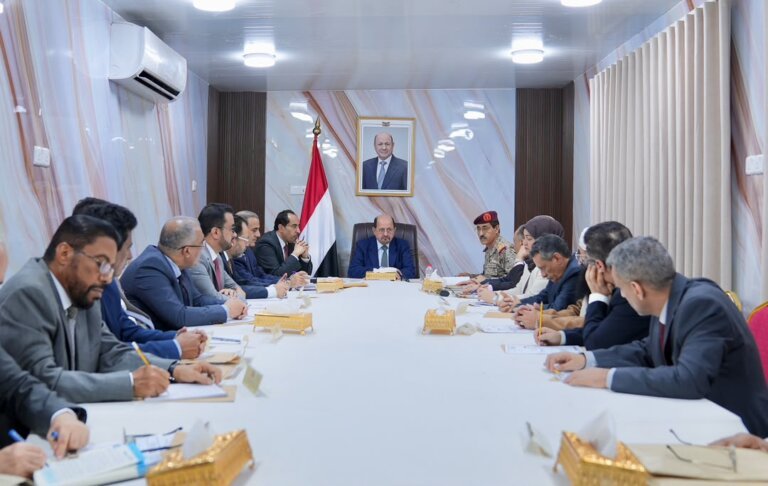
President Rashad al-Alimi, chairman of the Presidential Leadership Council, has insisted that the government is not imposing a blockade on Sana’a airport, while stressing that it will show no tolerance for what he called complicity in violations of national sovereignty. Western governments, including the United Kingdom and Greece, have echoed Yemen’s concerns at the Security Council, arguing that Iranian flights into Sana’a breach the country’s sovereignty and undermine existing resolutions.
Sana’a and much of northern Yemen have been controlled by the Houthi movement since it seized the capital in 2014, an advance that triggered the intervention of a Saudi-led coalition the following year. Sana’a airport, closed to most traffic for years, resumed limited commercial flights under arrangements linked to the UN-brokered truce of 2022, but those services operated with the acquiescence of the recognized government. A regular direct service between Tehran and Sana’a would sit entirely outside that framework. Restoring and expanding those flights has been a recurring element of truce diplomacy, making the unilateral opening of a new route especially sensitive.
The Yemeni government and Western officials have long accused Iran of arming and financing the Houthis, a charge Tehran denies, describing its backing as political. Security analysts have cautioned that an unmonitored air corridor between Iran and Houthi-held territory could make it easier to move personnel and materiel, deepening concern among Yemen’s neighbours about the trajectory of the conflict.
Sudan’s position carries its own history. Khartoum contributed forces to the Saudi-led coalition in Yemen from 2015, and earlier this year it condemned Iranian missile strikes on Gulf states, aligning itself with Arab governments alarmed by the widening regional confrontation. Its latest statement frames the flight dispute as part of that broader pattern rather than as a bilateral matter between Iran and Yemen.
The escalation comes at a perilous moment for Yemen’s civilians. United Nations agencies estimate that more than 18 million people in the country need some form of humanitarian assistance, and the UN has expressed concern over the recent escalation, urging the parties to return to negotiations toward a comprehensive political settlement. Aid organizations have warned that any disruption to ports, airports or supply corridors would fall hardest on families already struggling to afford food.
For now, diplomats say the immediate question is whether international pressure can halt the flights before the dispute hardens into a new front in the conflict. Sudan’s intervention suggests the issue has moved beyond Yemen’s borders and is increasingly seen across the region as a test of how far the principles of sovereignty and territorial integrity will be defended.
About the Author