Shabwah Governor and Arab Coalition Commander Discuss Stronger Coordination on Security and Development
 Yemen Herald News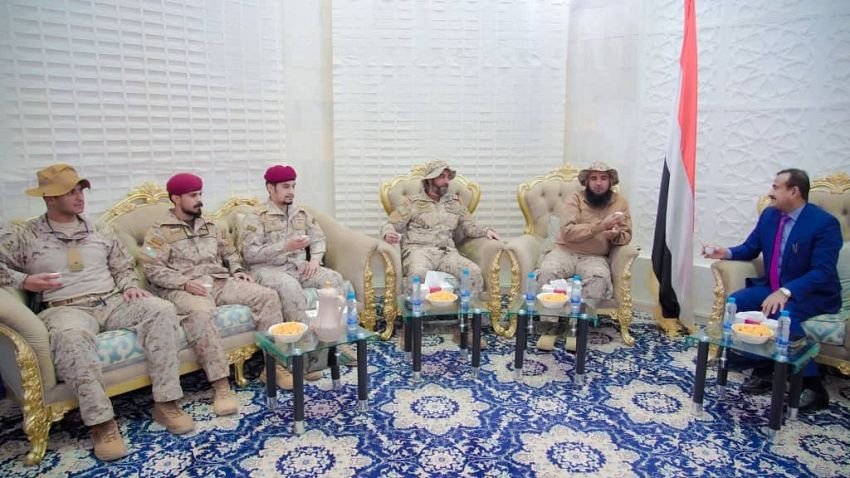
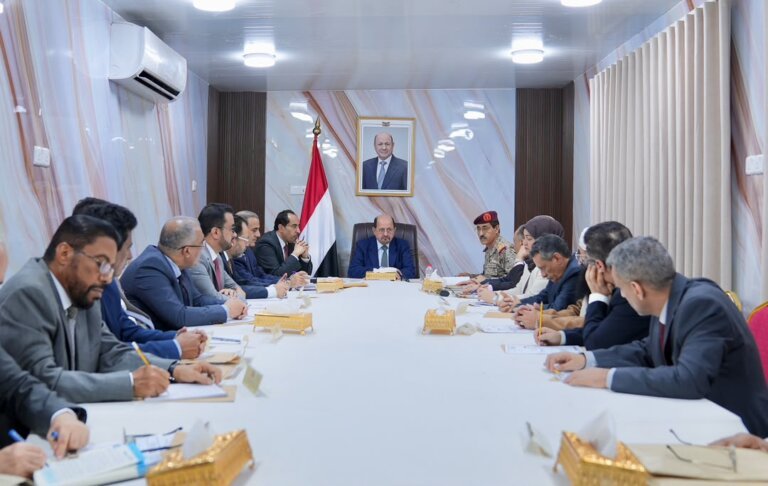
Shabwah Governor Awad bin al-Wazir has met Brigadier General Masaleh Al-Otaibi, commander of the Arab Coalition Forces in the governorate, for talks on strengthening coordination between the local authority and the coalition and on reinforcing security and stability across the province. Yemen’s official news agency Saba reported that the two officials reviewed a number of issues of mutual interest, with development and reconstruction at the top of the agenda.
According to the official account of the meeting, the two men discussed the continued implementation of service and development projects intended to improve essential public services and to meet the aspirations of Shabwah’s people for sustainable development. After a decade of war that has degraded infrastructure across Yemen, local authorities increasingly measure their performance by their ability to deliver such projects.
Governor bin al-Wazir thanked the Coalition to Restore Legitimacy, led by Saudi Arabia, for what he described as fraternal support for the local authority’s efforts. He pointed in particular to the coalition’s role in strengthening the governorate’s security and military institutions and in backing key public service sectors.
For his part, Brigadier General Al-Otaibi reaffirmed the coalition’s commitment to continuing its support for the local authority in Shabwah and to enhancing cooperation and coordination across various fields in ways that serve the governorate’s security and stability.
Shabwah occupies a place of unusual importance in Yemen’s political and economic geography. The governorate, whose capital is Ataq, stretches from mountain highlands and fertile plains to a long coastline on the Gulf of Aden and comprises seventeen districts. Beneath its deserts lie some of the country’s most significant oil and gas reserves, resources that once generated a large share of national export revenue.
The province is home to the Balhaf liquefied natural gas terminal, the largest industrial investment project in Yemen’s history. The facility began commercial production in 2009 and was designed to export around 6.7 million tonnes of liquefied gas a year, fed by gas piped from the Marib fields, before the war forced it to suspend operations. Crude oil exports from Yemen’s southern terminals also came to a halt in late 2022, after the Houthi movement carried out drone attacks against export facilities, depriving the internationally recognized government of its most important source of revenue.
That loss of income has had cascading effects. The Yemeni rial has depreciated sharply in government-held areas, public salaries are paid irregularly, and the state has struggled to fund basic services. Reviving oil and gas exports from Shabwah and neighbouring Hadramawt is widely seen as central to any economic recovery, which lends the governorate’s security a significance that extends far beyond its borders.
The meeting also unfolded against a tense regional backdrop. In recent days the Houthis have declared what they called a maritime blockade of Saudi Arabia and claimed missile and drone attacks on two Saudi oil tankers in the southern Red Sea, an escalation condemned by governments across the region. Shabwah’s coastline lies along the Gulf of Aden near the shipping lanes that approach the Bab al-Mandab Strait, and the security of Yemen’s southern coast has taken on renewed urgency as maritime threats have multiplied.
Yemen’s war has deep roots. The Houthis seized the capital, Sanaa, in late 2014, prompting a Saudi-led coalition to intervene in March 2015 in support of the internationally recognized government. Although front lines have remained largely static since a UN-brokered truce in 2022, no political settlement has followed, and the country remains divided between rival administrations, with the government controlling Shabwah and most of the south and east.
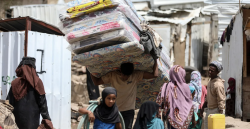
The human toll remains staggering. According to the United Nations 2026 Humanitarian Needs and Response Plan, 22.3 million people in Yemen require humanitarian assistance and protection this year, including 5.2 million internally displaced people. Some 18.3 million Yemenis face acute food insecurity, and more than 2.2 million children under the age of five are acutely malnourished. Aid agencies have appealed for 2.16 billion dollars to reach 12 million of the most vulnerable people, but funding has lagged, and humanitarian officials warn that shortfalls are already forcing cuts to life-saving programmes.
Basic services are under comparable strain. Nearly forty per cent of Yemen’s health facilities are only partially functional or not functioning at all, and more than fourteen million people need help obtaining safe water and sanitation. In Shabwah, as elsewhere, local officials argue that development projects backed by the coalition and by Gulf development programmes are among the few channels through which daily conditions can improve while the wider conflict remains unresolved.
For the local authority and the coalition alike, the test of the renewed coordination will be delivery: whether projects translate into more reliable electricity, cleaner water, functioning clinics and jobs for a young population with few opportunities. Both sides have an interest in showing that stability in Shabwah produces tangible benefits, not least because the governorate’s relative calm stands in contrast to the volatility elsewhere in the country.
Much will depend on factors beyond the province, from the trajectory of the Red Sea escalation to the funding available for reconstruction. But the meeting between Governor bin al-Wazir and Brigadier General Al-Otaibi signals that both the local administration and its coalition partners intend to keep security cooperation and development at the centre of their agenda for one of Yemen’s most strategically vital governorates.
About the Author